

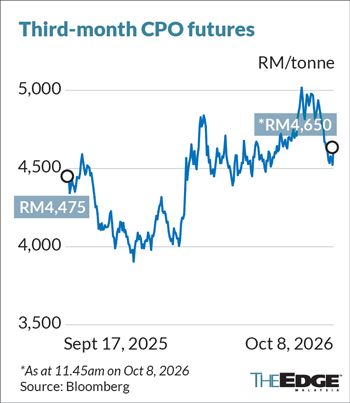
KUALA LUMPUR (Oct 8): Analysts see the recent weakness in crude palm oil (CPO) prices as a buying opportunity for plantation stocks ahead of a potential supply tightening in 2027.
RHB Investment Bank (RHB IB) expects CPO prices to remain range-bound in the near term amid the peak production season and elevated stock levels, but sees the outlook improving from the first quarter of 2027 as output begins to moderate significantly due to the El Niño weather phenomenon.
“Once stock levels start to diminish from the current highs, CPO prices could trend upwards in 1H2027 (first half of 2027). Our 2026 and 2027 assumptions of RM4,400 per tonne and RM4,500 per tonne are unchanged,” the research house said in a note to clients.
Similarly, CIMB Securities views the recent weakness in CPO and plantation share prices as an opportunity to accumulate selected stocks ahead of a potential tightening in the palm oil supply cycle next year.
Its preferred Malaysian plantation stocks are IOI Corp Bhd (KL:IOICORP), Kuala Lumpur Kepong Bhd (KL:KLK), Genting Plantations Bhd (KL:GENP) and Hap Seng Plantations Holdings Bhd (KL:HSPLANT), all of which it retained “buy” calls on.
“Key upside risk is stronger-than-expected CPO prices, while downside risks include weaker FFB (fresh fruit bunch) production should drought conditions persist into 2027 and intensify across Malaysia. We maintain our overweight sector rating,” CIMB Securities said.
Indonesia’s new law adds to supply risks
Beyond dry weather caused by El Niño and Indonesia’s push to raise its biodiesel mandate from B50 to B60, RHB IB flagged rising regulatory risks in Indonesia as another potential threat to the country’s palm oil productivity, which could further tighten global supply next year.
The country’s proposed new Agrarian Reform Law has raised uncertainty over whether planters would need to surrender more land to the government to “address land ownership inequality”, RHB IB said.
Under the draft law, either 20% of land would need to be redistributed or a mandatory profit-based payment would have to be made.
“It is unclear if this 20% can be addressed with the plasma plantations that all planters should already have in the country. While the draft law states that this new ruling is not retroactive, there is still uncertainty as to whether this will affect existing landowners.
“What is clear is that regulatory risks are much higher in Indonesia and, if this law is implemented, productivity in Indonesia will be affected negatively, thereby causing further supply tightness,” the research house said.