

(Oct 8) : In recent times, it is not politicians, but bond vigilantes, who hold the most power over the global economy. In 2022, then-newly minted UK Prime Minister Liz Truss presided over a meltdown in the UK government bond market after her government announced sweeping tax cuts without any corresponding spending adjustments.
Bond vigilantes punished Truss’ largesse severely by voting with their feet and selling off their UK government bonds. Yields spiked and the Bank of England was forced to buy back bonds to stabilise the market. Truss’ premiership was cut short unceremoniously, ending in just 45 days.
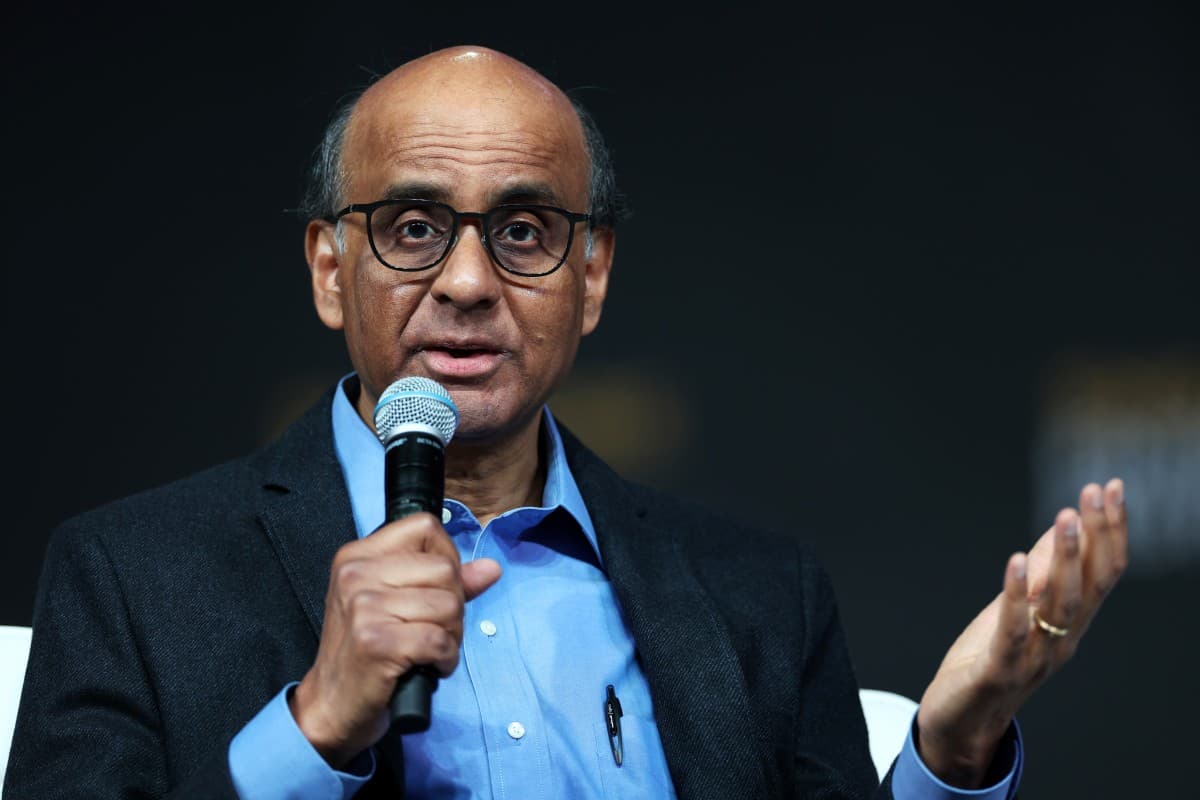
“I can’t help thinking that we have to thank the bond markets,” says President Tharman Shanmugaratnam during a fireside chat with International Monetary Fund (IMF) managing director Kristalina Georgieva and National University of Singapore economics professor Danny Quah at the Lee Kuan Yew School of Public Policy on Oct 7.
The fireside chat place took place after Georgieva had delivered her curtain raiser speech for the IMF’s upcoming annual meetings, slated to be held in Bangkok, Thailand next week.
“The bond markets are a blessing in disguise. We have learnt that, partly because of polarised and fragmented electorates, leaders in the affected countries are not going to volunteer the truth until they have no choice. They are not going to force painful choices on the electorate until they have no choice. The bond markets are literally the only discipline we have now,” Tharman says.
“They are forcing the issue, and they are telling everyone that, ‘Well, if you don’t act on this step, it’s going to go to the next step.’ In other words, not only do you not have a free lunch, but lunch gets more and more expensive.”
This appears to be what is happening right now with the US Treasury market after US national debt levels rose to US$40 trillion, or 6% of its GDP, in August. On Oct 5, 10- and 30-year Treasury yields rose to 5.34% and 5.7% respectively, the highest it has been in 24 years.
Earlier, in September, US Treasury Secretary Scott Bessent tried to lower bond yields by announcing a plan to buy up to US$6 billion worth of long-dated Treasuries. The buyback, however, did little to assuage bond investors, who responded by selling off their Treasuries, sending yields even higher.
“So, thank the bond markets. It’s not yet a meltdown. It’s not a revolt. You don’t have what we had in 2022 in the UK, not yet, but it could happen. It’s a warning, a very clear warning and governments need to now sit back and realise these aren’t market disorders,” Tharman says.
“These are actually rational signals from a multitude of players in global markets, telling us you’ve reached the limit, and now you have to make hard choices, and that can be an advantage politically.”
Fiscal dominance persists
Tharman is no stranger to the IMF’s work. Before assuming the presidency in September 2023, he spent 22 years in politics, where he served as Deputy Prime Minister, Finance Minister and Chairman of the Monetary Authority of Singapore (MAS) among other roles.
From 2011 to 2014, Tharman chaired the International Monetary and Financial Committee (IMFC). The committee advises and reports to the IMF Board of Governors on the supervision of the global monetary and financial system.
In Tharman’s view, governments around the world are increasingly more willing to impose their will on central banks, viewing them as an extension of fiscal policy through measures such as quantitative easing.
Even though countries are now gradually pulling back on quantitative easing (QE), Tharman reckons that there are two more subtle forms of fiscal dominance lurking subtly in the shadows.
“Governments are now starting from a position of large fiscal deficits and very high debts as a starting point. Their ability to deal with future crises is now much constrained. Their room for manoeuvre is much constrained. If you get another Covid-like situation, or a recession, or some turbulence in the AI cycle and capex gets withdrawn very quickly, governments cannot step in the way they did in Covid because [there is] no fiscal space,” Tharman says.
“The burden will fall on central banks and it will fall, increasingly with each crisis, on central banks to have to ease monetary policy. Maybe another round of QE. That will lead over time, on average, to lower interest rates than should be the case, more leverage in the system and ultimately less credibility.”
Besides that, governments are going to have to grapple with disorderly market conditions more often. According to Tharman, what happened to Liz Truss in 2022 may have been an extreme case but there is a possibility of similar events happening down the line.
“When you're operating at very high levels of debt, and when the investors purchasing your debt are now no longer just the traditional, stable, patient, sovereign investors, but you've got a very large proportion of your investors who are hedge funds and other leveraged players with much more complex trading strategies, from time to time there's going to be disorder. And again, who steps in to resolve the disorder? It's the central banks, because they do have that responsibility of financial stability,” Tharman says.
Policy reset necessary
As such, countries will need to build up their fiscal buffers if they want to weather the next crisis more effectively. Tharman cites the example of Portugal, a country he says he was most impressed by when he was chair of the IMFC.
“Portugal realised, when it had spreads of about 1,200 basis points, in other words, 12 percentage points higher than German sovereign bonds, that it had no choice,” Tharman says.
“But Portugal, with all the imperfections of the IMF programme at the time, got good advice, and most important [of all], it took ownership. It took national ownership of the problem. There was no more bluffing.”
Portugal was able to lower its fiscal deficit in a socially progressive manner, Tharman adds. The country’s upper and middle class bore the brunt of the adjustments while the pay and pensions of the lower classes were left untouched.
“It wasn't just about cutting expenditures and raising taxes. It is about going for efficiencies,” Tharman says. “So, efficiency, design, fairness. These are very important principles. It's not just a brutal macroeconomic adjustment. It's about [the] redesign of fiscal policy.”