

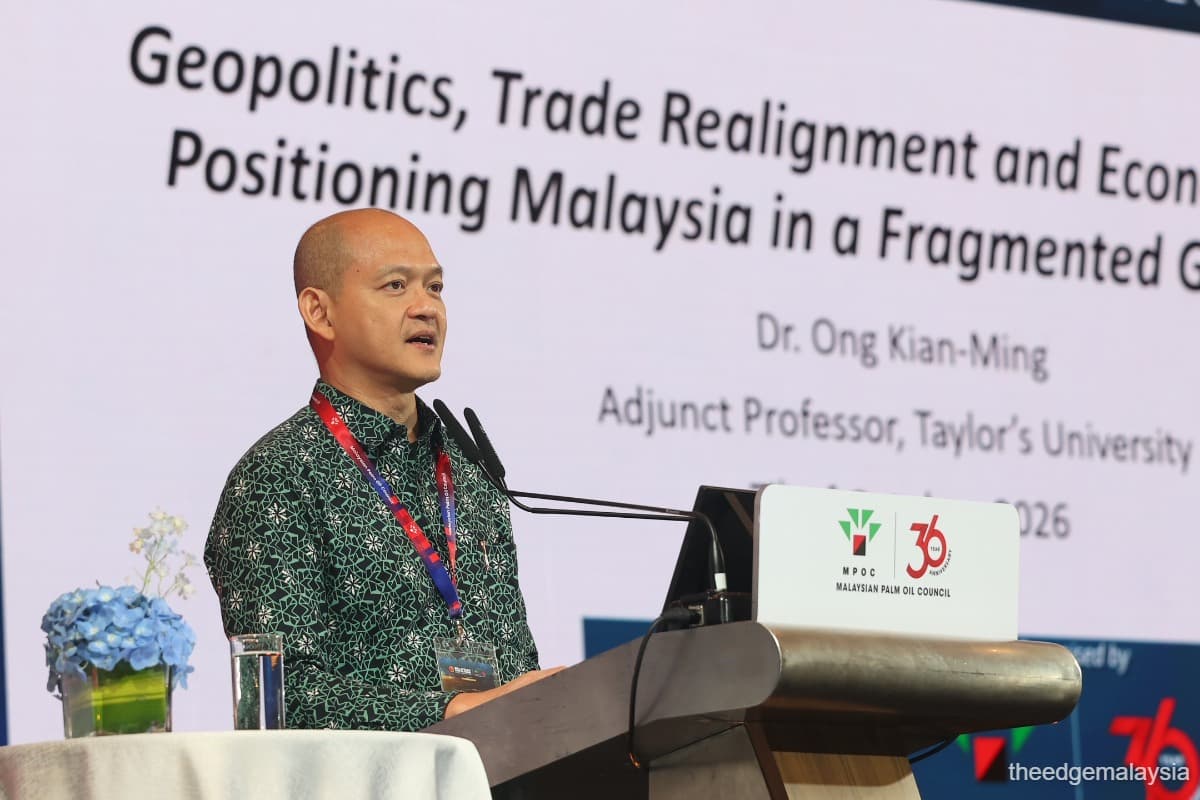
KUALA LUMPUR (Oct 7): Malaysia should consider imposing a special charge when plantation land is converted for high-value uses such as data centres, said Taylor’s University adjunct professor Dr Ong Kian Ming.
The proceeds should then be channelled into replanting, productivity improvements and smallholder land consolidation initiative, he said on Wednesday during a panel discussion at the Malaysian Palm Oil Forum 2026 organised by the Malaysian Palm Oil Council.
Growing demand for data centres and industrial parks would make plantation land increasingly attractive for conversion and sale, particularly estates with ageing oil palm trees, he said.
“Converting palm oil estates into industrial parks and subsequently selling them to data centre players can generate almost supernormal profits,” he said. “We’re talking about multiple times the revenue and profits.”
Malaysia is now witnessing a data centre boom thanks to the rollout of artificial intelligence (AI) models. The boom also coincided with the country’s drive for renewable energy, leading some palm oil planters to convert some land into solar farms.
An analysis by Maybank Investment Bank in 2024 found that large-scale solar ventures generate up to 54 times more operating profits per hectare compared to oil palm estates.
“There is a lot of money to be made from these kinds of activities,” Ong said.
However, he cautioned that any windfall charge or higher conversion rates would need to address potential loopholes, as developers could initially convert plantation land for industrial use without declaring that it would eventually be developed into a data centre.
The government should also examine the implications of large-scale solar projects on agricultural land, he said, noting that such projects can, under certain arrangements, be carried out without conventional land conversion.
“Although large-scale solar returns are not as lucrative as data centres, that may also have to be looked into,” Ong said. “For any conversion that you have, there should be some mechanism for you to take part of that to plough back into the palm oil ecosystem for productivity purposes.”
Ong was responding to a question at the forum on how Malaysia could balance growing demand for land from data centres and industrial parks with the need to preserve oil palm acreage, given the crop’s importance to food security.
The issue is particularly pertinent as Malaysia’s oil palm acreage is unlikely to expand beyond the current 5.7 million hectares and the government has also pledged to maintain at least 50% of its landmass under forest and tree cover.
Given the limited scope for expansion, converting more oil palm land could constrain production and supply, unless yields from the remaining plantations improve.