

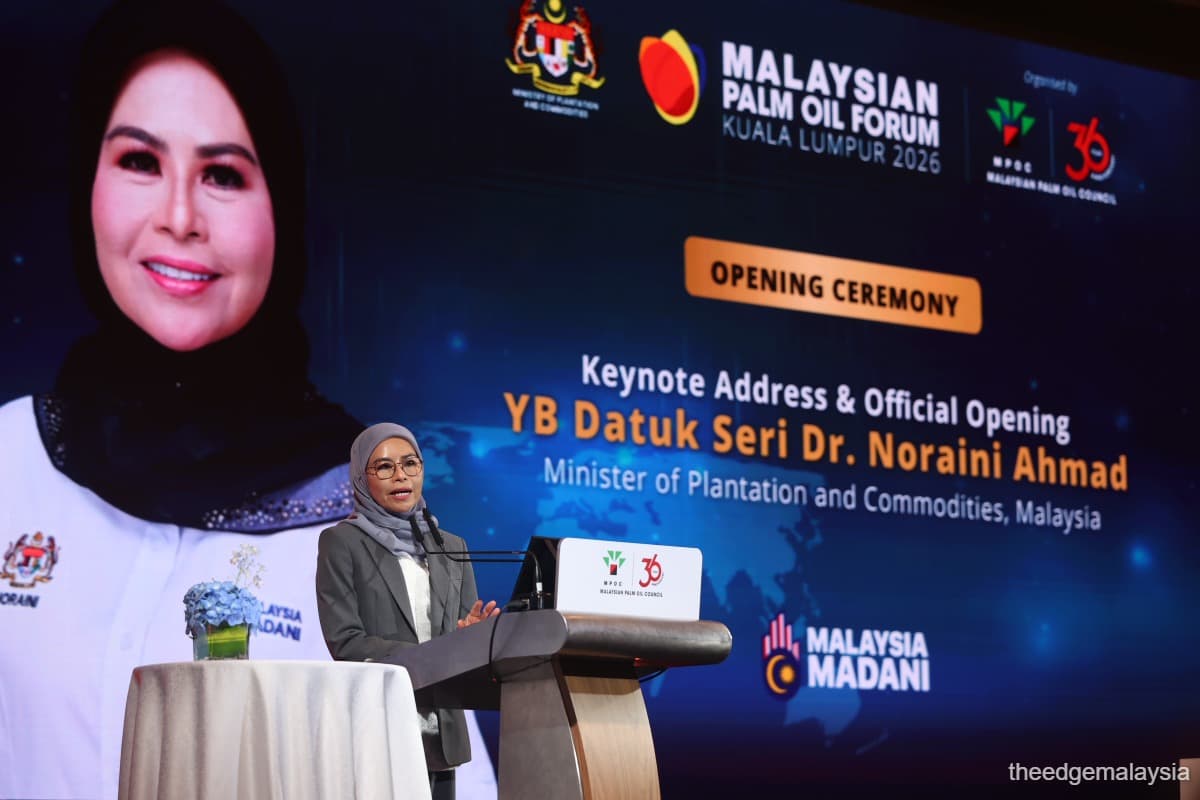
KUALA LUMPUR (Oct 7): Malaysia’s palm oil production for this year is meeting projections and could even surpass 2025’s record level despite risks from the Super El Niño, Plantation and Commodities Minister Datuk Seri Dr Noraini Ahmad said.
Last year's crude palm oil (CPO) production of 20.28 million tonnes was the highest in a decade, according to the Malaysian Palm Oil Board (MPOB).
Noraini said this year's production was in line with expectations, with another two months remaining before the year ends.
“I’m looking at it positively. We expect production to be at least on a par with, or better than, last year,” she told reporters on the sidelines of the Malaysian Palm Oil Forum Kuala Lumpur 2026 on Wednesday.
The MPOB expects CPO production of 19.5 million to 19.8 million tonnes this year. Its latest data showed CPO production at 1.82 million tonnes in August, bringing cumulative output for the first eight months to about 12.63 million tonnes.
Official September data is due to be released next week, but a Bloomberg survey of industry players estimated that palm oil production may have surged 16% month-on-month to 2.11 million tonnes, the highest output recorded for the month. September and October are traditionally peak production months for palm oil.
Noraini said the industry is also stepping up marketing and promotional efforts, alongside initiatives by the ministry, the Malaysian Palm Oil Council and MPOB.
New revenue stream from waste
Separately, Noraini said Malaysia’s palm oil industry should turn its biomass waste into a new revenue stream by developing it into renewable energy and higher-value products.
She said this would support Malaysia’s wider goals in renewable energy and better use of resources.
Palm oil mills generate large volumes of biomass, including empty fruit bunches, fibre, palm kernel shells, fronds and trunks. Palm oil mill effluent can also be used to produce biogas.
These resources can be converted into renewable energy, pellets, biochar and other higher-value products.
Many mills already use biomass to generate steam and electricity for their own operations. However, Noraini said the industry should now take the next step by commercialising these resources.
“This requires the right technology, investment and business partnerships.
“I therefore encourage industry players, researchers and investors to explore these opportunities together,” she said.