

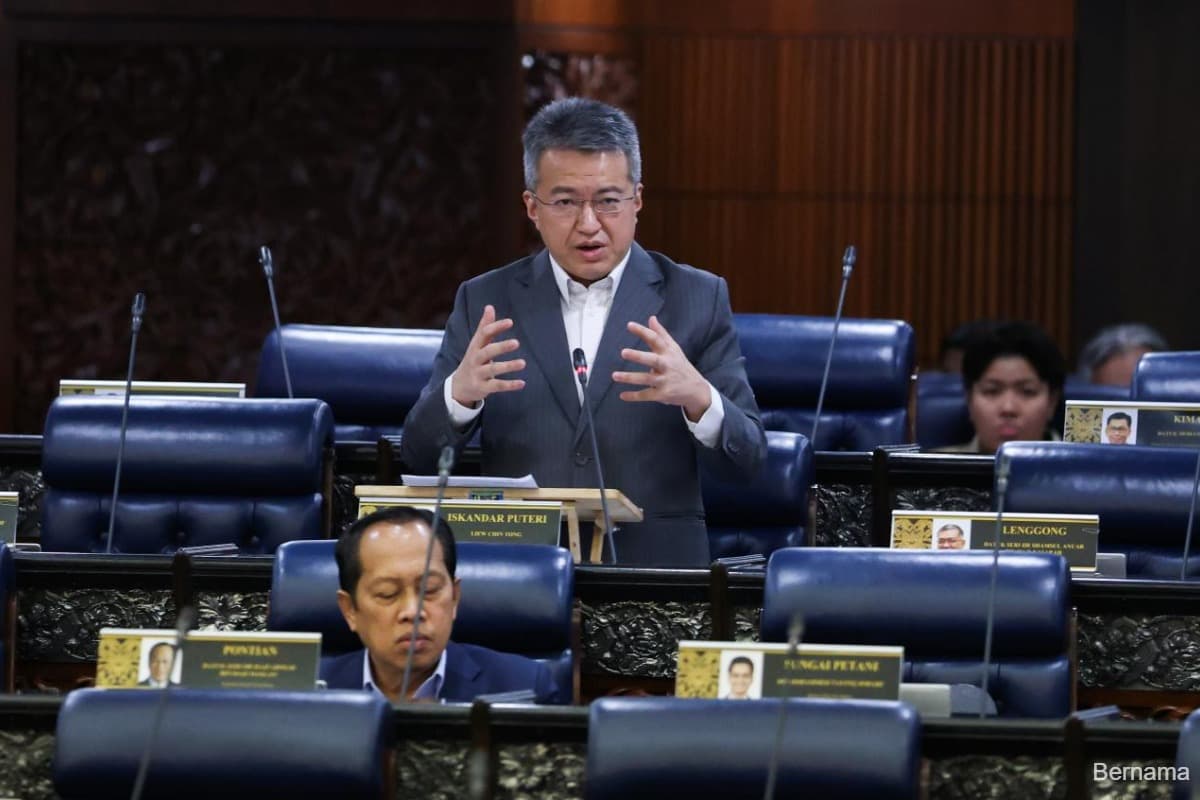
KUALA LUMPUR (Oct 7): Tax collection in Malaysia rose to RM129.6 billion in the first half of 2026 from RM119.1 billion a year earlier, supported by higher corporate income tax and sales and service tax (SST) receipts, the Dewan Rakyat heard on Wednesday.
Deputy Finance Minister Liew Chin Tong attributed the 9% increase to stronger economic activity, thanks to domestic demand, electrical and electronics exports, and growth in the services and manufacturing sectors.
Higher SST receipts came particularly from the food and beverage, insurance and logistics sectors, he said during parliamentary question time.
“The government is committed to achieving the tax revenue collection target of RM343.1 billion for the entire year of 2026,” Liew said. “Targeted tax reforms also play a role in ensuring more effective revenue collection mechanisms and providing a foundation for investor confidence, economic stability and national competitiveness.”
Liew was responding to Opposition Leader Datuk Seri Hamzah Zainudin (Larut), who asked about tax collection this year compared with previous years. In a follow-up question, Hamzah sought clarity on the government’s tax policy after apparent friction within the Cabinet’s top ranks regarding the future direction of the nation’s taxation system.
Prime Minister Datuk Seri Anwar Ibrahim had previously indicated a preference for a hybrid approach where he suggested the goods and services tax (GST) could be integrated into the existing SST framework. Conversely, Deputy Prime Minister Datuk Seri Dr Ahmad Zahid Hamidi had openly called instead for a full implementation of the GST system to boost national revenue.
“I want to know this because many of us need to understand the actual mechanism so that we can plan ahead. What I worry about is that this planning lacks clarity. For instance, with e-invoicing, they occasionally say the exemption threshold is being raised — from RM150,000 to RM300,000, then RM1 million, and today they say RM3 million,” Hamzah questioned.
Liew on Wednesday said the government would retain the SST while incorporating features of the GST intended to prevent cascading taxation, or tax accumulating through successive stages of the supply chain.
“Our system remains the SST, but we are taking elements from the GST to ensure there is no cascading effect,” he said, referring to Anwar’s remarks at a Finance Ministry engagement session on Aug 18. He did not outline the detailed mechanism or implementation timetable for the changes.
Liew said the SST was easier to understand and had a history of more than five decades in Malaysia. He also argued that it involved fewer businesses in tax collection than the GST. The GST would require about 480,000 companies to act as tax collection agents, compared with around 80,000 under the SST, he said.
He added that e-invoicing could help strengthen transaction records and reduce revenue leakage within the existing system.
Responding to a separate supplementary question from Tebrau member of Parliament Jimmy Puah Wee Tse, Liew said the revised e-invoicing exemption covered 1.01 million taxpayers with annual sales of RM3 million or less. Puah had asked how many businesses would benefit from the higher threshold and what impact the exemption would have on potential tax revenue.
Liew said around 160,000 taxpayers within the exempted group had already registered and could choose whether to continue implementing e-invoicing.
For more Parliament stories, click here.