

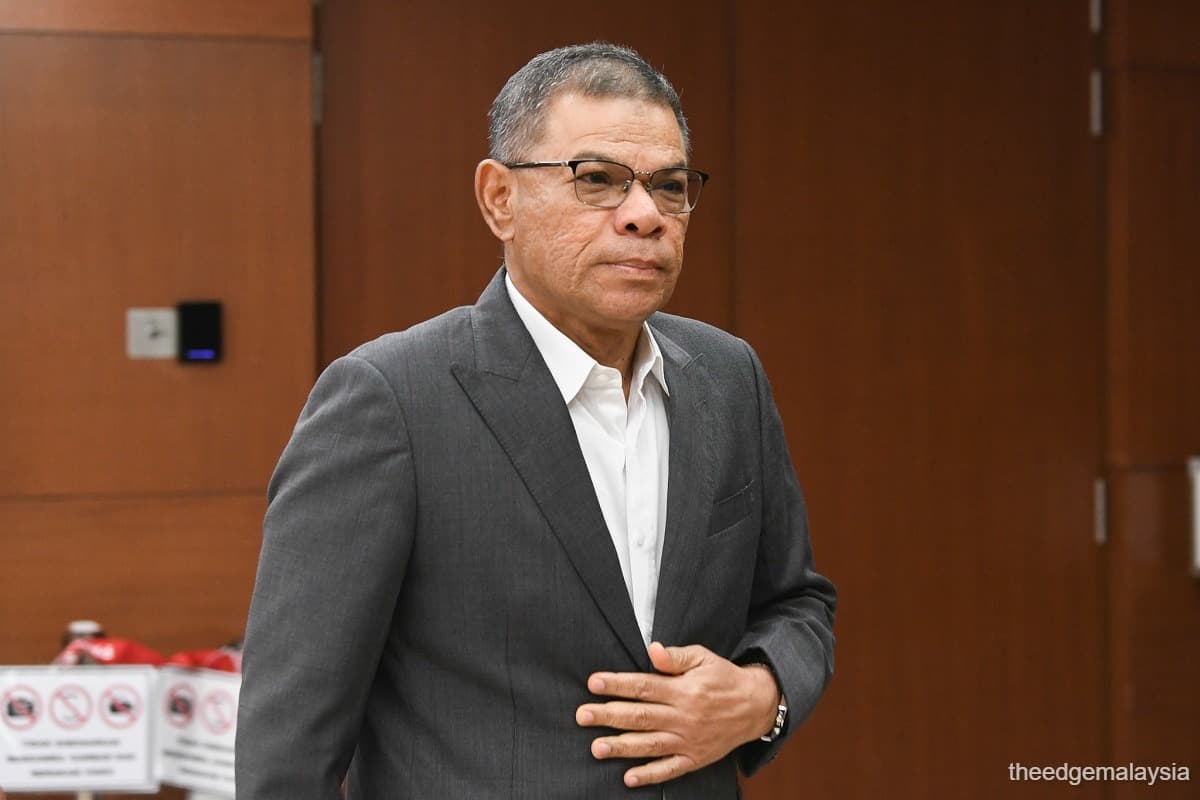
KUALA LUMPUR (Oct 7): Home confinement granted under a royal conditional pardon cannot be equated with a statutory house arrest order as it operates under its own set of rules, according to Home Minister Datuk Seri Saifuddin Nasution Ismail.
Addressing questions about monitoring protocols and visitation limits, Saifuddin explained in a written parliamentary reply on Tuesday that while general house arrest legislation remains under review, terms for conditional home confinement would be detailed through the relevant standard operating procedures.
This is because home confinement stems from the King's prerogative of clemency under the Federal Constitution, so its implementation is subject to the terms set by the pardoning authority.
“As such, conditions relating to supervision, movement, visits and other matters for a person placed under home confinement following a conditional pardon would be subject to the terms set by the relevant authority and applicable implementation procedures,” Saifuddin said.
Imprisoned former prime minister Datuk Seri Najib Razak was granted a conditional pardon last month by the Federal Territories Pardons Board, chaired by the King, Sultan Ibrahim Sultan Iskandar. This allows him to serve the remainder of his prison sentence for his SRC International Sdn Bhd conviction under home confinement until August 2028 — on condition that he first pays the RM50 million fine imposed on him. Najib has yet to settle the fine.
The 73-year-old has been imprisoned in the Kajang Prison since Aug 23, 2022, after being found guilty of misappropriating RM42 million belonging to SRC International.
He was originally sentenced by the Federal Court to 12 years in prison and fined RM210 million. But in January 2024, the FT Pardons Board — then chaired by the previous King, Al-Sultan Abdullah Ri’ayatuddin Al-Mustafa Billah Shah — halved his prison term and reduced the fine to RM50 million.
House arrest law still being finalised
The government has yet to issue any house arrest order under any specific law, Saifuddin said, as the legislation to establish the legal framework for it is still being finalised and reviewed by the Attorney General’s Chambers.
He was responding to questions from Kepong MP Lim Lip Eng, who wanted to know how many house-arrest orders had been issued.
Lim also asked whether individuals placed under house arrest were required to be monitored by closed-circuit television (CCTV), wear electronic ankle tags or other monitoring devices, and what types of visitors would be allowed.
Saifuddin said the government had agreed, in principle, to establish a legal framework that would allow remand detainees who meet certain conditions to be considered for house arrest as an alternative to detention in prison while awaiting trial.
However, details regarding the framework and requirements such as CCTV installation, the use of monitoring devices and types of permitted visitors have yet to be finalised, he added.
For more Parliament stories, click here.