

This article first appeared in City & Country, The Edge Malaysia Weekly on October 5, 2026 - October 11, 2026
About 63%, or 114, of the 181 respondents in the Real Estate and Housing Developers’ Association Malaysia’s (Rehda) latest Property Industry Survey said they had no plans to launch residential projects in the second half of 2026, while the remaining respondents planned to unveil 18,696 units. The survey involved Rehda members in Peninsular Malaysia.
The respondents who were not planning to launch projects cited unfavourable market conditions, approval delays and more unsold units.
The 37% of respondents planning to launch developments in 2H2026 accounted for 13,203 stratified units and 5,493 landed units. The pipeline of 18,696 units is about 18% higher than the 15,834 units launched by the respondents in 1H2026.
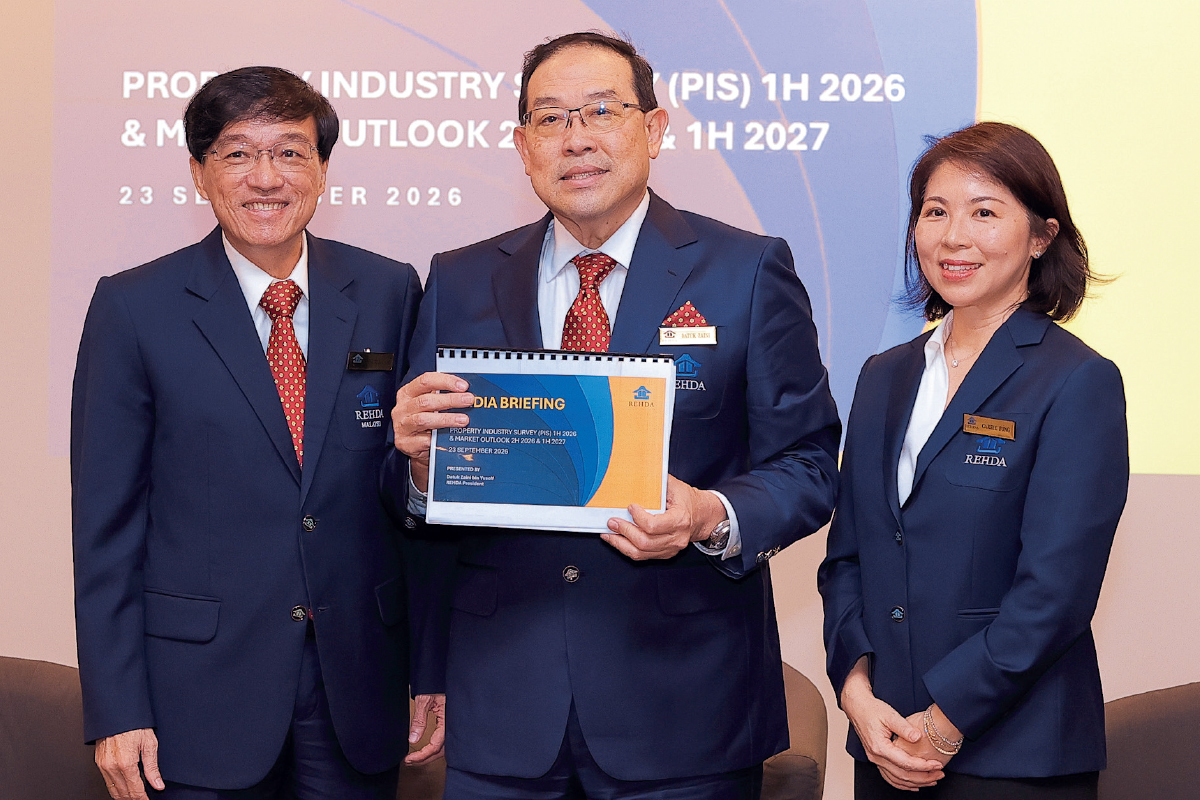
In the media briefing of the Rehda Property Industry Survey 1H2026 and Market Outlook for 2H2026 and 1H2027 held on Sept 23, Rehda president Datuk Zaini Yusoff said developers’ launch decisions were linked to market conditions and project viability. “This demonstrates that the supply pipeline is responsive to market conditions and that developers do not simply continue launching irrespective of demand and viability.”
Sales expectations remain guarded. Of the 60 respondents who answered the question on anticipated sales performance for planned 2H2026 launches, 33 expected a take-up rate below 25% within three months. At six months, 30 expected a take-up rate of 25% to 50%, while 20 expected it to remain below 25%.
“At this rate, sales performance remains cautious, with most respondents expecting a take-up rate of below 50% over the next three to six months,” he said.
Weaker outlook on 2H2026 sales
Property sales performance registered the weakest outlook among respondents. A total of 47% of respondents were pessimistic and very pessimistic about sales prospects in 2H2026, compared with 15% who were optimistic and very optimistic and 38% who were neutral.
Consumer purchasing power was another concern, with 43% pessimistic or very pessimistic, 37% neutral and 19% optimistic or very optimistic.
On property market trends, 45% of respondents were pessimistic or very pessimistic, compared with 18% who were optimistic or very optimistic, while 37% were neutral.
Assessments of the broader domestic economic environment showed 48% of respondents were pessimistic or very pessimistic, 40% neutral and 12% optimistic or very optimistic.
Business prospects reflected a similar distribution, with 50% pessimistic or very pessimistic, 37% neutral and 13% optimistic or very optimistic.
On residential sector growth specifically, 35% were pessimistic or very pessimistic, 40% were neutral and 25% were optimistic.
Zaini noted that global geopolitical conditions continue to affect purchaser sentiment, while demand for housing remains present.
“[Buyers] will remain cautious depending on the war, whether it stops or not. But as a developer, we will take the necessary step because even with the war, people still need homes. We have to provide a range of homes, from affordable to mid-range and also higher end, because each segment has its own respective buyers,” he said.
More neutral outlook for 1H2027
The outlook improves for 1H2027, although respondents were mainly neutral rather than broadly optimistic.
For the domestic economic environment, 54% of respondents were neutral. Another 18% were optimistic or very optimistic, while 28% were pessimistic or very pessimistic.
On property market trends, 45% were neutral, 24% were optimistic or very optimistic and 31% were pessimistic or very pessimistic. For business prospects, 54% were neutral, while both the optimistic and pessimistic groups stood at 23% each.
Views on residential sector growth were more balanced, with 47% neutral, 28% optimistic or very optimistic and 25% pessimistic or very pessimistic.
On consumer purchasing power, 49% were neutral, 19% were optimistic or very optimistic and 32% were pessimistic or very pessimistic. Property sales performance was more balanced, with 44% neutral, 24% optimistic or very optimistic and 32% pessimistic or very pessimistic.
Zaini said the market could improve if the external uncertainty eased. “We are quite optimistic that the market will turn around if [the geopolitical tensions] are tackled by this year,” he added.
1H2026 launch volumes
The survey reported that launch volumes in 1H2026 were broadly unchanged compared with the previous corresponding period.
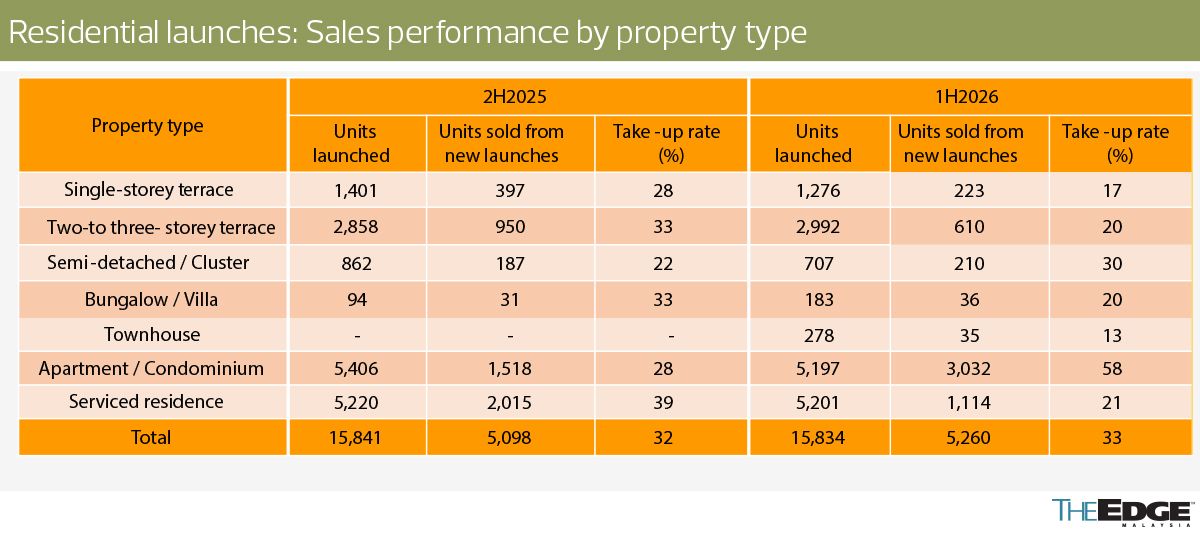
Survey respondents launched 15,834 residential units in 1H2026, compared with 15,841 units in 2H2025. Sales from new launches rose 3.2% to 5,260 units from 5,098, while the overall take-up rate improved to 33.2% from 32.2%.
Apartments and condominiums recorded a 58% take-up rate in 1H2026 (3,032 units sold out of 5,197 launched), up from 28% in 2H2025. Semi-detached and cluster homes recorded a 30% take-up rate, up from 22%.
The take-up rate of serviced residences fell to 21% from 39%, two- to three-storey terraced homes dropped to 20% from 33%, while single-storey terraced homes fell to 17% from 28%. Townhouses recorded a 13% take-up rate.
More than half of the units launched in 1H2026, or 53%, were priced from RM300,001 to RM500,000. Another 20% were priced from RM500,001 to RM700,000. Strata homes accounted for 66% of the launches, while landed homes made up 34%.
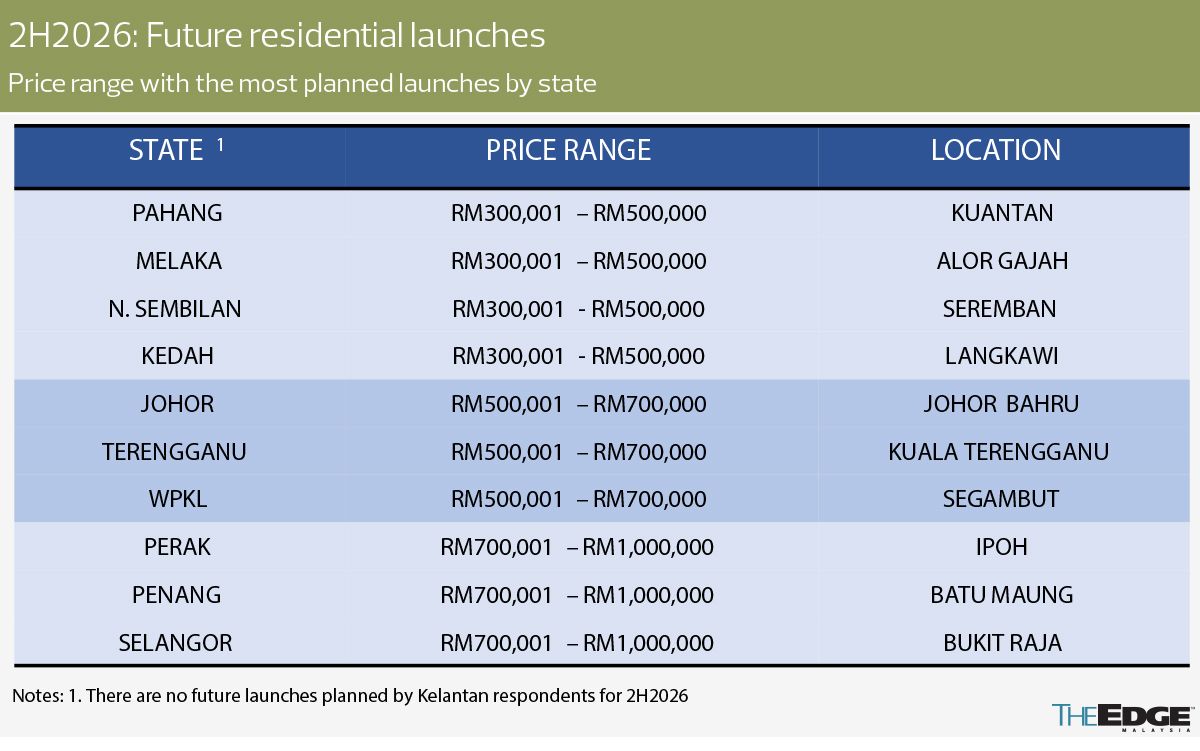
Zaini said future launch price ranges varied by state and location. “The RM300,000 to RM500,000 range remains common in several locations, while higher rates are anticipated in selected states and urban markets. This once again supports the case for locally responsive housing policies rather than a single national formula for all markets.”
Owner-occupiers drive demand
The survey data indicated that buyer activity in 1H2026 consisted primarily of owner-occupiers.
Malaysians accounted for 98% of buyers, while foreign purchasers made up 2%. Some 80% of residential purchases in 1H2026 were by owner-occupiers, while upgraders accounted for 8%, investments (6%), retirement homes (4%) and holiday homes (2%). By age group, 70% of the purchasers were between 29 and 44 years old.
Zaini said buyers’ profiles needed to be considered when assessing actual market demand.
“Understanding who is buying and why they are buying is important in assessing actual demand rather than looking only at the headline launch numbers. The survey indicates that the market continues to be primarily supported by local owner-occupier demand,” he added.
Rehda immediate past president Datuk Ho Hon Sang said buyers were becoming more selective before committing to a purchase. “The potential buyers will evaluate various factors before they buy, and most of them, according to our reports, show that actual dwellers are buying. Speculators have reduced a lot,” he noted.
Zaini said many buyers still preferred landed homes, but land costs in established locations had pushed prices beyond what many households can afford. “The price of landed property has gone up way above the affordable level,” he pointed out.
Financing, unsold homes remain key constraints
Financing remained a key barrier to completed sales. The survey found that 77% of respondents faced financing issues in 1H2026. Among those affected, 84% reported end-financing issues, 3% reported bridging-finance issues and 13% reported both.
The main end-financing problems cited were buyer-income ineligibility, adverse credit history and lower financing margins. For bridging finance, respondents mentioned bank caps on loan amounts, requests for additional documentation and higher sales required before drawdown.
Homes priced from RM500,001 to RM700,000 recorded the highest reported loan-rejection bracket, at 31% to 45%. Respondents could select more than one answer for this question.
Rehda secretary-general Carrie Fong said the issue was not necessarily a lack of interest in homeownership, but prospective purchasers’ ability to complete a transaction. “We see a shift in household expenditure increasing over the years on car ownership and well-being. Perhaps house ownership is taking a backseat and other immediate items are more of a priority. I think there’s still a very strong demand for homes. Our problem is the conversion … because the end-financing is being rejected.”
She added that prospective buyers needed to plan their finances and savings for homeownership over a longer period.
“We want to continue bringing awareness and education programmes to the public and future homebuyers — first homebuyers [on] how they should prioritise their income [and] save for future homeownership, something that perhaps they don’t see immediately, but will have to work towards.”
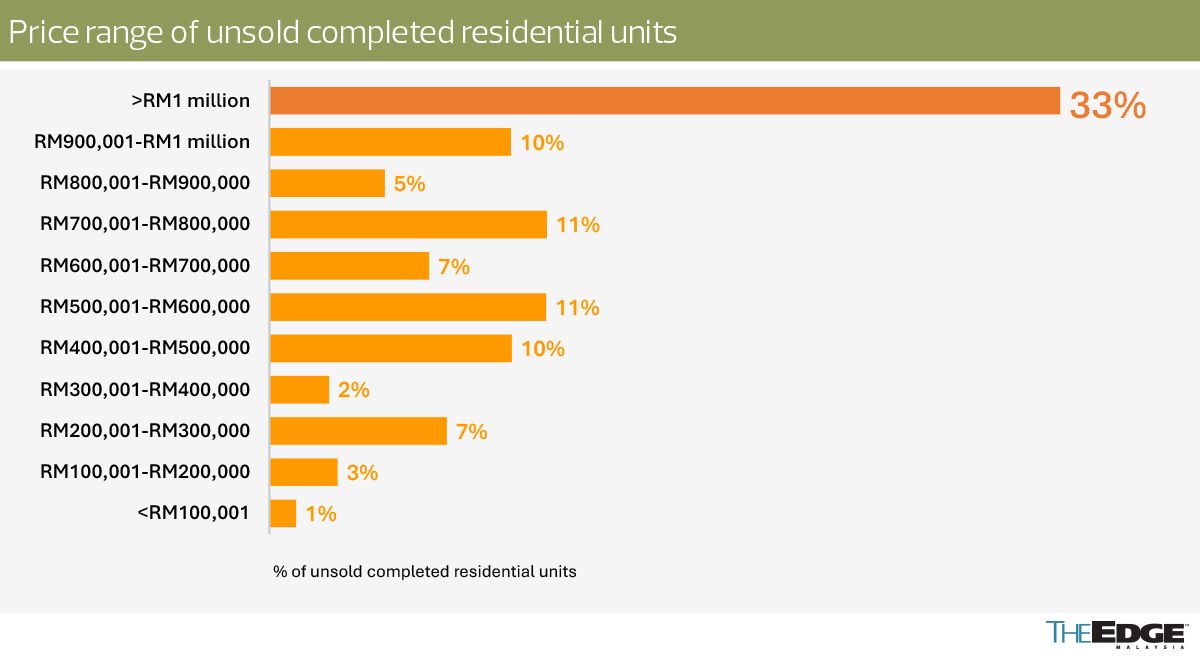
Meanwhile, 59% of respondents reported having unsold completed residential units as at June 30, 2026. The leading reasons cited were end-financing loan rejection (30% of responses), followed by high pricing (21%) and unreleased bumiputera units (16%).
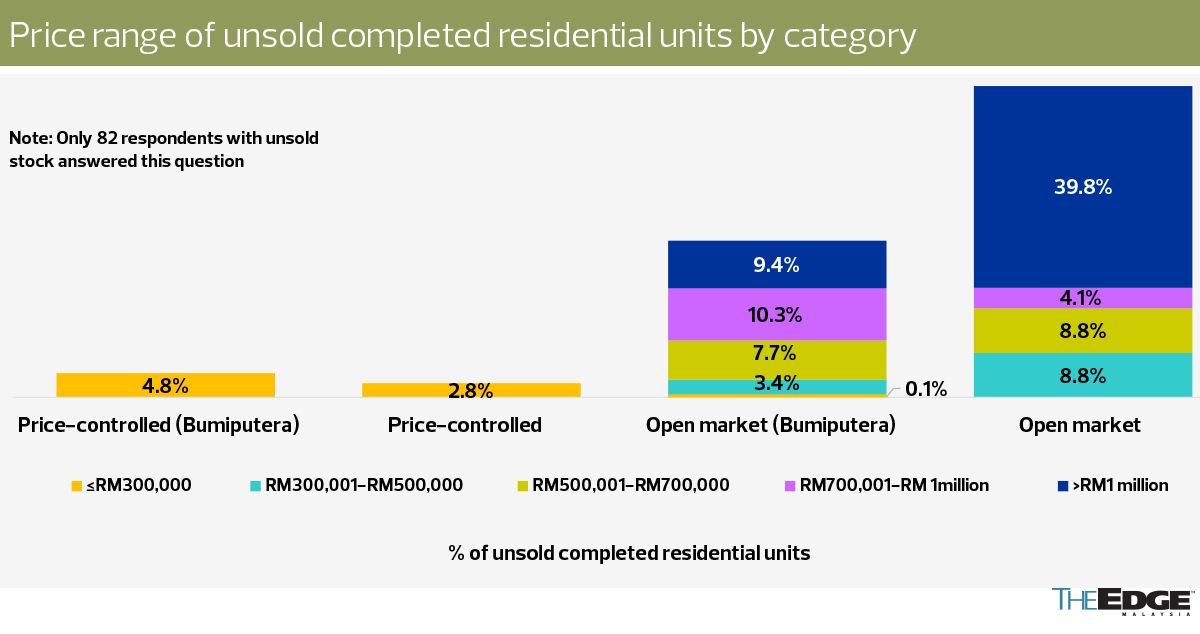
Thirty-two per cent of reported unsold completed residential units had remained unsold for more than 36 months. Homes priced above RM1 million made up the largest share of unsold completed units by price range, at 33%.
Among the 82 respondents with unsold stock who answered the category question, open-market homes priced above RM1 million accounted for 39.8% of unsold completed units. By property type, two- to three-storey terraced homes accounted for 29.3% of reported unsold units, followed by semi-detached and cluster homes at 28.6%.
High construction costs still felt
The survey found that 81% of the 181 respondents experienced the higher cost of doing business in 1H2026, compared with 74% in 2H2025. Among those reporting higher costs, 35% said their costs had increased by 3% to 6%.
Separately, 90% of 168 respondents reported an average increase of 13% in construction costs between March and June 2026.
Zaini noted that the first round of material cost increases had been incorporated into tenders and project budgets.
“Prices have already stabilised. As the war continues, I don’t expect much jump [in] construction material costs because currently [property developers] have already absorbed the first tranche of high prices,” he said.
“For earthwork and infrastructure works, we have experienced a 20% to 24% [increase in construction costs]. But for normal building work, some of it is even as low as 3% to 5%.”
Sixty-three per cent of the respondents said they faced construction challenges in 1H2026. The main material-related challenges were high material prices, supply shortages and inconsistent supply. Main labour-related challenges were high wages, labour shortages and a lack of skilled workers.
Looking ahead, 56% planned to expand their land bank.
Mixed response to green incentives, IBS and Qlassic
The survey found that 79% of respondents viewed sustainability as important in property development, while 67% agreed that green building certification effectively improved environmental performance in the property and construction sector.
Zaini said cost remained a barrier to wider adoption of green measures, and developers needed government incentives to continue adopting them.
However, 54% reported having no green-certified projects over the past 10 years, from mid-2016 to mid-2026. Another 29% reported having between one and five green-certified projects during the period.
The adoption of the industrialised building system (IBS) was also limited. Seventy-one per cent of respondents said they had not adopted IBS in the past 10 years, while 29% said they had. Higher construction costs, insufficient government incentives and a lack of skilled labour were the main barriers cited.
The findings on the Quality Assessment System in Construction (Qlassic) were mixed. Forty-five per cent of the 169 respondents who answered the relevant question said they had projects certified under Qlassic over the past 10 years, while 55% said they did not.
Respondents with Qlassic-certified projects averaged 80 certified projects annually over the 10-year period.
Fifty-one per cent of respondents agreed that Qlassic should be implemented for all residential developments. The main concerns cited were its suitability for certain projects, including small-scale and price-controlled housing, higher development costs and additional compliance requirements.
Save by subscribing to us for your print and/or digital copy.
P/S: The Edge is also available on Apple's App Store and Android's Google Play.