

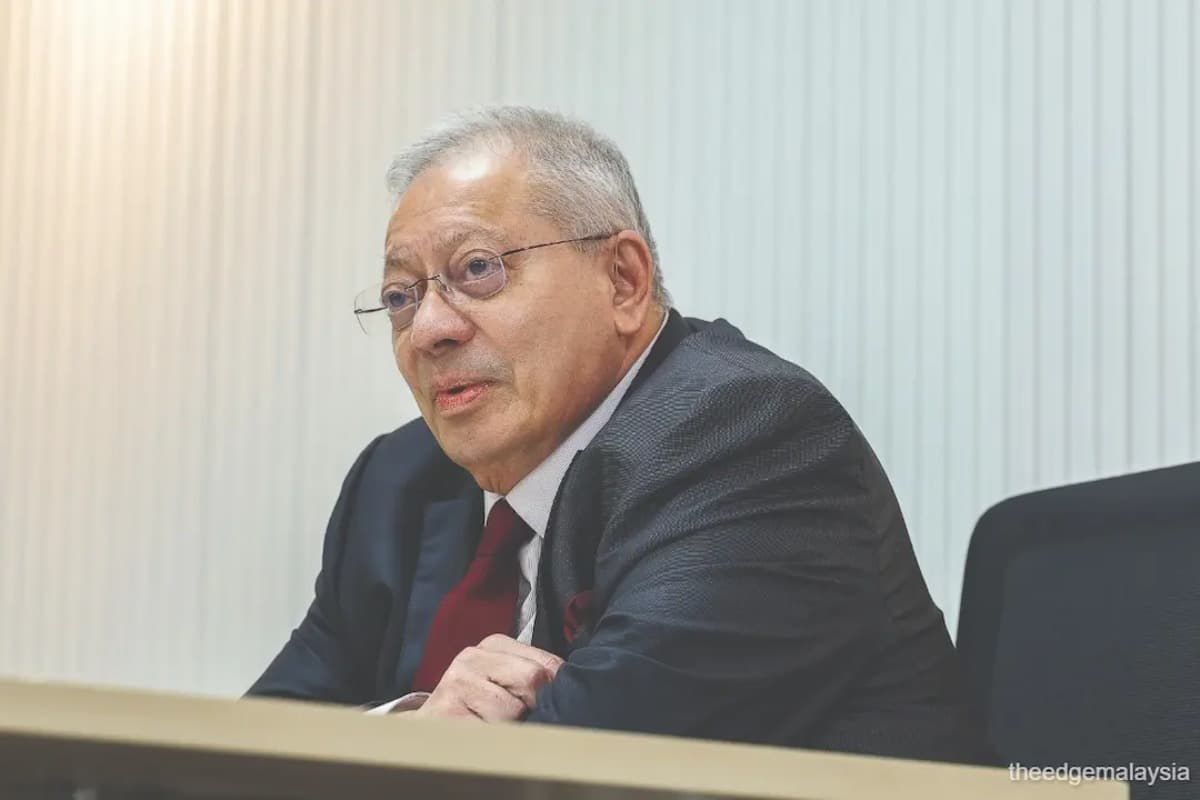
KUALA LUMPUR (Oct 6): There must be a culture of accountability among Malaysia's business leaders as the growing number of laws and regulations has not prevented failures in corporate governance, said Lembaga Tabung Haji chairman Tan Sri Abdul Rashid Hussain.
Speaking at the inaugural Financial Lines Forum on Tuesday, Abdul Rashid said corporate governance must move beyond compliance towards a culture where directors take responsibility for their decisions.
“By any measure, we have never had more laws, more codes, more disclosure and more scrutiny than we have today. And yet, every few years, we find ourselves in another inquiry, another investigation, another courtroom,” he said.
This raises two questions, he said: “How did the board not see it? Or worse: how did the board see it, and say nothing?”
Abdul Rashid said governance failures can happen when boards did not properly review papers before approving them, accept assumptions without question, or fail to bring informally raised concerns into the boardroom.
“The minutes will record that a decision was made. They rarely record whether the right questions were asked. Trust never appears on the balance sheet, yet every other asset depends on it,” he said.
His remarks come months after the release of the Royal Commission of Inquiry (RCI) report on Tabung Haji's governance lapses between 2014 and 2020.
Abdul Rashid, who was one of six members of the RCI before being appointed chairman of the pilgrim fund in December 2023, said governance failures happen when a situation is not covered by regulations or when those responsible fail to apply rules properly.
“They happen in the spaces the rules do not reach. Cracks that quietly become loopholes. Worse, I fear there is still a cynical cultural gap in understanding what is right and what is wrong,” he said.
“Structures, rules, policies and disclosures are indispensable, but they are only enablers. What gives them meaning are the principles behind them: accountability, transparency, integrity and fairness."
'D&O policy can protect your balance sheet, but not your name'
Under Section 17A of the MACC Act, when a commercial organisation commits corruption, its directors and officers are also held responsible unless they can prove it happened without their consent or connivance and that they exercised due diligence to prevent it.
“The burden has shifted. ‘I did not know’ is no longer a defence,” he said.
“Let me say this plainly — a D&O (directors and officers) policy can protect your balance sheet, but it cannot protect your name. No insurance product has yet been designed that can buy back a reputation,” he said.
Boards need better people, oversight and AI safeguards
Abdul Rashid said governance needs to evolve in three key areas: the quality of directors, board oversight and the management of emerging risks like AI.
“If we expect a higher standard of governance, we must raise the standard of who enters the boardroom, and who stays there,” he said, adding that directors must be capable and trustworthy.
Fit-and-proper assessments should not be a one-off exercise, while nomination committees should look beyond qualifications to candidates’ character, references and track record, he said.
Abdul Rashid said boards need deeper oversight, with committees given sufficient authority, expertise and information to scrutinise risks.
Boards must also treat AI as a governance issue, rather than merely an IT project, he said.
“AI is already shaping who receives financing, which transactions are flagged and what our stakeholders are told,” he said.
“Directors need not become data scientists, but they must be able to answer four basic questions: Where are we using AI? Who is accountable for it? How would we know if it went wrong? And could we explain its decisions to a regulator, a customer or a court?,” he said.
The inaugural Financial Lines Forum was organised by law firm Chan Ban Eng & Co, in collaboration with Universiti Malaya.
Among the speakers are former Federal Court judge Tan Sri Zainun Ali and Attorney General Tan Sri Mohd Dusuki Mokhtar.