

This article first appeared in The Edge Malaysia Weekly on October 5, 2026 - October 11, 2026
IN Malaysian restaurants, a telling sign of growing pressure on household budgets can be seen in what customers are increasingly omitting from their orders.
In its latest Malaysia Retail Industry Report, Retail Group Malaysia (RGM) says many diners are choosing cheaper dishes and drinks, skipping beverages altogether or downsizing their usual orders. Others are dining out less, cutting back on food deliveries, making coffee at home or in the office, or having breakfast at home.
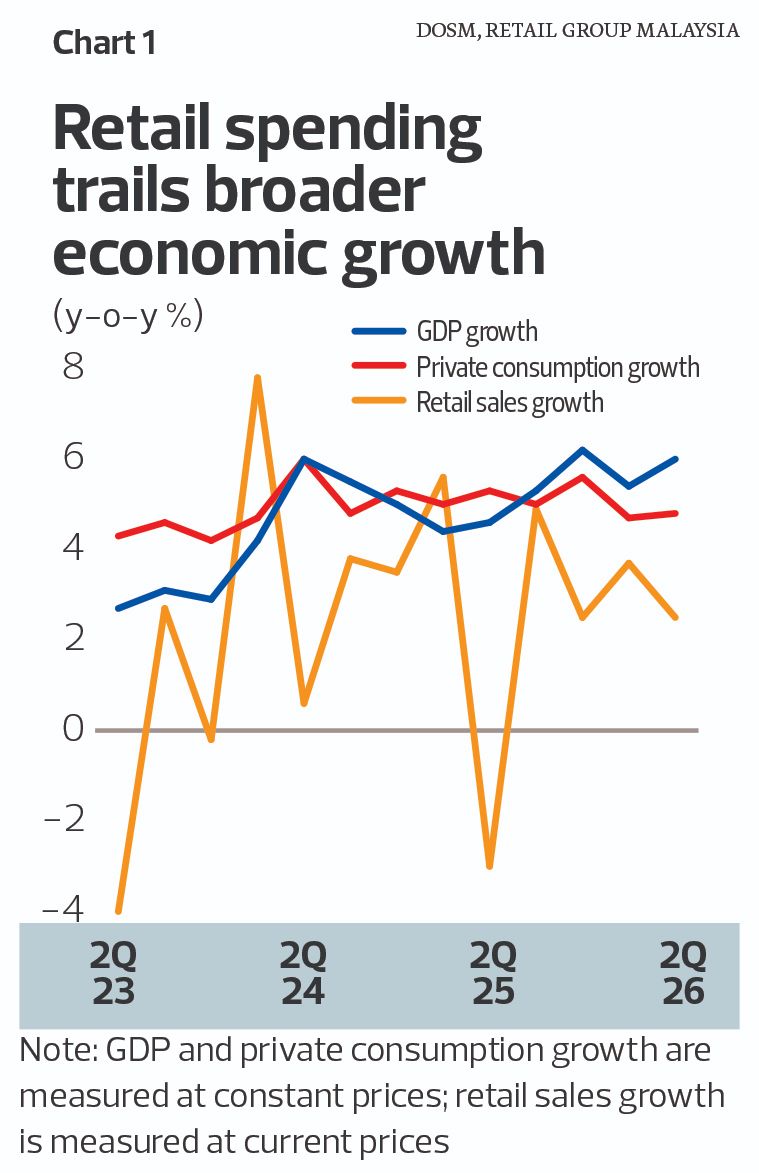
It is a curious backdrop to an economy that expanded by a faster-than-expected 6% in the second quarter of 2026 (2Q2026), marking Malaysia’s strongest growth since 4Q2024.
Private consumption expanded 4.8% year on year (y-o-y), but retail sales grew by just 2.5%, according to RGM. This was barely half the 4.8% that retailers had expected for the quarter three months earlier. (See Chart 1)
So, if the economy is growing at 6%, why doesn’t it feel that way in the shops?
The discrepancy is less contradictory than it appears, as several years of rising living costs after the Covid-19 pandemic have made consumers more selective about where each ringgit goes. At the same time, Malaysia’s stronger economic growth has largely come from beyond the shopping mall.
“The better framing is not ‘we are spending less’ but ‘we are becoming more selective on what we are actually spending on, and where’,” AmBank Group chief economist Firdaos Rosli tells The Edge.
Inflation low, but prices remain high
It may seem surprising that consumers are cautious when traditional measures of household economic health look fairly benign.
Unemployment stood at 3% in 2Q2026, a level generally considered full employment, while headline inflation averaged just 1.9%.
But low inflation does not mean prices have returned to where they were several years ago, nor does the headline number necessarily reflect the expenses that weigh most heavily on individual households.
“The higher cost of living was the main reason,” says RGM managing director Tan Hai Hsin when asked why consumers remain cautious.
“Average inflation might be low, but consumers are still paying more,” he says, particularly those living in major cities such as Kuala Lumpur, Penang, Melaka and Johor Bahru.
Tan points to higher costs for groceries, dining out, rent, electricity, healthcare and transport, among others.
RGM found that consumers are making fewer shopping trips, comparing prices before buying, looking for discounts and vouchers, switching from branded products to cheaper alternatives, and turning to online platforms in search of lower prices.
Firdaos says headline employment and inflation numbers cannot fully capture household financial conditions, particularly after the cumulative increase in prices since the pandemic. “The mismatch between headline numbers and the reality on the ground is simply because gains from the rapidly growing economy are uneven, while the cumulative increase in living costs remains unabated.”
He points to uneven wage growth, noting that wages for lower-paid workers have been rising faster since the pandemic while those in the middle have seen slower gains.
“Since middle-income earners (M40) constitute the largest spending bloc, the accumulated rise in living costs and the middle-income wage squeeze may partly explain why consumers are more cautious and sensitive to rising prices,” he says.
Malaysia Retailers Association (MRA) president Datuk Andrew Lim Tatt Keong says a less obvious sign of weakness — not reflected in headline sales figures — is the number of transactions.
“Although you may see a good total sales figure, the transaction count has actually dropped. That is what our MRA members are seeing on the ground,” says Lim, who is also group executive chairman of USP Resources Sdn Bhd.
“Just ask anyone managing a household how much RM50 can buy today. A few years ago, RM50 might have bought enough groceries for three or four days. Today, it may only be enough for two days. We are spending the same amount, but getting less for it.”
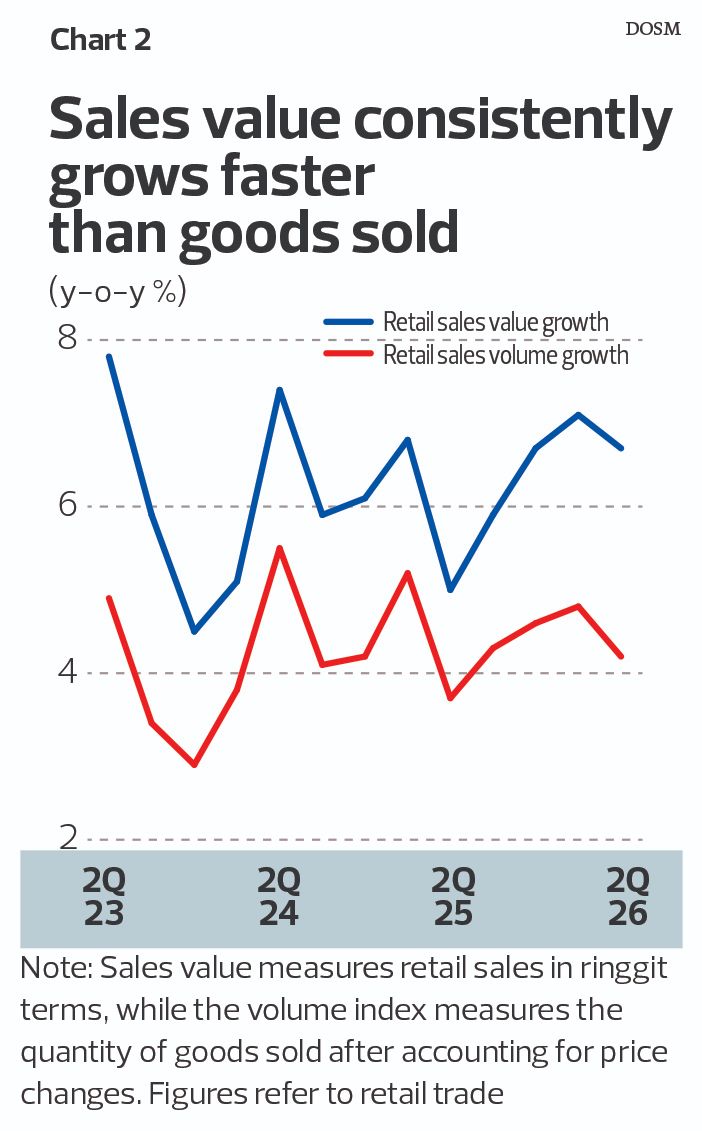
This is also reflected in the data from the Department of Statistics Malaysia, which show sales value consistently growing faster than the quantity of goods sold in recent quarters. (See Chart 2)
More selective with every ringgit
The more careful spending is playing out differently across the retail sector, as Eco-Shop Marketing Bhd (KL:ECOSHOP), whose business is built around low-priced household products and everyday necessities, is seeing greater emphasis on affordability among its customers.
CEO Jessica Ng says this behaviour is evident across income groups, not just among lower-income households.
“This does not necessarily mean consumers are simply spending less. Rather, they are becoming more conscious of what they receive for every ringgit spent,” she tells The Edge.
Customers are increasingly comparing alternatives and less willing to pay a premium simply for a brand name when another product can perform the same function at a lower price, according to Ng.
“Consumers respond more to what they feel in their own household finances than to headline GDP growth. Disposable income, employment security and the cost of living have a much more immediate influence on spending decisions.”
Likewise, AEON Co (M) Bhd (KL:AEON) said in its latest quarterly filing that consumer spending remained cautious and shoppers continued to prioritise essentials over discretionary purchases.
Demand for daily necessities remained resilient, AEON said, but its retail revenue fell 1.2% y-o-y to RM795.4 million in 2QFY2026 from RM805.4 million a year earlier.
A similar pattern can be seen in the food and beverage subsector, where sales at cafés and restaurants contracted 2.4% in 2Q2026 while that at takeaway outlets, kiosks and stalls grew 9.1%, according to RGM.
The contrasting performances suggest that consumers are not necessarily giving up dining out altogether, but some are switching to cheaper options.
Not all retailers feeling the squeeze equally
Consumers’ changing priorities are producing starkly different outcomes across the retail industry, as spending holds up in some segments while weakening sharply in others.
According to RGM, supermarket and hypermarket sales contracted 9% in 2Q2026, while that at department stores declined 7.2%. Sales of furniture, furnishings, home improvement products and electrical and electronics goods fell 5.8%, while that of other speciality retailers recorded a 3.4% contraction.
At the other end of the spectrum, pharmacy sales grew 3.7% and personal care sales increased 4.1%.
Sales of fashion and fashion accessories stood out with a 12.9% growth, although Tan says the strong showing partly reflected the timing of Hari Raya Aidilfitri and a low base after fashion sales contracted 8% in 2Q2025.
The rebound therefore does not necessarily point to a broader recovery in discretionary spending, particularly given the weakness seen across several other non-essential retail segments.
Meanwhile, 99 Speed Mart Retail Holdings Bhd (KL:99SMART), whose stores are heavily geared towards groceries and everyday necessities, saw its revenue rise 13.6% y-o-y to RM3.08 billion for the quarter ended June 30, 2026 (2QFY2026), while net profit increased 13.4% to RM163.95 million. Total sales transactions rose 13.6% to 146.4 million, while average basket size remained at RM21.
Eco-Shop similarly had a strong quarter, with revenue increasing 12.2% to RM772.89 million and net profit surging 44.9% to a record RM72.63 million in the three months ended May 31 (4QFY2026).
Mr DIY Group (M) Bhd (KL:MRDIY) presented a more mixed picture, as it recorded 3.6% revenue growth to RM1.26 billion in 2QFY2026, although net profit fell 15.2% to RM134.41 million amid higher operating costs.
CIMB Securities noted in a September consumer sector report that daily essentials accounted for a larger share of sales at 99 Speed Mart, Eco-Shop and Mr DIY, while AEON recorded a higher share of foodline sales but a lower share from health and beauty.
“Within discretionary consumption, we expect any recovery to remain concentrated in semi-essential, low-price-point categories as consumers continue to trade down, while broader discretionary spending is likely to remain subdued until consumer sentiment and purchasing power improve,” it said.
This suggests that consumers are still spending, but prioritising essentials, convenience and lower-priced goods over discretionary purchases.
Beneath the headline growth
The gap between strong GDP growth and cautious consumer spending becomes clearer when looking at what drove the economy in 2Q2026.
While net exports provided a significant lift to GDP as electrical and electronics (E&E) exports surged almost 58%, domestic demand growth actually slowed to 5% in 2Q2026 from 5.2% in the preceding quarter, Firdaos points out.
“Headline growth presents a more optimistic account of the nation’s growth than aggregate domestic demand does,” Firdaos says.
Private consumption is also much broader than shopping, RGM’s Tan says, encompassing spending on restaurants, vehicles, utilities, telecommunications, healthcare, education, transport and rent, among others.
As such, the weaker retail performance does not necessarily mean Malaysians are spending less, but it does show that the strength of the economy is not being felt evenly across households or retailers that depend on their wallets.
Malaysia can continue to post healthy growth in the near term even if household spending remains cautious, Firdaos says, although relying on exports leaves the economy exposed to the global technology cycle.
“Stronger private consumption is not needed tomorrow, but it is eventually needed as a critical ingredient for sustaining growth in the medium to long term.”
Over the longer term, Firdaos says stronger household spending cannot depend on subsidies and cash assistance alone. “Cash transfers matter for the safety net, but they cannot substitute for wage growth,” he says. “Broad-based domestic demand requires more higher-paying, productive jobs. The challenge is not just creating jobs, but creating jobs that offer wage ladders for the M40.”
Save by subscribing to us for your print and/or digital copy.
P/S: The Edge is also available on Apple's App Store and Android's Google Play.