


This article first appeared in The Edge Malaysia Weekly on October 5, 2026 - October 11, 2026
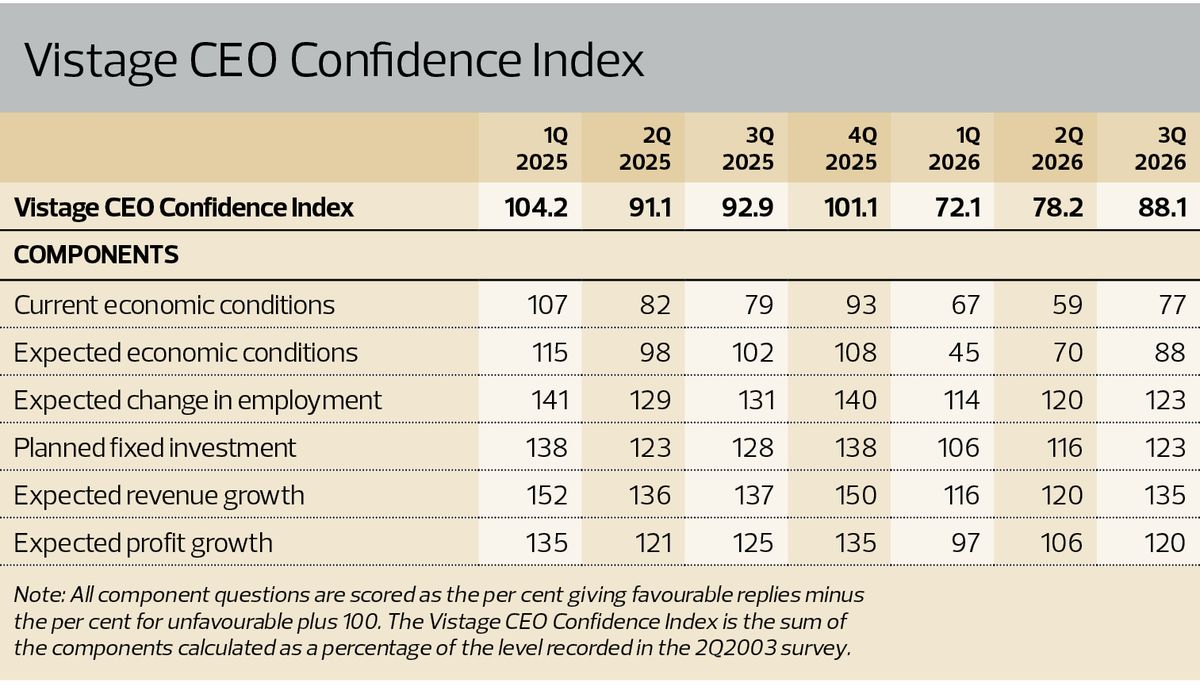
The Vistage CEO Confidence Index climbed 9.9 points, or 12.7%, from the previous quarter to 88.1 in the third-quarter survey, which closed in September 2026. This is the second consecutive quarterly increase since confidence fell to 72.1 in 1Q2026, and the index is now at its highest since 4Q2025 (101.1).
The recovery comes against a firmer macroeconomic backdrop. Malaysia’s real gross domestic product grew 6.0% year on year (y-o-y) in 2Q2026, faster than the 5.4% recorded in 1Q2026, according to the Department of Statistics Malaysia. Even so, the index remains 5.1% below its level a year earlier (92.9 in 3Q2025) and below its 100 baseline, indicating that CEOs are less pessimistic but still cautious.
What the index components show
All six components improved from the previous quarter (see table). The largest gains came in the two macroeconomic components, where the share of pessimistic CEOs fell sharply. The four firm-level components (employment, investment, revenue and profit) are all at or above 120, which means optimists clearly outnumber pessimists.
Current economic conditions:
The component rose 30.5% to 77 from 59, reversing two quarters of decline. It is now only 2.5% below the year-ago level. However, a score below 100 means more CEOs still see conditions as worse than a year ago than those who see them as better.
- Expected economic conditions: The component rose 25.7% to 88 from 70, extending the recovery from the 1Q2026 low of 45. It remains 13.7% below the year-ago level, the largest y-o-y gap among the six components.
- Expected change in employment: This component edged up 2.5% to 123. Hiring intentions remain firmly positive, although they are 6.1% below a year ago.
- Planned fixed investment: Investment intentions rose 6.0% to 123, only 3.9% below the year-ago level.
- Expected revenue growth: This component jumped 12.5% to 135, almost back to its 3Q2025 level (137).
- Expected profit growth: This component rose 13.2% to 120, the strongest reading since 4Q2025, but still 4.0% below a year ago.
Distribution of CEO sentiment
More CEOs expect improvement
The share of “optimistic” CEOs rose for all six index components this quarter. The biggest shifts were in expected revenue (42% to 50%) and expected profit (34% to 41%). The share expecting better current economic conditions also rose, from 11% to 17%. Optimism, however, is still below the levels of late 2025.
Pessimism recedes across the board
The share of CEOs expecting deterioration fell for five of the six components and held steady for employment at 15%. The sharpest declines were in the macroeconomic measures. Pessimism about current economic conditions fell from 52% to 40%, and about the economic outlook from 47% to 33%, half the 66% peak recorded in 1Q2026.
A larger share sees stability ahead
The share of CEOs expecting no change rose for current economic conditions (37% to 43%) and, most notably, for expected economic conditions (36% to 46%). This suggests that many former pessimists have moved to a neutral view rather than an outright optimistic one. The shares expecting no change were broadly stable for the firm-level components.
How CEO sentiment has shifted: A component-by-component view
Looking at the shares of CEOs expecting improvement, deterioration or no change shows a consistent pattern this quarter: pessimism is receding and optimism is rebuilding, led by the macroeconomic outlook and revenue expectations.
Current economic conditions: Pessimism recedes sharply
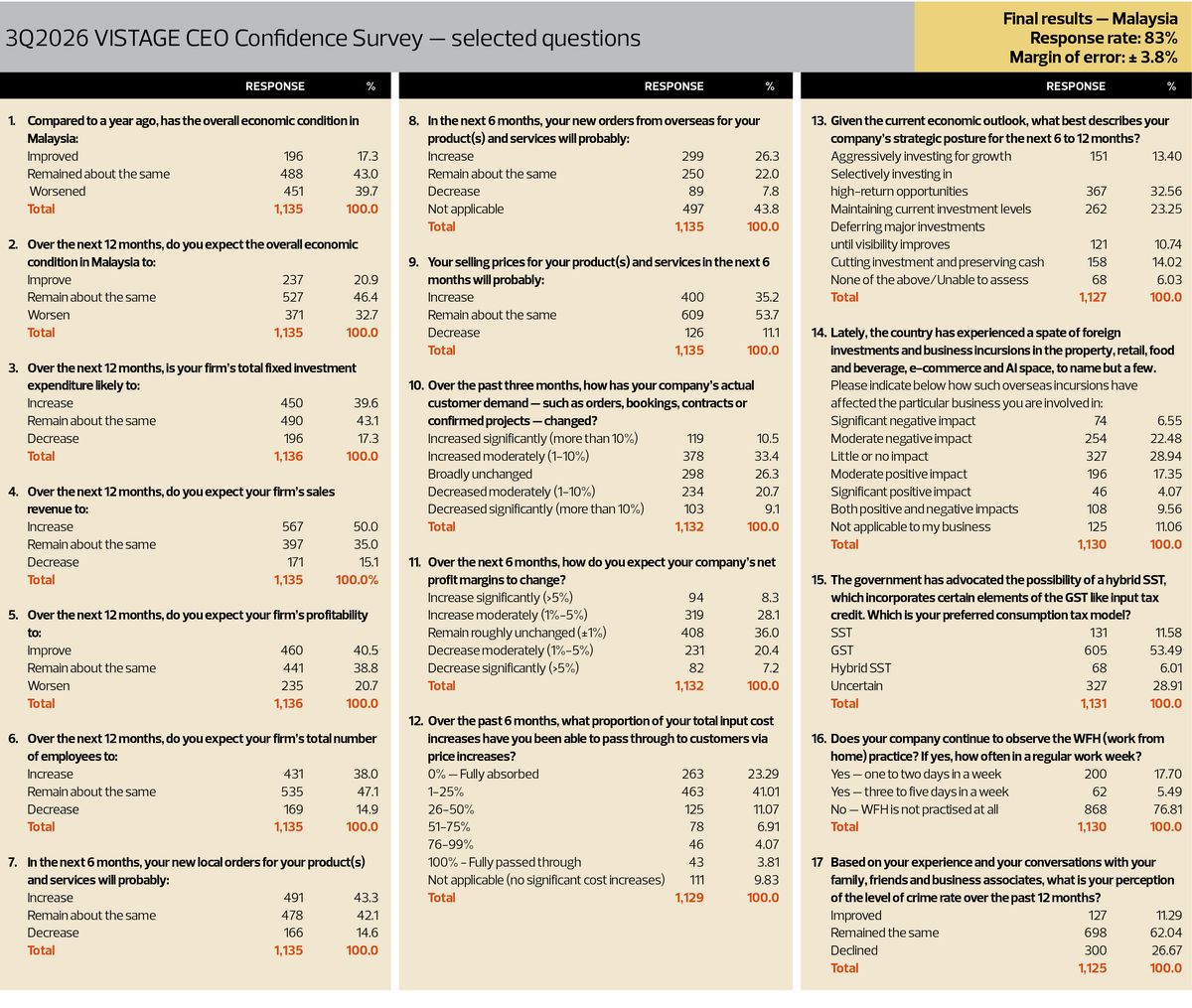
The share of CEOs who say economic conditions have worsened compared with a year ago fell to 40% from 52% in 2Q2026, while those seeing improvement rose to 17% from 11%. A further 43% see conditions as unchanged. Pessimists still outnumber optimists by more than two to one, so CEOs remain cautious about the operating environment even as they register the improvement.
Expected economic conditions: Outlook continues to brighten
Views of the economic outlook continued to recover from the 1Q2026 slump. The share expecting conditions to improve over the next 12 months rose to 21% from 17%, while the share expecting conditions to worsen fell to 33% from 47%. Almost half (46%) now expect conditions to stay about the same, the highest share in five quarters.
Employment: Hiring intentions edge higher
The share of CEOs planning to increase headcount rose to 38% from 35%, while those planning reductions held at 15%. Just under half (47%) intend to keep their workforce stable. Hiring intentions are firmly positive but well short of the 49% recorded in 4Q2025, which suggests a measured approach to adding staff.
Planned fixed Investment: Investment plans regain momentum
Investment intentions improved for a second consecutive quarter. 40% of CEOs plan to increase fixed investment (up from 37%) and 17% plan to cut it (down from 21%). The remaining 43% plan to hold investment steady, which suggests many are still waiting for greater clarity before committing capital.
Revenue: Half of CEOs now expect higher sales
Revenue expectations posted one of the strongest improvements this quarter. Half of the CEOs (50%) expect sales revenue to increase over the next 12 months, up from 42%. The share expecting a decline fell to 15% from 22%, back to its 3Q2025 level.
Profit: Earnings outlook strengthens
Profit expectations followed the revenue outlook higher. 41% of CEOs expect profitability to improve (up from 34%), and the share expecting it to worsen fell to 21% from 28%. The gap between revenue optimism (50%) and profit optimism (41%) points to continued pressure on margins, which is examined in the Profit Margins and Cost Pass-Through section.
Orders, demand and selling prices
Local and export orders pick up
Order expectations improved on both fronts this quarter. The local orders sub-index rose 12.3% to 128: 43% of CEOs expect higher local orders over the next six months (up from 36%), and only 15% expect a decline (down from 22%).
The export orders sub-index rose 8.1% to 133, the highest of the three sub-indices. Among CEOs with export exposure, 47% expect higher overseas orders (up from 39%) and 14% expect a decline. About 44% of respondents said export orders were not applicable to their business.
Pricing pressures continue to ease
The share of CEOs planning to raise selling prices over the next six months fell for a second straight quarter, to 35% from 40% in 2Q2026 and 58% in 1Q2026. Most CEOs (54%) now plan to hold prices steady, and 11% expect to lower them. The selling price sub-index eased to 124 from 128.
Actual demand has Improved for many firms
The survey also asked CEOs how actual customer demand, such as orders, bookings, contracts or confirmed projects, changed over the past three months. 44% reported an increase (10.5% significantly and 33.4% moderately), while 30% saw a decrease and 26% reported demand broadly unchanged. This net balance of about +14 points suggests that the improvement in expectations is grounded, at least in part, in real demand.
Profit margins and cost pass-through
Last quarter, the share of CEOs planning price increases was well above the share expecting higher revenue or profit, which pointed to pressure on margins. This quarter’s survey looked at margins in more detail.
Margin expectations are modestly positive
Over the next six months, 36% of CEOs expect their net profit margins to increase (8.3% significantly and 28.1% moderately), while 28% expect margins to shrink. The largest group (36%) expects margins to stay roughly unchanged, within ±1%. The resulting net balance of +8.8 points is positive but modest.
Margin outlook varies widely by sector
The margin outlook differs markedly across sectors. Service-oriented sectors are the most upbeat: financial services (+43), education and training (+34), healthcare (+29), logistics (+28) and technology/ICT (+26) all show strongly positive net balances. By contrast, the two largest sectors, manufacturing (+5) and wholesale/retail/trading (+2), are close to neutral. Construction and property (16) is clearly negative. Agriculture (43) is the most negative, although its small sample (14 responses) calls for caution.
Competition is the main force shaping margins
Asked for the single most important factor behind their expected change in margins, 36.5% of CEOs cited competitive pressures, such as intense competition, new entrants or price wars. This was well ahead of cost pass-through (24.2%), demand conditions (18.1%) and market power or pricing leverage (17.2%). Among the larger sectors, competition was cited most often in construction and property (49%) and wholesale/retail/trading (46%), while cost pass-through was the leading factor in manufacturing (38%) and food and beverage/hospitality (39%).
Most firms absorb the bulk of cost increases
Most firms have limited ability to pass higher input costs on to customers. Over the past six months, 23% of CEOs fully absorbed their cost increases and a further 41% passed on only 1%–25% of them. Just 4% passed on the full increase. Excluding the 10% of firms with no significant cost increases, 71% passed on a quarter or less of their higher costs.
Risks and strategic posture
Weak domestic demand tops the list of growth risks
Asked to name the two greatest risks to their company’s growth over the next 12 months, CEOs pointed most often to weak domestic demand or customer spending. This option was selected by 561 CEOs (49% of respondents) and accounted for 20.6% of all responses. Global economic uncertainty (15.4% of responses; 37% of CEOs) and rising labour and talent costs (15.2%; 36% of CEOs) followed closely.
Energy, logistics and raw-material costs ranked fourth (10.1%). This suggests input-cost worries are less prominent than at the height of the Middle East energy shock earlier in the year. Government policy and regulatory uncertainty (8.5%) ranked fifth. Among the “other” risks CEOs cited, competition from low-cost Chinese products and suppliers came up repeatedly.
Investment strategy: Selective rather than aggressive
Nearly half of CEOs (46%) are investing for growth, but mainly on a selective basis: 32.6% are targeting high-return opportunities, compared with 13.4% investing aggressively. Another 23.2% are maintaining current investment levels. About a quarter are on the defensive: 10.7% are deferring major investments until visibility improves and 14.0% are cutting investment to preserve cash.
Workforce
Talent acquisition Is the biggest workforce challenge
Difficulty attracting or hiring suitable talent is by far the workforce challenge with the greatest impact on growth, cited by 32.0% of CEOs. It is followed by rising salary and employee costs (18.7%) and skills gaps among existing employees (16.8%). Workforce productivity (12.2%) and employee retention (8.7%) are secondary concerns, and only 5.4% of CEOs report no significant workforce challenge.
Together, talent availability and skills gaps account for almost half of responses (48.8%). Many CEOs see capability, not just cost, as the constraint on growth, which fits with the 36% who named rising labour and talent costs as a key growth risk.
Work-from-home has largely faded
More than three-quarters of companies (76.8%) no longer practise work-from-home. Among those that do, most allow one to two days a week (17.7%), while only 5.5% offer three to five days a week.
Business environment and policy
Foreign business incursions: A mixed impact
CEOs were asked how the recent wave of foreign investment and business entry into sectors such as property, retail, food and beverage, e commerce and artificial intelligence has affected their business. The responses are mixed. 29.0% report a negative impact (6.5% significant and 22.5% moderate), while 21.4% report a positive one (17.3% moderate and 4.1% significant). A further 28.9% see little or no impact, 9.6% see both positive and negative effects, and 11.1% say the question does not apply to their business.
Majority prefer a return to GST
On consumption tax, a clear majority of CEOs (53.5%) prefer the goods and services tax (GST), well ahead of the current sales and service tax (SST) at 11.6% and the proposed hybrid SST at 6.0%. A sizeable 28.9% remain uncertain, which suggests a need for clearer communication on how a hybrid model with input tax credits would work.
Perception of crime
Based on their own experience and conversations with family, friends and business associates, most CEOs (62.0%) feel the crime situation has remained the same over the past 12 months. 26.7% said it had declined and 11.3% said it had improved.
Respondent profile
The 3Q2026 survey received 1,135 responses from Vistage CEOs across a broad range of industries. Manufacturing (21.9%) and wholesale/retail/trading (20.2%) together account for over two-fifths of respondents. They are followed by technology/ICT (10.1%), professional and business services (10.0%) and construction and property (9.4%). Of the 81 respondents classified as “Others”, many are in engineering, oil and gas, renewable energy and other specialised services.
About the Vistage CEO Confidence Index
Vistage Malaysia is a fully owned subsidiary of Vistage International, USA — the world’s most trusted resource for CEOs, business owners and key executives of small and medium-sized businesses. Vistage helps leaders become better decision makers and deliver better results through monthly peer advisory group meetings, one-on-one business coaching, expert speaker presentations and a global network spanning more than 40 countries with over 45,000 members worldwide.
In Malaysia, more than 1,500 Vistage members represent a combined annual revenue of RM90 billion and employ over 140,000 people. Vistage member companies grow, on average, 2.2 times faster than they did prior to joining Vistage.
In 2Q2025, Vistage Malaysia engaged Professor Dr Yeah Kim Leng as its adviser and collaborator for the quarterly Vistage CEO Confidence Index (CCI). Dr Yeah is a distinguished Malaysian economist with extensive experience in academia, policy advisory and economic research. He currently serves as a professor of economics and director of the Economic Studies Programme at the Jeffrey Cheah Institute on Southeast Asia, Sunway University. Dr Yeah was the group chief economist at RAM Holdings Bhd for two decades. He also served as a senior analyst at the Institute of Strategic and International Studies (ISIS) Malaysia. In addition to his academic roles, Dr Yeah holds several notable positions:
• President of the Malaysian Economic Association (MEA)
• Trustee of the Malaysia Tax Research Foundation
• Member of the National Consumer Advisory Council at the Malaysian Ministry of Domestic Trade and Consumer Affairs
• Former External Member of Bank Negara Malaysia’s Monetary Policy Committee
In April 2025, he was appointed as one of four advisers in the Policy Advisory Committee to the Prime Minister of Malaysia.
Save by subscribing to us for your print and/or digital copy.
P/S: The Edge is also available on Apple's App Store and Android's Google Play.