

This article first appeared in Capital, The Edge Malaysia Weekly on October 5, 2026 - October 11, 2026
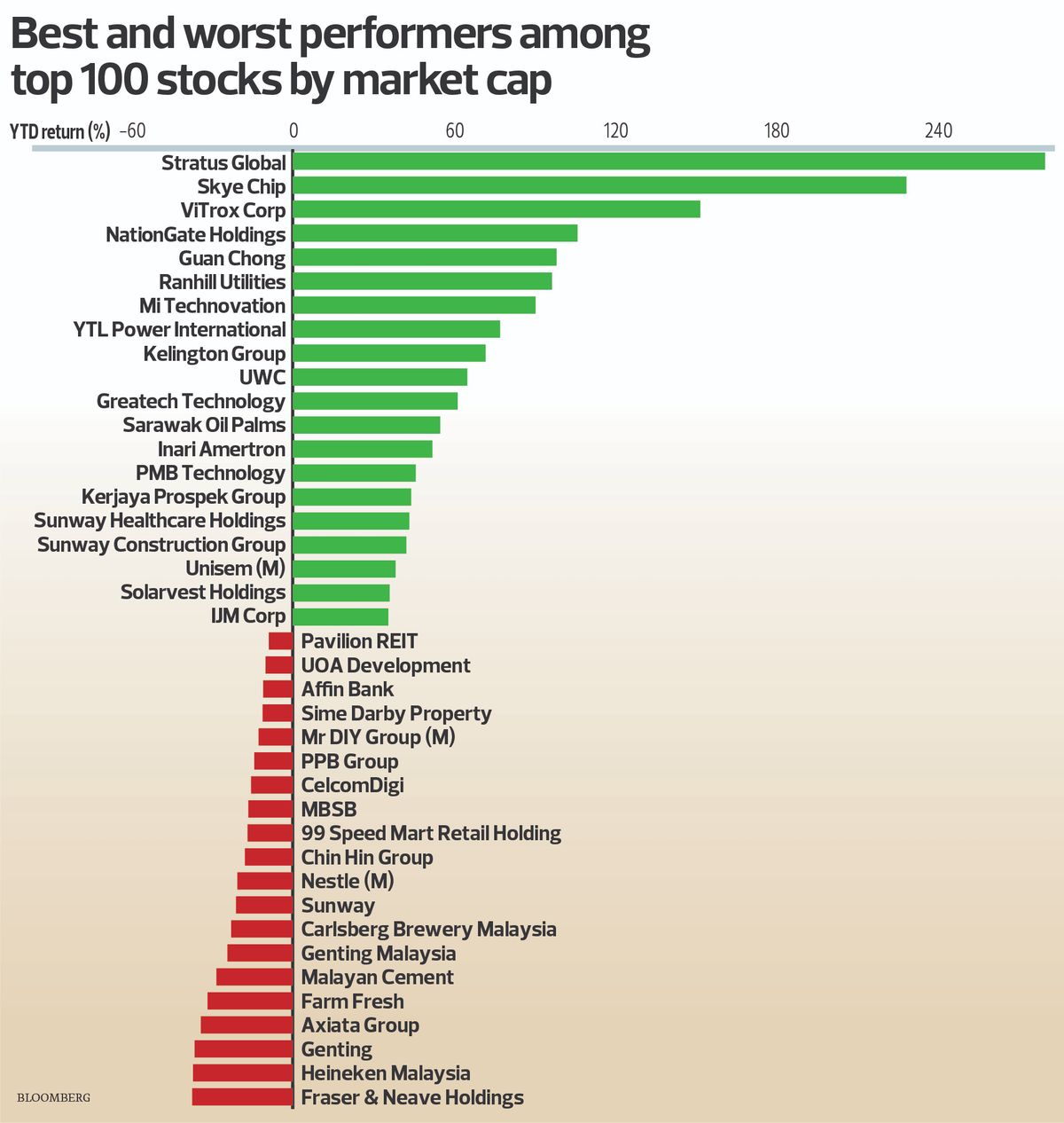
THE Malaysian equity market wrapped up the first nine months of the year on stable ground, with about half of the 13 sectors across Bursa Malaysia delivering positive returns to investors. Of the 100 largest stocks by market capitalisation, 74 recorded year-to-date (YTD) share price gains.
As expected, technology players dominated the list of top gainers, with the two debutants this year — Stratus Global Holdings Bhd (KL:STRATUS) and SkyeChip Bhd (KL:SKYECHIP) — surging more than 200% from their respective listing prices. Stratus Global specialises in semiconductor cleanroom automation, while SkyeChip designs fabless integrated circuits.
Other top-performing tech and tech-linked counters included ViTrox Corp Bhd (KL:VITROX), NationGate Holdings Bhd (KL:NATGATE), Mi Technovation Bhd (KL:MI), Kelington Group Bhd (KL:KGB), UWC Bhd (KL:UWC) and Greatech Technology Bhd (KL:GREATEC).
In contrast, consumer names came under selling pressure, with Fraser & Neave Holdings Bhd (KL:F&N), Farm Fresh Bhd (KL:FFB), Nestlé (Malaysia) Bhd (KL:NESTLE), 99 Speed Mart Retail Holdings Bhd (KL:99SMART) and Mr D.I.Y. Group (M) Bhd (KL:MRDIY) among the notable decliners.
The shares of breweries Heineken Malaysia Bhd (KL:HEIM) and Carlsberg Brewery Malaysia Bhd (KL:CARLSBG) also faced heavy sell-off.
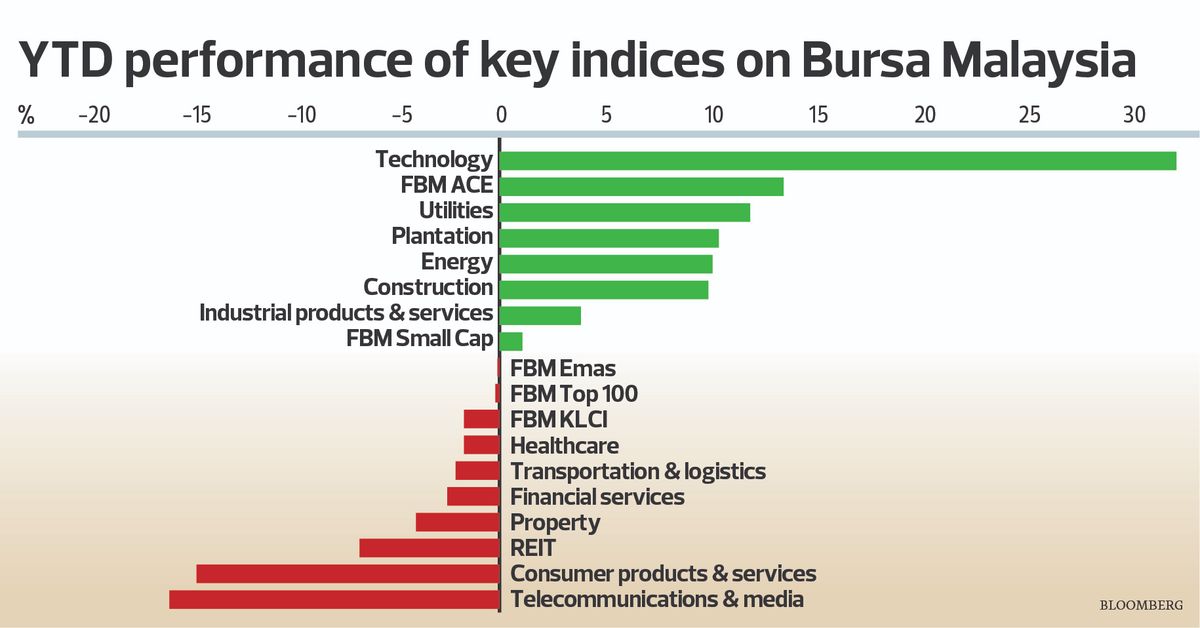
The Bursa Malaysia Technology Index, with a price-earnings ratio (PER) of 53.5 times, posted an impressive gain of 32.4% in the first nine months of the year, driven by strong investor interest in artificial intelligence (AI) and a recovery in semiconductor sales.
The technology index significantly outperformed the FBM KLCI, which fell 1.7% over the same period. The benchmark had a lower PER of 14.3 times, based on last Wednesday’s close of 1,651.17 points.
It is worth noting that the FBM ACE Index, which has a higher PER of nearly 38 times, has risen more than 13% YTD as investors gravitated towards high-beta stocks, particularly those linked to data centres and AI.
Utilities, plantation, energy and construction stocks have also delivered solid returns so far this year.
However, telecommunications & media, consumer products & services and real estate investment trust counters were among the biggest underperformers. Similarly, the financial services sector slipped into negative territory, with the persistent decline in Malayan Banking Bhd’s (KL:MAYBANK) share price drawing investor attention.
The largest stock on Bursa saw its share price dip below the RM10 mark last week, touching an intraday low of RM9.83, its lowest in more than a year. The decline may not have come as a surprise given the net foreign selling of RM3.34 billion worth of shares for the year to Sept 24 — the largest among the FBM KLCI constituents — according to CIMB Securities data.
In contrast, Public Bank Bhd (KL:PBBANK) saw the largest net foreign buying among the FBM KLCI component stocks, at RM1.52 billion worth of shares during the period in review.
Only about one-third of the FBM KLCI constituents have attracted net foreign buying so far this year. Apart from Public Bank, the others include SD Guthrie Bhd (KL:SDG) at RM1.11 billion, MISC Bhd (KL:MISC) at RM762.6 million, IOI Corp Bhd (KL:IOICORP) at RM398 million, YTL Power International Bhd (KL:YTLPOWR) at RM292.6 million, RHB Bank Bhd (KL:RHBBANK) at RM270.1 million, Hong Leong Bank Bhd (KL:HLBANK) at RM178.2 million, AMMB Holdings Bhd (KL:AMBANK) at RM164.9 million and Kuala Lumpur Kepong Bhd (KL:KLK) at RM13.8 million.
For the year to Sept 25, foreign funds’ net selling of Malaysian equities amounted to RM5.6 billion, according to MBSB Research data, following on from the whopping RM22.48 billion net sold in 2025.
Foreign funds turned net sellers in 2Q2026, with net outflows of RM5.51 billion, after starting the year as net buyers with RM2.73 billion of net inflows in 1Q2026. In 3Q2026 (as at Sept 25), net foreign selling totalled RM2.82 billion.
For the year to Sept 25, local institutional funds mopped up nearly RM5 billion net of equities, while retail investors bought RM700 million net.
Analysts expect the US-Iran war to keep energy prices elevated for the rest of the year, while potentially more hawkish US Federal Reserve policy and rising bond yields are expected to cap market upside.
In view of the narrowing risk premium, Rakuten Trade head of research Kenny Yee tells The Edge that the research house will reduce its valuation assumption for the FBM KLCI from a PER of about 17 times to about 16 to 16.5 times. He says the foreign outflows reflect the unwinding of the yen carry trade following the Bank of Japan’s (BoJ) interest rate hike last month, which narrowed interest rate differentials between the BoJ and central banks in the region. Japan’s key policy rate is now at a 31-year high of 1.25%.
Alexander Chia, head of regional equity research at RHB Investment Bank, expects the local market to trade range-bound. His preferred approach is to buy on weakness, build positions patiently after a sell-off and take profit when target prices are reached.
“If the market gets closer to 1,600 points, there will definitely be a lot of support. At 1,650 points, we should be nibbling. And when it reaches 1,720 to 1,740 points, maybe take some profit,” he says.
Chia notes that rising global bond yields and borrowing costs could pressure equity valuations, corporate funding and the real economy. Furthermore, severe El Niño weather conditions could add to inflationary pressures and remain a feature of the investment climate, he says.
His favoured areas include plantation, aluminium, basic materials, oil and gas, energy, water infrastructure, tech, ports, transport and healthcare. “The tech and AI cycle will continue for some time, but investors have to be careful as the stocks have run up a lot,” he notes.
On the continuous foreign fund outflows, Chia stresses that this reflects Malaysia’s mere MSCI Emerging Markets weighting of 1%, higher US interest rates and lacklustre corporate earnings growth.
“When you have US interest rates moving higher, the immediate outcome is a stronger US dollar. There is no strong reason for a foreign portfolio fund to invest in Malaysia, unless there is a Malaysia mandate,” he says.
“In terms of corporate earnings, over the past 10 years, I think it has been a disappointment in eight or nine years. Even now, our earnings growth, at best, is in the mid single digit of 5% to 7%.”
Cumulative foreign net selling of Malaysian equities since 2017 was estimated at a very telling RM70 billion.
The Fed recently raised US interest rates for the first time in three years, lifting the federal funds rate to 3.75%-4%. This led to the US dollar having its best month since June, with the US Dollar Spot Index rising 1.8% in September.
Banking sector closely watched
As a proxy to the broader economy, the heavyweight banking sector is being closely watched. Following the 2Q corporate earnings reporting season, RHB even downgraded the sector to “neutral” because of valuations and signs of asset-quality stress, although the situation was not seen as alarming.
“I think it’s the beginning of some stress in asset quality, not particularly worrying. It has been a month since we downgraded the sector. So the pullback in banking stocks has justified our downgrade,” says Chia.
On whether this is a good opportunity to accumulate banking stocks, he says: “You have to look at the whole market. I think the market will continue to be range-bound because the liquidity levels are quite good.”
Yee stresses that investors should remain vigilant about banking stocks despite a relief rebound as further foreign selling may occur, even though the current valuations are considered cheap.
Meanwhile, MBSB Research head Imran Yassin Yusof says bank earnings are not expected to deteriorate materially. Instead, any surprise policy rate hike could provide temporary net interest margin expansion, although he does not project an increase in Bank Negara Malaysia’s overnight policy rate — currently at 2.75% — in the near term.
Imran is of the view that corporate earnings remain broadly solid, with limited margin compression in certain sectors. He believes Budget 2027, scheduled to be tabled on Oct 9, may help improve market sentiment on expectations that it will be “mildly expansionary”, with higher development expenditure and cost-of-living support measures.
Imran expects energy, utility and plantation stocks to remain strong, with commodity-linked sectors benefiting from elevated crude oil and crude palm oil prices, and the construction sector to continue benefiting from healthy job flows. Nonetheless, he considers the technology sector’s valuations stretched, and expects the sector’s performance to be very much dependent on individual stocks and their value chain exposure.
Amid the ongoing Middle East uncertainties, Imran says a potential lull in the conflict could lower oil prices and support a market recovery. “If oil prices stay high, bond prices may continue to stay high and that will put a dampener on the stock market,” he adds.
Imran is maintaining his FBM KLCI year-end target of 1,770 points, premised on a PER of 15.6 times. MBSB’s top picks are CelcomDigi Bhd (KL:CDB), 99 Speed Mart, KPJ Healthcare Bhd (KL:KPJ), Dialog Group Bhd (KL:DIALOG), Sarawak Plantation Bhd (KL:SWKPLNT), Nestlé (Malaysia) Bhd, Tenaga Nasional Bhd (KL:TENAGA), MISC, SD Guthrie and Gamuda Bhd (KL:GAMUDA).
Yee says Sunway Group and the YTL Group of companies may continue to attract market interest, but cautions about the hype surrounding some data centre- and AI-linked names.
In the regional market, persistent stretched valuations were seen in Japan, South Korea and Taiwan due to the concentration in a small number of AI-linked stocks. Tech giants like Samsung, SK Hynix and Taiwan Semiconductor Manufacturing Co dominate their respective markets.
Elevated US bond yields and midterm elections in focus
Apart from the prolonged Middle East tensions, analysts flagged elevated US bond yields and high borrowing costs as potential triggers of the next market downturn.
“A market crash can happen any time. We have been talking about this high bond yield situation for more than a year. The US economy is not doing well, yet they are now paying record high borrowing rates. I think the middle class is suffocating, which will affect the US growth engine,” cautions Rakuten’s Yee.
MBSB’s Imran is of the view that the US bond yield has not reached an alarming or breaking-point level, but will remain under strong scrutiny for its implications on global financial markets.
Last Thursday, the US benchmark yield climbed to the highest since 2002, with that of the 10-year Treasury note gaining as much as six basis points to 5.34%, according to Bloomberg. This came as rising oil prices drove a renewed sell-off in global bonds. Brent crude was trading at US$100.25 a barrel at 5pm that day.
Imran notes that the US midterm elections in November could increase foreign policy uncertainty or cause US Treasury yields to rise, affecting global bond and equity markets.
“Although there will not be a direct impact on Malaysia per se, it does have repercussions in terms of whether it could lead to a more aggressive foreign policy or contention in the election results. Then we could probably see bond yields start to spike again,” he observes.
RHB’s Chia concurs that the probability of US President Donald Trump’s Republican Party losing one or both houses of Congress could stir up more uncertainty in global financial markets.
Save by subscribing to us for your print and/or digital copy.
P/S: The Edge is also available on Apple's App Store and Android's Google Play.