


This article first appeared in The Edge Malaysia Weekly on October 5, 2026 - October 11, 2026
PENANG-based precision engineering solutions provider Coraza Integrated Technology Bhd (KL:CORAZA) has already been through the global semiconductor industry’s boom and bust cycle in the five years since its debut on Bursa Malaysia’s ACE Market in January 2022. And now, it is riding another up cycle.
The difference now is that Coraza has climbed up the value chain, says its managing director Lim Teik Hoe. “We are in the ecosystem supporting all those fab equipment makers. We supply fabricated components to them.”
The company is already reaping the fruits of its investments.
Coraza operates two shifts, with some staff working overtime. The group currently employs more than 900 workers.
“We are trying to see how to balance the end,” says Lim, referring to the need to balance manpower, capacity and overtime.
During the previous downturn that lasted less than three years, the company doubled down on its capital expenditure (capex) on machinery and equipment. It added more sophisticated machinery and developed new manufacturing processes capable of making larger and more complex components with increasingly stringent tolerances.
Coraza specialises in sheet-metal fabrication, frames and structures, precision machining and related processes. It develops the manufacturing processes according to its customers’ specifications.
According to Lim, the company’s customers, which are mainly multinational corporations (MNCs), have painted a strong outlook for 2027, indicating that their orders could potentially double.
Coraza’s current order book of RM170 million may not appear exciting. Nevertheless, Lim tells The Edge that the rolling six- to 12-month forecasts of its customers have become more upbeat since early this year.
“These forecasts give us more visibility to plan and procure materials which are highly specialised with long lead times and are not easily redeployed to other customers,” he adds.
Coraza’s top five customers account for more than 80% of its revenue, while its customer base spans both front-end and back-end semiconductor applications.
Reaping the fruits of its investments
In 2023, a front-end customer started talking about localising parts of its supply chains. Lim then seized the opportunity by identifying the manufacturing processes needed to capture a bigger share of the semiconductor equipment market.
“Our only way to widen our TAM (total addressable market) is to widen our process capability. So that we can capture a wider market,” he explains.
The company began investing in advanced manufacturing technologies capable of producing larger material formats and more sophisticated components with tighter tolerances. For products it has never fabricated before, it often purchases the relevant equipment, develops and validates its processes, then undertakes extensive testing until the process is repeatable and reproducible.
Such development cycles can be six months to two years, particularly for products requiring tolerances below 10 microns, where metrology, environmental controls and process stability are increasingly critical. But the payoff is potentially higher value and able to create customer stickiness.
“More complex, more bulky, and all that. It doesn’t make sense if you don’t move up the value chain,” says Lim.
The expansion in capabilities requires more capacity and factory floor space.
Since 2023, Coraza has added five factories, bringing the total to six facilities — three owned facilities in Nibong Tebal, Penang, and three rented ones in Kulim, Kedah. The total floor space has been expanded more than fourfold, from 93,000 sq ft to 415,000 sq ft.
Its latest facility, P6, which Coraza expects to take possession of this month, will add about 90,000 sq ft. Lim says the expanded capacity could support a growth trajectory of 30% to 40%.
P6 is not just about adding floor space. The company is handling more components that are both larger and heavier, requiring different manufacturing layouts and processes. It is also looking to expand its surface-finishing capabilities as its existing set-up is less suited to the increasingly bulky products it is handling.
“The volume has grown. We are also looking at additional facilities,” says Lim.
Coraza’s products support equipment used across different parts of the semiconductor manufacturing ecosystem, including front-end processes such as deposition and etching, as well as inspection, metrology and advanced packaging.
As semiconductor nodes become more complex, Lim expects demand for increasingly sophisticated equipment, and therefore more complex components. “We are beginning to do a lot more complex frames and all that,” he says.
The company is also seeing opportunities in metrology and inspection equipment, where increasingly sophisticated semiconductor processes require more precise inspection capabilities.
Coraza is broadening its offerings through its joint venture with a Singapore-based company, which provides specialised processes such as cleaning, anodising and coating after the components have been fabricated.
“We call ourselves a one-stop solution. So, we try to see what else we can do,” says Lim.
Bringing more processes to its offerings should give Coraza greater control over production and potentially shorten lead times, which is increasingly important as customers demand faster turnaround times.
Meanwhile, the company is seeing healthy activity in new product introduction, or NPI. Lim says NPI-related growth continues to be strong, with a handful of projects typically being developed concurrently.
NPI can be resource-intensive because it requires engineering time, machining capacity and repeated process validations. Once the process has been stabilised and moves into production, however, the customer relationship can be more entrenched.
“All these will make a stickier customer relationship, and they will stay with you for a long time. After passing through the development stage and going into the optimisation stage, we should be able to improve our margin over time,” says Lim.
The company’s investments in both capability and capacity expansion are already translating into stronger financial performance.
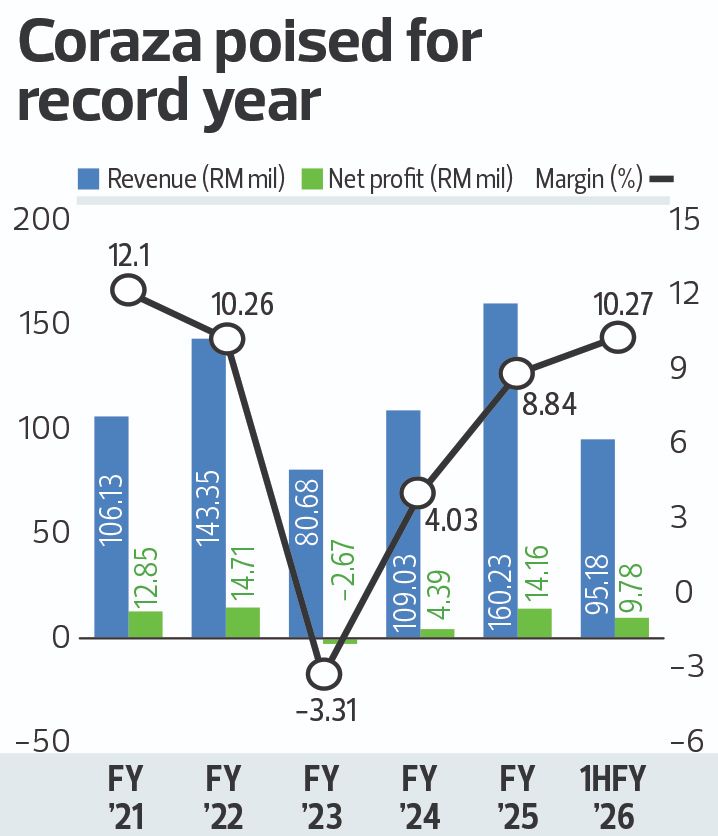
For the second quarter ended June 30, 2026 (2QFY2026), Coraza posted a record quarterly revenue of RM51.05 million, compared with RM42.49 million in the previous corresponding period. This lifted its revenue for the first half of FY2026 (1HFY2026) to RM95.18 million, up 21.5% from RM78.3 million in 1HFY2025.
Its quarterly net profit increased to RM5.43 million from RM3.19 million previously. For 1HFY2026, its net profit jumped 66.3% year on year to RM9.78 million from RM5.88 million.
Lim is optimistic that Coraza’s annual earnings will reach a new peak in FY2026, with the growth momentum carrying into FY2027.
RHB Research forecasts revenue of RM213 million in FY2026 and RM285 million in FY2027, compared with RM160 million in FY2025. It expects net profit to expand to RM22 million in FY2026 and RM30 million in FY2027, from RM15 million in FY2025.
The need to fund its continued expansion is also guiding Coraza’s capital allocation. Lim says the group is prioritising reinvestment over dividend payouts as it is still in the growth phase.
“As you see, we are in the growth stage. Whatever things we have for growth, [we should] put into more productive stuff first,” he elaborates.
Coraza has not paid dividends since its listing in 2022, mainly because it has continued to invest heavily in expanding its manufacturing capacity and capabilities. The group has spent RM125 million on net additions to property, plant and equipment over the past four years.
On its balance sheet, the group has total cash of RM47.22 million against total borrowings of RM49.43 million. Its net gearing ratio stood at a modest 4.4% as at end-June.
Looking beyond 2027
The bigger question is how long this semiconductor investment cycle will last.
Lim expects the current cycle to remain resilient beyond 2027, unless global macroeconomic conditions deteriorate significantly. “If the global macro is really bad, I don’t think it will plunge,” he says, adding that it is likely to be more measured growth, rather than no growth at all.
He also expects advanced packaging to play a larger role in the next phase of semiconductor investment, as equipment installed in the current cycle supports later production stages.
Non-independent non-executive director Paul Heng Weng Seng is Coraza’s largest shareholder with a 42.08% stake. Lim has a direct stake of 0.36% and an indirect stake of 16.68%, mainly through his spouse Liew Sow Ying.
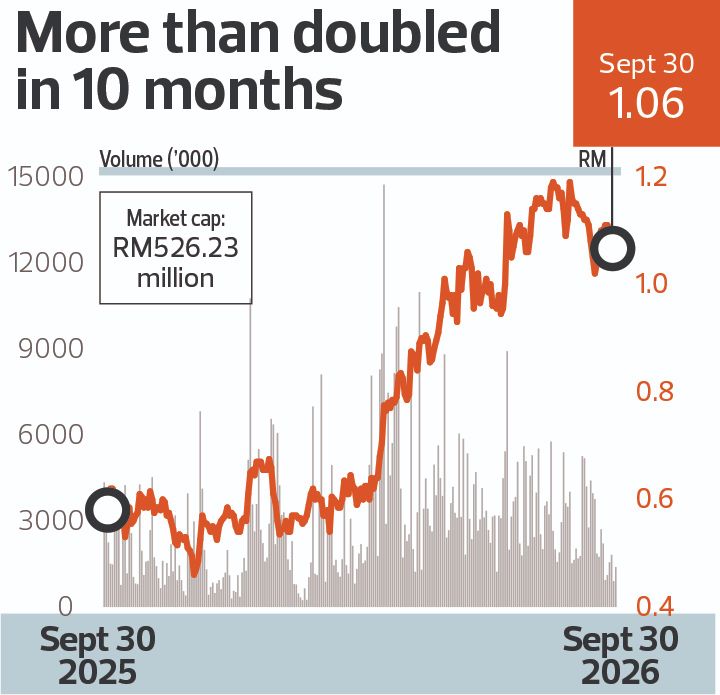
Coraza’s share price had more than doubled to RM1.06 last Wednesday from 54 sen at the start of the year, giving the company a market capitalisation of RM526.23 million The shares were trading at a forward price-earnings ratio (PER) of about 24.2 times.
There are two “buy” recommendations and one “hold” call on the stock, with target prices ranging from TA Securities’ RM1.29 to RHB Research’s RM1.45. The average target price of RM1.36 implies an upside of 28.3%.
Save by subscribing to us for your print and/or digital copy.
P/S: The Edge is also available on Apple's App Store and Android's Google Play.