

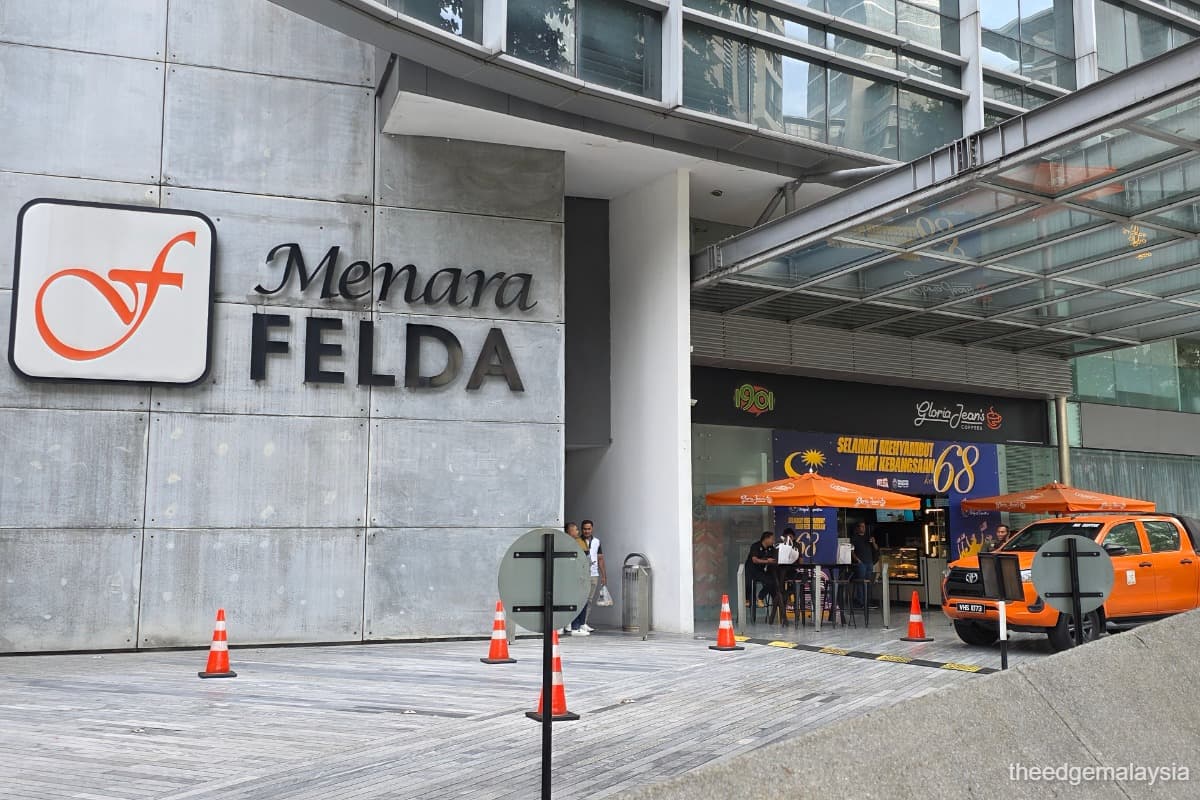
KUALA LUMPUR (Oct 6): Seven years after Malaysians were made aware of the problems confronting the Federal Land Development Authority (Felda), the institution is once again at a crossroads.
Felda, which has the largest plantation footprint in the country and has helped improve the livelihoods of more than 100,000 original settlers and their families, is undergoing another strategic review amid concerns over its long-term sustainability.
An interim report on the Felda Group Strategic Roadmap 2025-2030 (HTF 30) was submitted last month by the Special Committee on the Strategic Plan for Felda Group to Prime Minister Datuk Seri Anwar Ibrahim.
Among the proposals under consideration is a redefinition of Felda’s mandate, including a review of the Land Development Act that governs the agency, as the committee monitors actions taken following the 2019 Felda White Paper, according to people with knowledge of the matter.
The review comes as the highly indebted entity grapples with crucial replanting costs that could reach RM900 million annually, on top of more than RM900 million in financing costs currently borne by the government.
Felda oversees some 870,000 hectares (ha) of land, of which 490,000ha was allocated to settlers, 330,000ha to Felda’s commercial plantations — later placed under FGV Holdings Bhd — and another 50,000ha for village development.
Fragmented and ineffective management of the land and operations, together with questionable transactions and investments, resulted in heavy losses despite Felda receiving billions of ringgit from the listing of its commercial arm, then known as Felda Global Ventures Holdings Bhd.
By 2017, Felda’s borrowings had ballooned to RM12.1 billion from just RM100 million in 2007.
In 2023, the government guaranteed and agreed to service Felda’s RM9.9 billion sukuk, issued to fund the RM3.7 billion privatisation of FGV to consolidate its estate operations, as well as Felda and settlers’ debt.
But more needs to be done before those efforts bear fruit.
Huge capital needed to become sustainable
In 2012, Felda raised RM6 billion through the offer for sale of FGV shares during the latter’s initial public offering, while FGV itself raised RM4.5 billion from investors. In total, the exercise raised RM10.5 billion.
Instead of directing more of those proceeds towards critical needs such as replanting, the 2019 Felda White Paper found that RM4.6 billion, or 76% of Felda’s IPO proceeds, went towards what it described as “unproductive spending”, while another RM1.4 billion was channelled into investments that failed to generate returns.
The spending included RM1.69 billion in special payments to settlers, RM550 million in one-off contributions to state governments, RM400 million in loans for settlers’ house extensions, RM406 million to redeem FGV shares and RM177 million in listing expenses.
FGV, meanwhile, spent RM3.3 billion, or 73% of its RM4.5 billion in IPO proceeds, on investments and developments that did not generate satisfactory returns.
FGV, which leased Felda’s plantation land, also failed to achieve the yields Felda had projected, leaving the agency with an earnings shortfall.
Following FGV’s privatisation, Felda is looking at consolidating the management of its commercial estates and settlers’ land. But that alone will not resolve the underlying balance-sheet problem, particularly the heavy capital requirements needed to keep the estates productive.
The role of Felda
Beyond its plantation operations, Felda bears significant social obligations to settlers, including spending on housing, infrastructure and income support for up to five years during the replanting cycle.
Today, the families of Felda settlers span as many as six generations and number about 2.8 million people. In many respects, Felda has fulfilled its original mandate of opening up rural land and developing communities alongside settlers, about 95% of whom have received titles to their land.
Without a clear framework for its future model, the institution’s role and the financial obligations that come with it risk continuing to be shaped by factors beyond its core mandate, particularly when political considerations intersect with policy during periods of adjustment.
Any new roadmap will therefore have to define more clearly where Felda’s commercial responsibilities end and its social obligations begin, and how each should be funded.
Felda’s troubled investments
Felda was in better shape before the mismanagement that followed the windfall from FGV’s listing, when the institution was earning around RM3 billion a year. There are also arguments that greater provisions should have been made for replanting, which is central to sustaining its core operations.
Poor investment decisions, however, turned Felda’s fortunes upside down in less than a decade.
A forensic audit found RM2.2 billion in asset impairments from eight transactions undertaken by Felda and Felda Investment Corporation Sdn Bhd (FIC) between 2010 and 2018 — equivalent to half of their initial RM4.4 billion investment value.
Among them were PT Eagle High Plantations Tbk, the Kuala Lumpur Vertical City (KLVC) project, and several London properties.
One of the largest was Felda’s US$505.4 million acquisition of a 37% non-controlling stake in Eagle High Plantations in 2016 at a premium, resulting in an impairment loss of RM1.576 billion in 2017.
Its London property purchases also came under scrutiny over discrepancies between reported acquisition prices and amounts received by vendors, while some properties saw their values fall sharply soon after acquisition.
KLVC, meanwhile, remains the subject of a legal dispute between Felda and developer Synergy Promenade Sdn Bhd (SPSB) over the development of Felda land along Jalan Semarak.
Former FIC chief executive officer Mohd Zaid Abdul Jalil has also been charged with two counts of cheating the company’s board, which allegedly resulted in the ownership of 16 land parcels being transferred from Felda to SPSB.