

(Oct 5): If 2026 feels like a banner year for the world’s tech billionaires, the numbers bear it out.
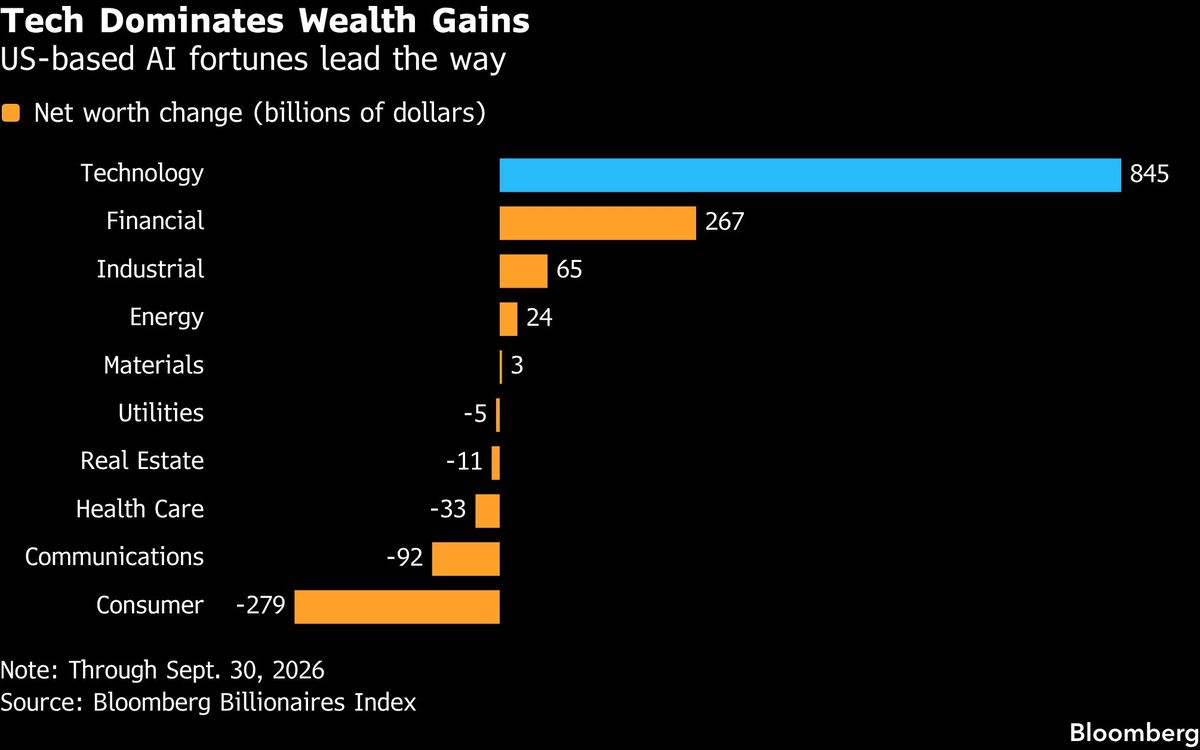
The roughly 100 technology fortunes among the world’s 500 richest people gained a combined US$845 billion (RM3.45 trillion) through Sept 30, the most ever for the first nine months of a year, according to the Bloomberg Billionaires Index.
Fuelling that surge were the same forces driving global markets: the artificial intelligence (AI) boom and soaring technology stocks, particularly in the US. Tech billionaires are now worth a combined US$4.6 trillion, accounting for 36% of the index’s wealth despite making up only about a fifth of its members.
The divergence is stark. Billionaires who made their fortunes outside technology lost a combined US$62 billion over the period, while Americans accounted for 94% of the index’s net gains. Since Sept 10, all 10 of the world’s richest people have been from the US — the first time that’s happened since Bloomberg began tracking billionaires in 2012.
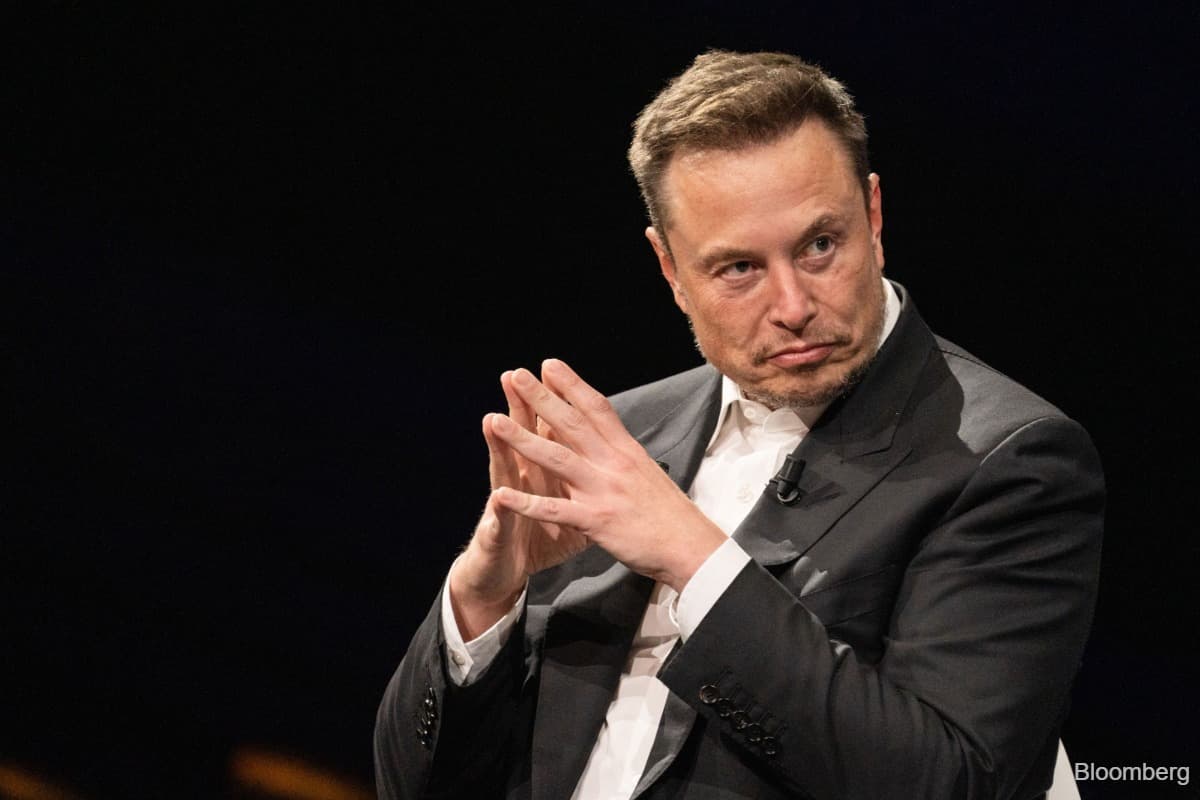
The gains have also been heavily concentrated at the very top. Elon Musk, the world’s richest person, added US$310 billion to his fortune this year through the end of September, or roughly 40% of the index’s total increase. He briefly became the world’s first trillionaire after SpaceX merged with his AI company, xAI, and went public in June.
Nine of the world’s 10 wealthiest people owe their fortunes to American tech firms. Dell Technologies Inc founder Michael Dell saw his wealth increase 81% to US$254 billion as his company’s data centre sales business ballooned. Mark Zuckerberg added US$23 billion to his net worth this year as shares of Meta Platforms Inc gained 27% in September — its best month in almost four years — after rolling out its new Muse personal AI assistant.
Cracks showing
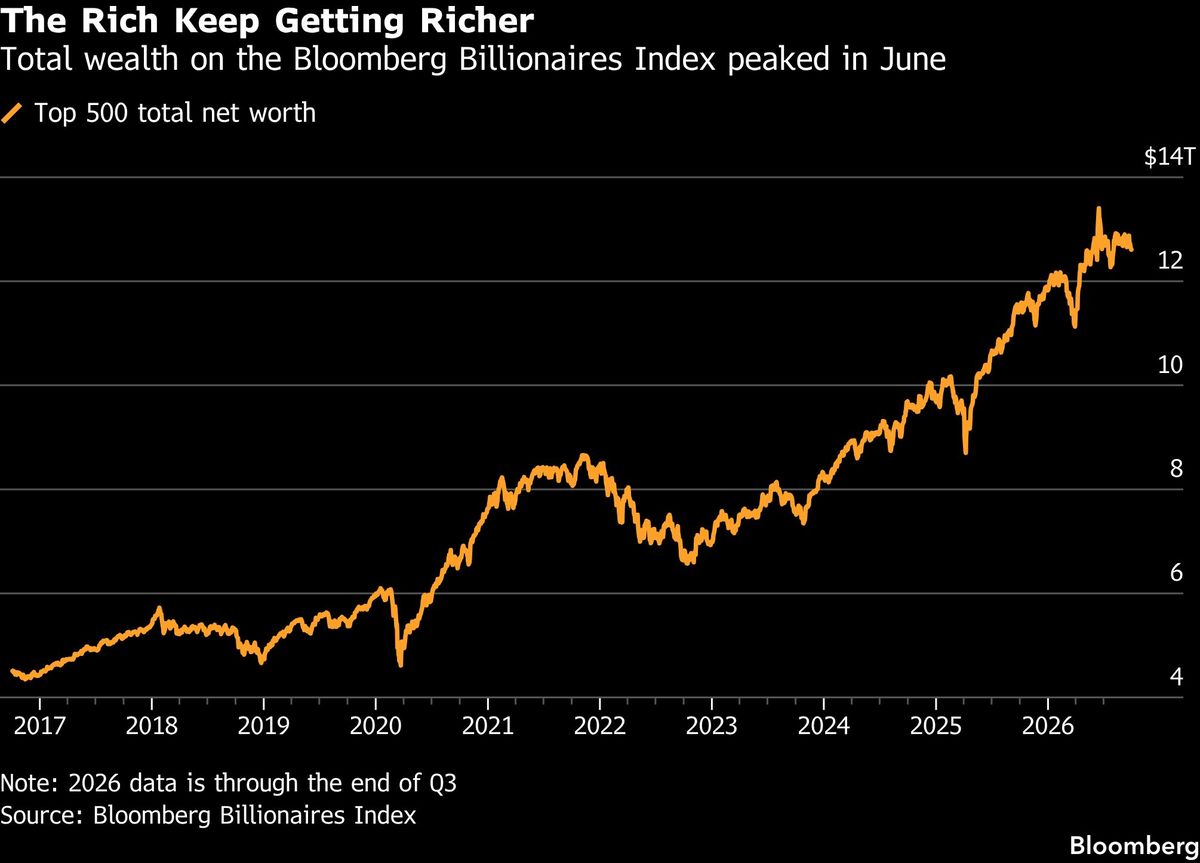
The world’s 500 richest people hit a peak of US$13.4 trillion in combined wealth in mid-June. That’s since fallen 6% to US$12.6 trillion amid a broader market slowdown and growing doubts about some of the biggest AI names.
The historic debt binge fuelling Big Tech’s AI ambitions is making some investors uneasy. Larry Ellison briefly became the world’s richest person in September 2025, gaining US$89 billion in a single day after Oracle Corp touted explosive growth in its AI-linked cloud infrastructure business.
A year later, Ellison’s net worth has fallen US$196 billion, while Oracle’s credit-default swaps are trading near record highs as investors balk at the massive borrowing needed to fund its AI infrastructure buildout.
The surge in billionaire wealth has also fuelled calls for higher taxes on the ultra-rich. California voters will decide in November whether to levy a wealth tax on the state’s billionaires, while states including Washington, New York, Illinois and Rhode Island have also discussed new taxes on wealthy residents.
The increasingly young, tech-heavy ranks of the ultra-rich also complicate the idea that the next great wealth shift will come primarily from ageing baby boomers passing fortunes to their heirs.
“We talk a lot about the great wealth transfer — but for the top 100 or 1,000 richest, some may be old and own rather traditional businesses, but a lot of them are young tech entrepreneurs,” said James Mazeau, an economist at UBS Group AG’s chief investment office. “I wonder to what extent that will fuel more wealth concentration.”
New money
While much of the AI boom’s wealth has accrued to the leaders of major tech firms, Bloomberg’s new entrants show how the surge is also minting fortunes among startup founders and the companies supplying AI infrastructure.
All seven of Anthropic PBC’s co-founders joined the wealth list in June after the AI firm closed a funding round valuing it at US$965 billion. Founders of Chinese firms including MiniMax Group Inc’s Yan Junjie and DeepSeek’s Liang Wenfeng also were added.
The boom has also enriched the businesses supplying AI’s hardware and infrastructure.
Lin Tsung-chi, founder of King Slide, a Taiwanese maker of server rails and cable management systems for data centres, emerged with a US$9.5 billion fortune this year, four decades after starting the company. Wang Xin, chair of Guangdong Dtech Technology Co, joined the wealth index as AI created demand for the specialised drill bits her company makes to assemble circuit boards.
Two heirs of Samsung Electronics Co’s Lee family — Boo-jin and Seo-hyun — also joined the list thanks to demand for the company’s memory chips. The uptick in Samsung’s stock price helped the family pay back an US$8 billion inheritance tax after former chairman Lee Kun-hee’s death in 2020. In Taiwan, chip designer MediaTek Inc’s Tsai Ming-kai and Morris Chang, founder of Taiwan Semiconductor Manufacturing Co, also joined the exclusive list this year.
China’s push for technology independence and rivalry with the US for AI dominance have resulted in several new entrants joining the list: Suzhou TFC Optical Communication Co’s Zou Zhinong and family, as well as Suzhou Dongshan Precision Manufacturing Co’s Yuan Fugen.
Uploaded by Felyx Teoh