

This article first appeared in The Edge Malaysia Weekly on October 5, 2026 - October 11, 2026

THE Melaka state election is quickly morphing into a confusing affair, with the key political players engaged in intense negotiations as each side publicly signals that alternative alignments remain on the table.
The situation is markedly different from just weeks ago, when political leaders appeared to have clearer strategies heading into the polling season. Neither Pakatan Harapan (PH), Barisan Nasional (BN), Perikatan Nasional (PN) nor PN breakaway faction Parti Pribumi Bersatu Malaysia (Bersatu) has committed to a firm collaboration, even as it becomes increasingly apparent that none is confident of winning Melaka alone.
Seat negotiations remain the biggest sticking point, putting the BN-PN formula that had worked in the Johor and Negeri Sembilan polls in July and August respectively to test at a time when the balance of power is not one-sided.
A rejuvenated BN is reportedly seeking to negotiate only with PAS, effectively snubbing fellow PN component Wawasan, while pushing to contest at least 21 of the 28 state seats despite its weaker showing in the 15th general election (GE15) in 2022.
PAS, the dominant party in PN, indicated its intention to contest up to 10 seats, whereas Parti Wawasan Negara (Wawasan) — said to be the one that previously helped keep PAS and Umno in the same room — is eyeing at least five seats.
Talks between the two blocs appear to have been difficult enough for the possibility of BN or PN going solo to surface occasionally, unlike during the Negeri Sembilan or even Johor polls. However, analysts say that remains unlikely. “There is no clarity as to where the BN-PN negotiations will end up,” says a PN insider.
Nonetheless, sources familiar with Umno politics say the “green wave” — the surge in support for PAS and the wider PN coalition among Malay voters — remains a force in the Malay heartland, giving BN an incentive to recreate some form of tafahum siyasi, or political understanding, and tap the Malay-Muslim unity formula that helped deliver the landslide victory in Negeri Sembilan.
On the other side, top leaders of PH and Bersatu — the party at the centre of the Sheraton Move — are reportedly still exploring a partnership even as state leaders sent mixed signals.
At the same time, PH election director Datuk Seri Amirudin Shari of Parti Keadilan Rakyat (PKR) reportedly has not discounted BN as a partner going into the polls, while Umno secretary-general Asyraf Wajdi Dusuki has also said BN’s door “remains open” and that no alliance has been formalised.
Who has the upper hand — BN or PN?
On the surface, the ethnic- and identity-based campaign narrative associated with BN and PN in recent elections could be particularly potent in Melaka, where 23 of the 28 state seats are Malay-majority.
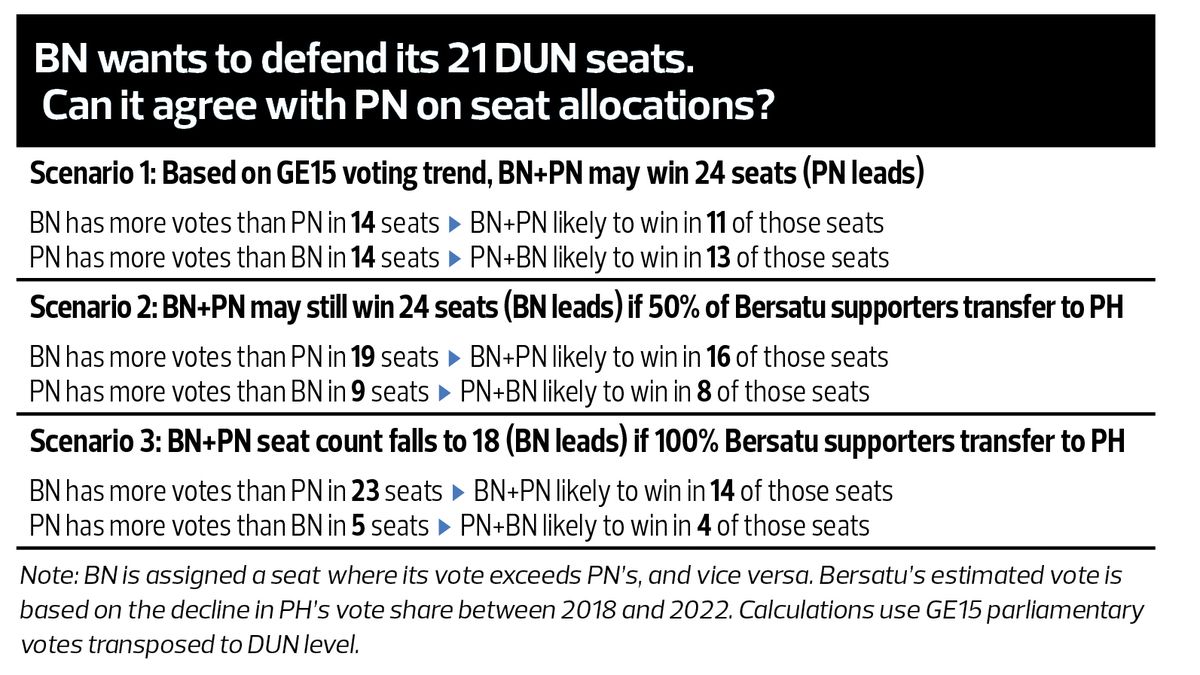
Caretaker Chief Minister Datuk Seri Ab Rauf Yusoh, who is also Melaka BN chairman, has described the coalition’s existing 21 seats as its “boundary” in negotiations, effectively leaving only seven seats up for discussion.

BN has also been campaigning hard.
Duyong assemblyman Datuk Mohd Noor Helmy Abdul Halem is among the more visible Umno leaders, maintaining an active social media presence centred on constituency work. Melaka is also home turf for Umno Youth chief Datuk Dr Muhamad Akmal Saleh, whose political appeal is geared strongly towards the party’s hardcore Malay base.
But as BN points to its 2021 landslide as its baseline, critics point to the unusual circumstances surrounding that particular state election.
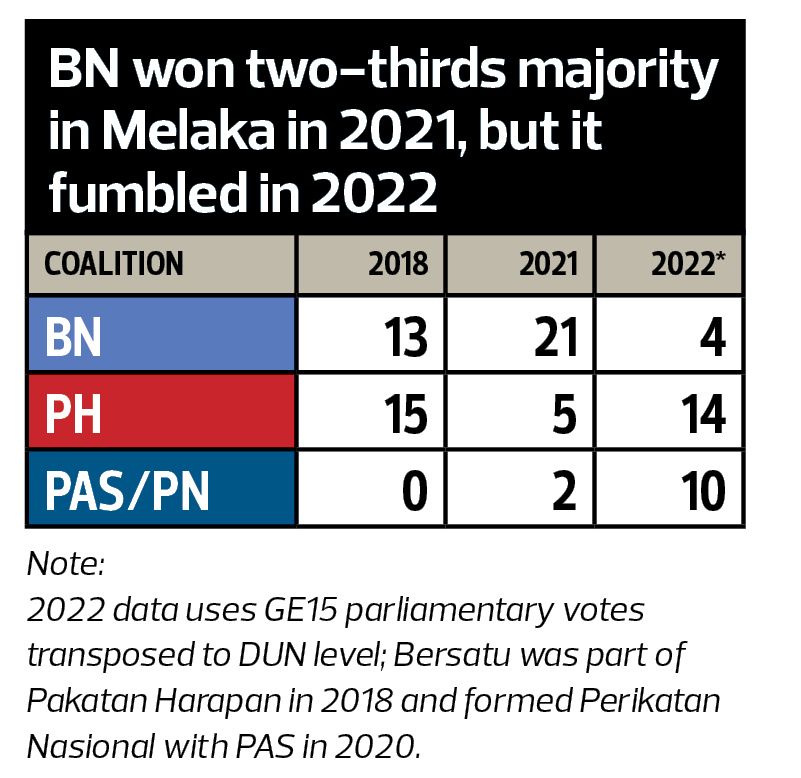
Turnout during the pandemic-era polls was below 66%, which critics say favoured BN because many opposition voters were living outside the state. Ten of the 21 seats BN won were secured with a majority of fewer than 1,000 votes. Just a year later, when turnout exceeded 80% in GE15, BN failed to win any of Melaka’s six parliamentary seats. An analysis of GE15 voting patterns transposed onto state constituencies shows BN leading in only four seats, against 10 for PN and 14 for PH.
That gives PN some leverage, but the coalition has problems of its own. PN has been suspended by the Registrar of Societies from conducting activities using the coalition logo amid the internal rift between PAS and Bersatu. That could force PAS to contest under its own banner, effectively retesting its Islamist branding on the west coast for the first time in seven years.
PAS’ relatively limited organisational footprint in Melaka has been obvious in past elections. It contested only eight state seats in 2021, against Bersatu’s 15 and Gerakan’s five. During GE15, PAS contested two parliamentary seats in Melaka, Bersatu three and Gerakan one.
Complicating matters further, PAS’ sole assemblyman before dissolution was originally elected on a BN ticket, before crossing over in 2023, following BN’s weak GE15 showing.
For PN, the challenge of holding on to Bersatu’s former support base rests increasingly with Wawasan. The splinter party “may no longer get a free ride”, says a political analyst, unlike in Negeri Sembilan, where it relied heavily on PAS’ machinery to win three of the four seats it contested.
Wawasan is keen to defend Bemban and Sungai Udang, which Bersatu won under the PN banner before its assemblymen declared support for Datuk Seri Hamzah Zainuddin, who was subsequently sacked from Bersatu and now heads Wawasan. It is also said to be eyeing seats under the Masjid Tanah parliamentary constituency, where MP Datuk Mas Ermieyati Samsudin — a Wawasan sympathiser — remains in Bersatu but is suspended.
Mas Ermieyati, a three-term Masjid Tanah MP, retains significant grassroots support. In the 2021 state election, she lost Tanjung Bidara to Ab Rauf by a margin of just 5%.
For PH, Melaka gauges its support floor
PH is not wasting its crisis with BN. While exploring other collaborations, Melaka will provide another test of its support after a series of recent developments that PH hopes could slow the surging “blue wave”, or renewed electoral support for BN, particularly Umno.
“Things are looking much better compared with a few months ago,” says a source familiar with the workings within PH.
Aside from the uncertainty engulfing the BN-PN camp, the PH-led federal government has rolled out a series of voter-friendly measures, including a larger quota for fuel subsidy, wider e-invoicing exemptions, expanded discounts on electricity bills and a commitment to temporarily exempt small businesses from potential increases to the minimum wage.
The state election will be held after the tabling of Budget 2027 on Oct 9, providing Prime Minister Datuk Seri Anwar Ibrahim, who is also PH chairman, with another national platform before campaigning intensifies.
Bersatu, for its part, would face an uphill battle without a partner, looking at how the party was wiped out in the Johor and Negeri Sembilan polls.
Secretary-general Datuk Seri Mohamed Azmin Ali has said Bersatu is prepared to contest alone in Melaka. But in Selangor, he has publicly cosied up with PKR’s Amirudin and DAP Selangor vice-chairman Datuk Ng Suee Lim.
Even so, the numbers show the limits of a PH-Bersatu tie-up. The Edge’s analysis of GE15 voting patterns suggests their combined votes would put them ahead in, at most, 10 state seats — still short of the 15 needed for a simple majority.
That is nevertheless considerably better than the four seats PH could lead in if it were to contest alone against a consolidated BN-PN front. PH currently holds just five Melaka seats — four held by DAP and one by Parti Amanah Negara (Amanah).
The elephant in the room is whether vote transferability will be smooth, considering many PH supporters will remember how the coalition was ousted from Putrajaya after Bersatu’s exit in 2020.
The state polls will also be the first election following the announcement of a conditional pardon allowing convicted former prime minister Datuk Seri Najib Razak to serve the remainder of his reduced six-year sentence under house arrest, which requires him to pay a RM50 million fine before it takes effect.
Najib’s continued influence among sections of Umno’s grassroots could energise BN supporters. But the development poses a more complicated question for DAP.
DAP has been among Najib’s most vocal critics over the multibillion-ringgit 1Malaysia Development Bhd (1MDB) scandal and has faced criticism over the Federal Territories Pardons Board’s decision to allow the former prime minister to serve the remainder of his sentence under house arrest. DAP secretary-general Anthony Loke subsequently said he would step down as transport minister, although his resignation would take effect only on the day Najib returns home.
How Melaka’s Chinese voters respond to Najib’s conditional pardon — and to Loke’s conditional resignation pledge — will therefore be closely watched by DAP as a measure of its core support.
DAP holds the predominantly Chinese seats of Kota Laksamana, Kesidang and Bandar Hilir. It is also the four-term incumbent in the mixed seat of Ayer Keroh, where Chinese voters make up 47.6% of the electorate, followed by Malays at 42.4% and Indians at 8.3%.
That makes Ayer Keroh a seat to watch if the Malay-Muslim unity narrative continues to gain traction. DAP’s winning margin here reached 42.4% in 2018 before narrowing to 35.7% in the 2021 state election.
Another seat where PH could face a tougher defence is Bukit Katil, held by PH Melaka chief and Deputy Minister of Defence Adly Zahari. Adly won with a 6.5% majority in 2021, down from 14.7% in 2018, and remains Amanah’s sole assemblyman in the state.
Bukit Katil is also expected to be on PAS’ radar, given its sizeable Malay electorate and the party’s history there. The party captured the seat in 2013 — its first victory in the Melaka state assembly — marking an important breakthrough for the party.
This election will also see Parti Bersama Malaysia (Bersama) throwing its hat into the ring, with up to 15 candidates, after sitting out the Negeri Sembilan polls, following its wipeout in the Johor state election.
Despite losing its deposits in all 15 seats contested in Johor, Bersama drew enough votes from PH in some constituencies to potentially contribute to the coalition’s losing two seats to BN. The party, led by former PKR deputy president Datuk Seri Rafizi Ramli, skipped the Negeri Sembilan state election as it sought a longer runway to prepare for Melaka and subsequent contests.
Other moving parts
At the recent Negeri Sembilan polls, the 73% turnout suggests that BN remains particularly well placed when participation falls below levels seen in general elections.
Against this backdrop, will PAS compromise its relationship with Wawasan to accommodate BN? The Wawasan name itself was supposedly suggested to Hamzah by PAS president Tan Sri Abdul Hadi Awang.
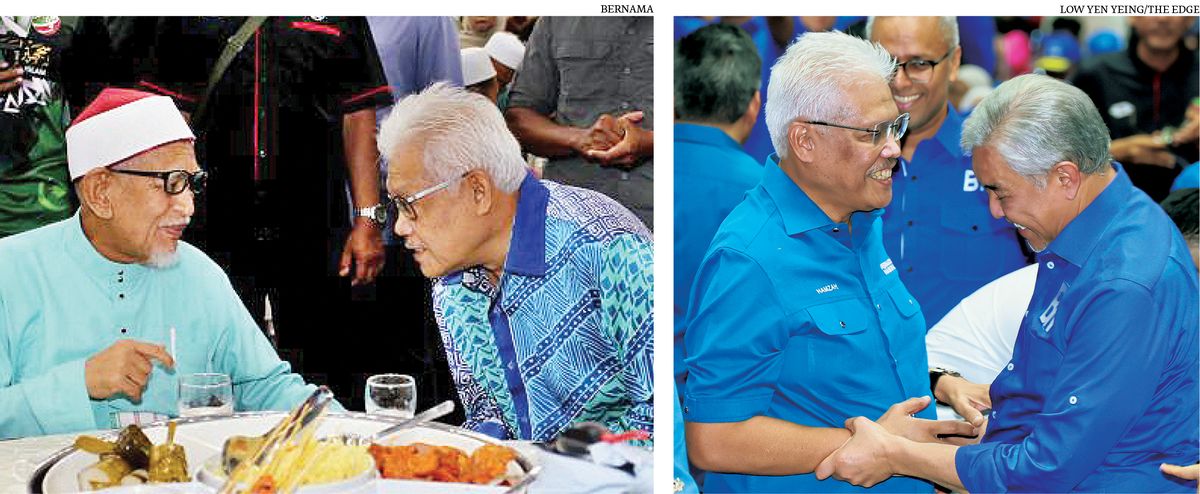
PAS and Umno have maintained channels of communication over possible cooperation, but Hamzah — himself a long-time Umno operator — is said to have played an important role in keeping the two largest Malay parties in the same room.
As Umno signals, however, that there is not enough room for Wawasan, somebody will eventually have to blink.
Hanging over all this is the ongoing crisis in Negeri Sembilan. The newly formed BN-led state government, following the September election, backed the proclamation supporting the removal of Tuanku Muhriz Tuanku Munawir as Yang Dipertuan Besar.
BN has since faced accusations and perceptions of derhaka, or disloyalty to the ruler — a particularly sensitive charge, given the importance of the royal institution in Malay politics.
Umno has sought to distance itself from that label, arguing that the party itself did not remove the ruler. But if the dispute remains unresolved as campaigning intensifies, its rivals will have ample opportunity to use it as another line of attack — adding one more complication to an election already defined less by fixed alliances than by parties trying to preserve as many options as possible.
Read also: Save by subscribing to us for
your print and/or
digital copy. P/S: The Edge is also available on
Apple's App Store and
Android's Google Play.
MELAKA: ELECTION WAR DRUMS BEATING | Melaka: The next test of shifting political alliances