

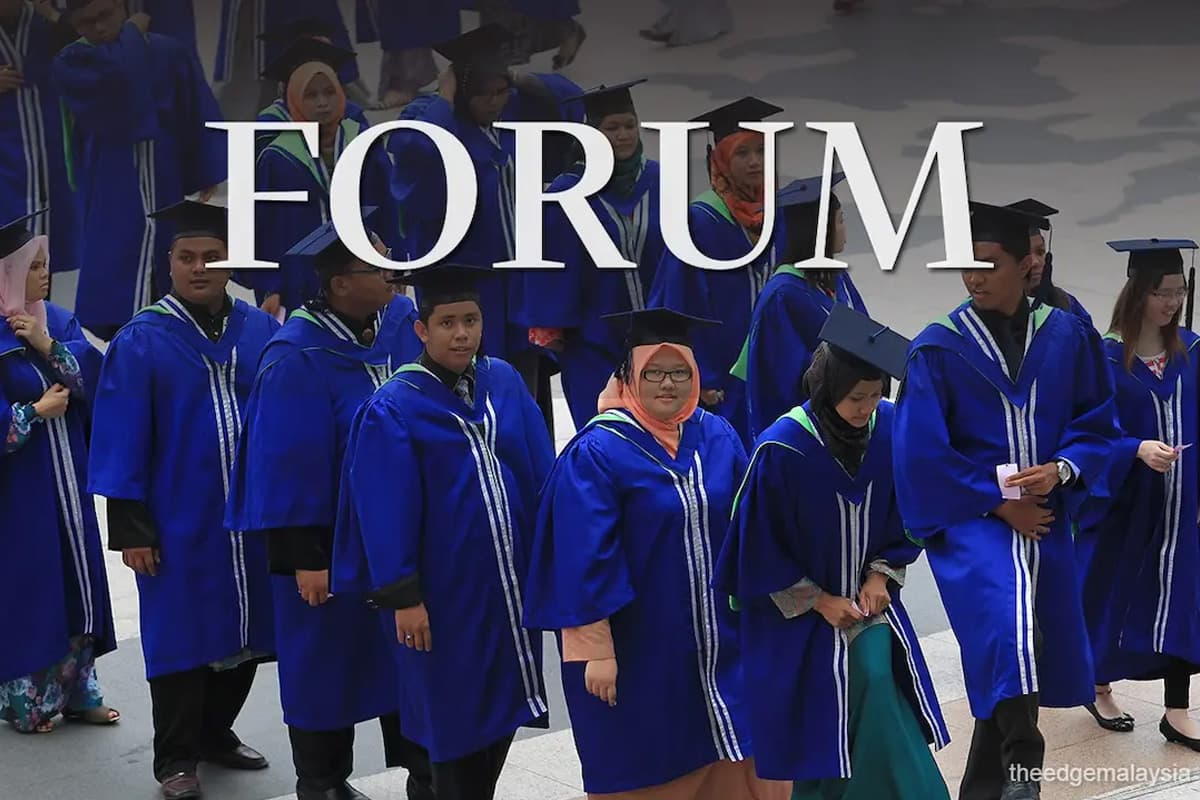
This article first appeared in Forum, The Edge Malaysia Weekly on October 5, 2026 - October 11, 2026
When you are in your 60s, a visit to the physio is almost a must. The neck and shoulders stiffen, and so do the glutes. To relieve the nagging pain and loosen the tight muscles, I go to Your Physio in SS15, Subang Jaya.
My regular physio is Akil, and I like him because he explains what is wrong in words I understand, works on the strained muscle according to what I tell him, and gives me exercises simple enough to actually do.
A good physio often draws customers into conversation, too. Akil isn’t keen on politics, but he knows I am a journalist, so he asked me: Why is local politics so divisive, and are the things said by people on social media true? He, too, does not like the toxic comments that follow.
That is the nature of politics everywhere, I said, it pits one against another. In Malaysia, the divisiveness, I added, became obvious when the current prime minister, Datuk Seri Anwar Ibrahim, was sacked from Umno, then the dominant Malay party. The Reformasi movement was born, street protests followed, Umno split into factions and new parties, lost Malay support, and eventually lost power.
“I didn’t know about this,” Akil said. “When did it start?”
“1998.”
“Hmm. I was born in 1999.”
That stopped me. Akil is 27 and will be 28 if the general election is held next year. For him, the Reformasi movement isn’t a memory but a history lesson. And for everyone his age and younger, and also those below 40, the fight that reshaped Malaysian politics happened before they could vote, before they could care about politics and, for some, before they were even born.
Many could not care less if Reformasi is dead and has become “reformati” to its critics. They want help to cope with the problem of low salaries and the high cost of living before institutional reforms would matter.
I asked Akil, who is a sports science graduate from Universiti Teknologi Mara (UiTM), what the main concerns of his friends and his generation are.
“Bread-and-butter issues, the high cost of living, and low graduate salaries,” he replied.
“I have some graduate friends who still earn below RM2,000 a month, and many whose salaries are below RM2,500. If you are a local, maybe that is enough, as you can save on rent and food if you are living with your parents.
“But, for those who are from other states and work in the Klang Valley, that amount is barely enough. Many have to do two jobs. The permanent job will cover utility bills, food, transportation and study loans, while allowing them to give some money to their parents.
The second job, be it freelancing or e-hailing work, is for us to spend on entertainment, recreation and new clothes.”
A low starting salary relative to the high cost of living also means that, for many new graduates, saving — beyond compulsory deductions such as contributions to the Employees Provident Fund (EPF) — is out of the question.
A case of two interns
I recently spoke with two students from local universities who, after completing their internships, were offered jobs by their respective employers.
The companies must have been impressed by their work and discipline to offer them jobs even before their final year ended and their convocation took place in November and December respectively. One declined, but the other accepted the offer.
The intern who declined was a science graduate majoring in materials science, a field that studies how materials are made and behave, and how their properties can be modified to make them stronger, lighter or more useful.
At some universities, materials science is a field under the engineering faculty. His internship stint was in the oil and gas sector.
The basic starting salary offered was RM2,300, which he said did not match the workload and his qualifications. He preferred to take a short break, wait for convocation day, and look for a better-paying job. I, too, consider the starting salary in such a specialised field too low.
The other one, a computer science graduate majoring in artificial intelligence, had done an internship at a European automotive company. Upon completion of the internship, a six-month contract at the same company was offered through a human resource (HR) company.
The scope of work is similar to that of the internship, involving the monitoring of front- and back-end database services for the company’s overseas branches.
The intern accepted the job with the HR company because it allows for continuation of work that will provide good experience that can be highlighted later. With a starting salary of slightly more than RM5,000, it is an offer that one simply cannot refuse.
Still, such an offer is not the norm, and many fresh graduates continue to struggle with low-paying starting salaries. This puts many of those who have invested much time and money in education into the B40 low-income category.
Two similar questions about low graduate salaries were also raised by a student and a retired lecturer with Anwar when he attended a gathering of alumni from my alma mater, UiTM, in Shah Alam on Sept 26.
I was there, too. The student’s question centred on his concerns about whether his generation would have access to the right job opportunities, face underemployment — working in jobs that do not utilise their skills and education — and receive starting salaries that match their qualifications and today’s cost of living.
The retired lecturer, who has experience in the media and advertising world in the private sector, was equally concerned about low salaries, reminding the audience and the prime minister that the entry-level salary for a fresh graduate has not improved much since the late 1980s.
I recall a friend telling me that her daughter’s starting salary as an architecture graduate with first-class honours was only RM1,500 some years ago. Today, there are still reports of fresh engineering graduates being offered starting salaries below RM2,000.
This should not be the case in the Klang Valley or anywhere in Malaysia.
Return on investment matters to graduates, too
The low-salary conundrum faced by graduates, and non-graduates for that matter, is often accompanied by employers’ argument that salaries must reflect experience and productivity. For many fresh graduates, experience normally comes from on-the-job training, and I believe that higher productivity will follow suit if employers pay better wages.
I have read reports that around 35% of fresh graduate engineers earn a starting salary of less than RM2,000. If this is true, their return on investment, based on the money and time spent to complete a difficult course, is simply not justifiable. The same goes for the starting salary of doctors in public healthcare.
On average, Malaysia has long struggled with a low-wage structure. This is mainly because of past policies that positioned the nation as a low-cost producer for investors, capital owners and companies.
The reliance on foreign workers, including illegal ones, added to the low-wage trap, where companies had the option not to pay local workers better salaries. This, in turn, allowed them to delay upgrading and automating their operations.
If compensation of employees (COE) is used as a salary benchmark relative to economic growth, its share of gross domestic product (GDP) has shrunk over the past decade, from 35.6% in 2016 to 33.9% in 2025, according to government statistics.
By comparison, the gross operating surplus (GOS) of businesses — broadly representing income accruing to businesses and owners of capital from production — rose from 59.3% of GDP to 62% over the same period.
The numbers raise an uncomfortable question: As the economy expands, is a sufficient share of that growth reaching workers through salaries and remuneration, or will capital owners continue to benefit more?
What now?
The government has set a target for COE to reach 40% of GDP by 2030, while the 13th Malaysia Plan (2026-2030) also places greater emphasis on raising wages, creating more high-paying jobs, and improving the quality of employment.
For its part, the government has gradually increased the minimum wage from RM900 in 2013 to RM1,200 in 2020, and RM1,500 in 2022. This was further raised to RM1,700 in 2025. As for government-linked and investment companies, a living wage commitment of RM3,100 has been adopted, reflecting a benchmark for a decent standard of living.
For other workers, including those in the private sector, the hope is that the government will announce a further increase in the minimum wage when the 2027 Budget is presented on Oct 9.
A new rate of RM2,000 has been mooted, with some suggesting RM2,100 or RM2,200. Whatever the rate, however, micro, small and medium enterprises (MSMEs) are likely to be exempt from the increase for now.
And if there is to be a minimum wage for general workers, should there be one for graduates, too?
The retired lecturer who asked the prime minister the question at the alumni gathering told me RM3,800 is a justifiable rate, given today’s cost of living.
If announced in the Budget, the new minimum wage will trigger a familiar debate: Companies need time to adjust to higher operational costs. Any increase in the baseline salary for graduates should also be linked to experience and productivity. Companies will need incentives to encourage them to invest in automation, training and technology that will help them improve their productivity and profits.
For the government, a coordinated policy of reducing foreign workers and promoting higher value-added industries that will hire for well-paid jobs must continue unabated.
But these changes take time.
In the meantime, the quest for higher salaries for fresh graduates can start with the country’s most profitable companies. The 100 most profitable companies on Bursa Malaysia should take the lead.
Other profitable companies, including privately owned MSMEs, should be kinder to their staff as well, by taking less remuneration for themselves.
I believe that in the long term, fairer compensation for staff will almost always result in higher productivity and profits for capital owners. The question is whether those who can afford to pay more will take the lead.
Azam Aris is an editor emeritus at The Edge
Save by subscribing to us for your print and/or digital copy.
P/S: The Edge is also available on Apple's App Store and Android's Google Play.