

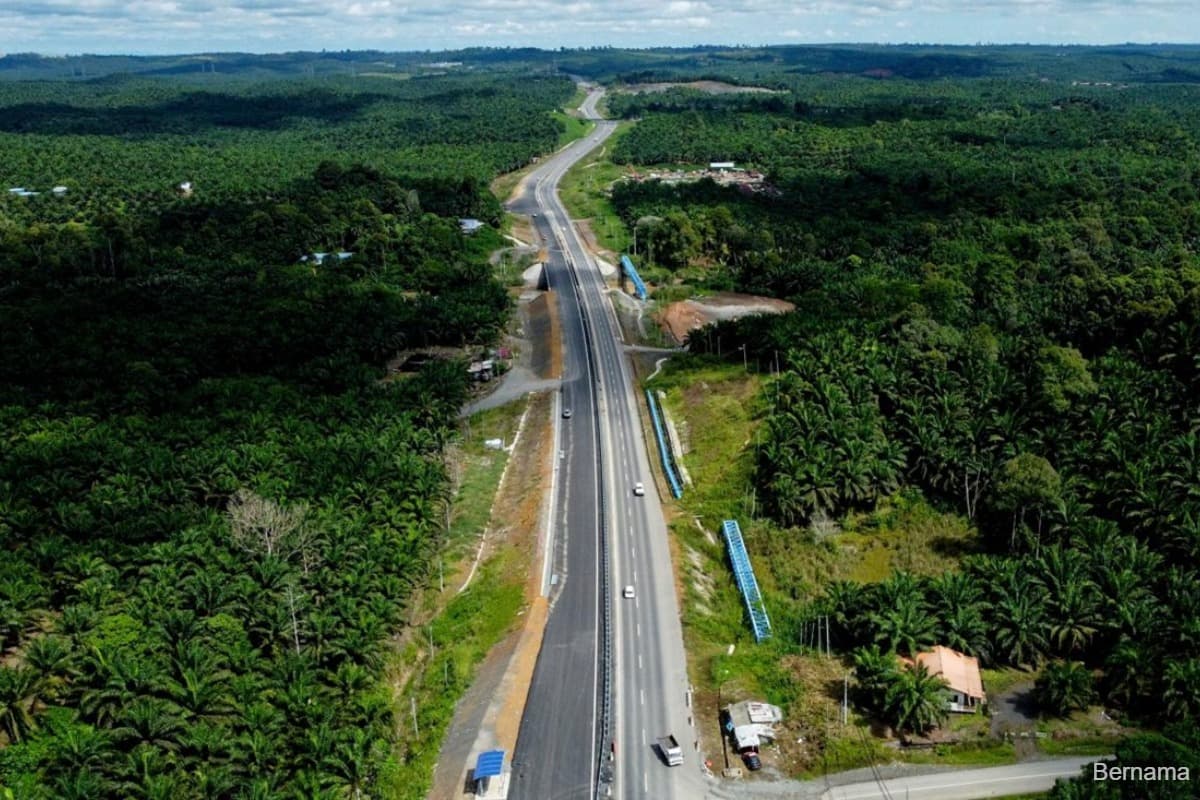
KUALA LUMPUR (Oct 5): The first phase of Pan Borneo Highway Sabah’s (LPB Sabah Project Phase 1) project costs increased by RM1.05 billion, or 6%, as the project remains incomplete after a decade, according to the Auditor General's report released on Monday.
The report cited the main factor behind the cost overrun was due to Phase 1a, which saw costs increased to RM11.323 billion, RM987 million or 9.5% higher compared to the original project cost of RM10.336 billion.
"Due to the cost increase, the project could not be fully completed and forced the government to provide additional allocations beyond the original allocation," it said.
The Pan Borneo Highway Sabah Project is an initiative of the cooperative government to improve the road infrastructure network in the state of Sabah, with the implementation concept outlined by the minister of works on Oct 23, 2015.
The project covers 35 work packages spanning a total road length of 706km. The main objective of the project is to "enhance connectivity and access, especially for rural communities in Sabah", according to the report.
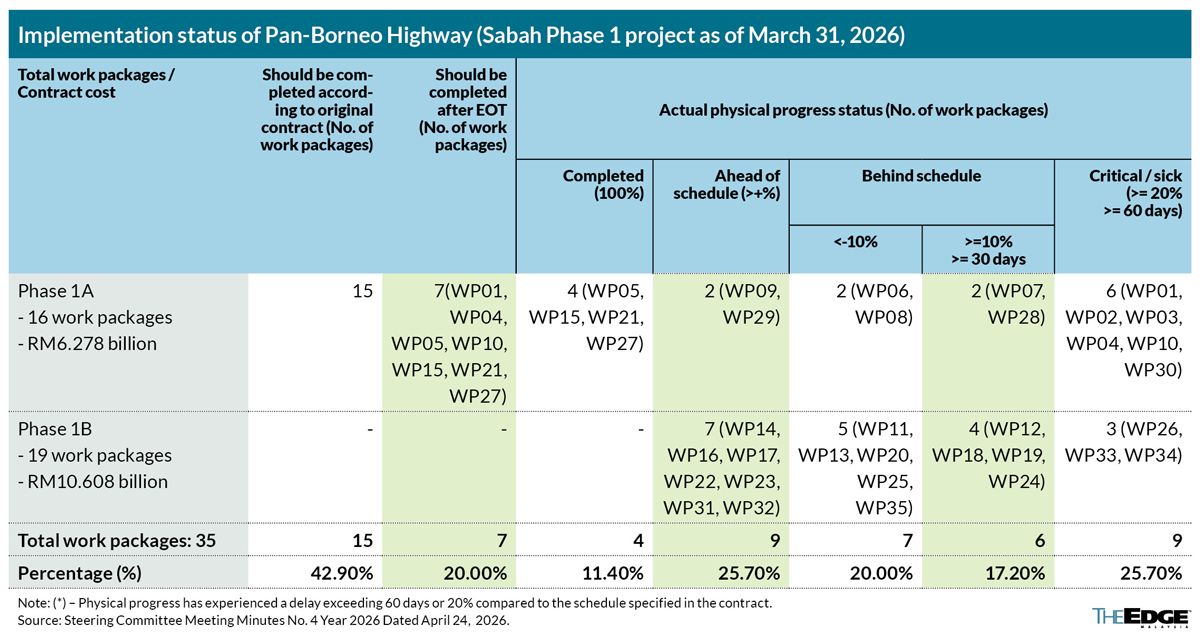
However, the overall project — originally scheduled for completion between April 2016 and December 2021 — remains incomplete as of March 31, 2026, despite a management transition from a Project Delivery Partner (PDP) model to the Ministry of Works (KKR) in September 2019.
Only four work packages, totalling RM567 million in original costs, have been fully completed while the remaining 31 work packages (88.6%), valued at RM16.319 billion, are still in progress. Of those, nine packages are classified as "sick" projects with delays exceeding 20% or 60 days, 13 are behind schedule and nine are ahead of schedule.
The delay in full project completion has pushed total overall contract projections for Phase 1 from RM17.91 billion to RM18.96 billion.
The Auditor General highlighted "weaknesses in planning, site readiness and contract management" as the primary root causes behind the project's massive delays and cost growth.
"The failure to clear and prepare project sites prior to the issuance of the Order to Commence Work led to recurring delays in physical construction," the report noted, pointing to slow compensation processes, valuation delays by the Sabah Lands and Surveys Department (JTU), and un-demolished structures along the highway alignment.
Furthermore, weak contract administration led to financial governance lapses, including "RM513.99 million in Variation Orders (APK) approved beyond authorised limits, RM41.37 million in delayed utility cost claims and RM6.03 million in leakages involving Construction Industry Development Board (CIDB) levy payments".
To ensure smooth implementation moving forward, the audit recommended that KKR and the Sabah Public Works Department (JKR Sabah) "establish proactive operational controls and clear execution timelines" to resolve land acquisition bottlenecks and ensure site readiness before handing work over to contractors.
Additionally, the report emphasised that the authorities must "enforce strict contract governance and enhanced oversight of contractors and consultants" by closely monitoring performance parameters and taking prompt remedial action against non-performing work packages.
Separately, the Pan Borneo Highway Sarawak (LPB Sarawak) project, which spans 786.41km across 11 work packages (WP), had achieved 100% completion in 10 out of its 11 work packages as of March 31, 2026.
The sole remaining package, WP11 involving Section Lambir in Miri, stood at 99.9% completion. The completion date for Section Lambir has been pushed to Dec 31, 2028, following an Extension of Time (EOT) granted on July 27, 2026, after two major main water pipe bursts disrupted work along a 4.2km stretch.
However, the report flagged compliance and governance deficiencies in contract management, notably the failure by the Ministry of Works (KKR) and JKR Sarawak to reclaim RM1.780 billion in utility relocation and re-installation costs from four utility companies.
Click here for more news on AG's Report 2026.