

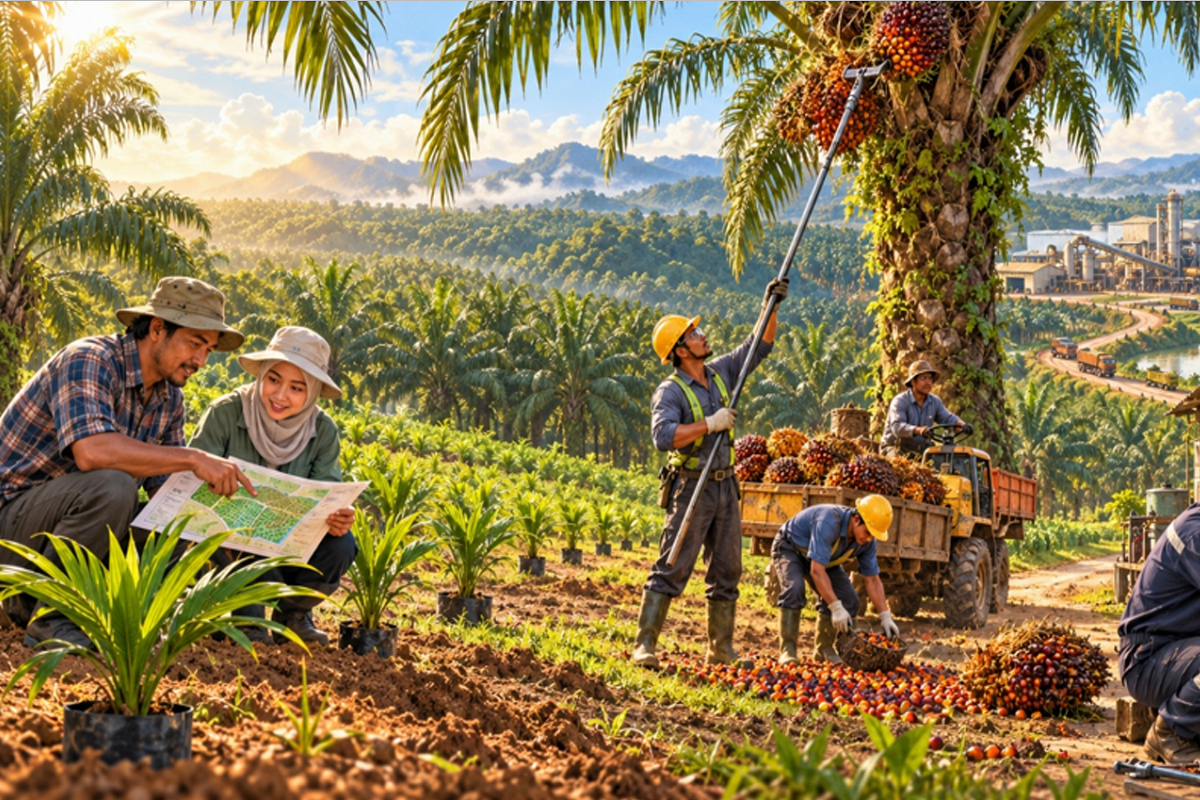
The prime minister’s pre-Budget 2027 remarks have put practical support for smallholders and agro-commodity businesses in the spotlight. The government is considering RM425.65 million for agro-commodity initiatives, including RM280.03 million for oil palm smallholder replanting, RM100 million for farm roads, RM28.57 million for disaster and disease control, and RM17.05 million for downstream agro-commodity entrepreneurs. These are proposals under consideration, not confirmed Budget allocations.
Having spent years in plantation-specific advocacy, I have learned that support works best when it reflects conditions on the ground. This personal opinion draws on a desktop review of Malaysia’s budgets from 2017 to 2026, with a focus on the upstream oil palm sector across about 5.7 million hectares and involving some 450,000 smallholders. Its nurseries, estates and mills form the beginning of a much wider supply chain.
Oil palm runs on two clocks. The perennial crop, planted mainly in rural areas, takes years to establish and bear fruit; no policy announcement can hurry it. But each ripe bunch has a shorter deadline: harvest and transport it to the mill promptly, or lose the crop after the fertiliser, labour and care have already been invested.
The question for Budget 2027 is how support can do more to encourage reinvestment and raise yields on land already planted.
Replanting needs continuity
The form of replanting assistance has changed over the past decade, but the underlying concern has remained. Budget 2017 provided a RM30 million grant for smallholder replanting. Budget 2018 included RM60 million for oil palm replanting. Budget 2020 introduced a RM550 million collateral-free loan fund for smallholders at two % interest, with a 12-year tenure and a four-year repayment moratorium. More recent assistance includes the Smallholder Oil Palm Replanting Financing Incentive Scheme, or TSPKS 2.0, which combines a 50% grant with 50% soft financing.
The need remains clear. Malaysia replanted about 114,000 hectares in 2024, roughly 2% of its planted area. The rate rose to 3.4% in 2025, according to the Plantation and Commodities Minister in Parliament, but remains below the four to 5% annual benchmark often cited for maintaining a healthier age profile.
Replanting is not a one-year expense. The old stand must be removed, new palms established and maintained, and growers must manage the immature period, when a replanted block produces little or no oil palm income. Good replanting to maturity can cost up to RM30,000 per hectare or more, depending on site conditions and method. For a smallholder who relies on oil palm for household income, the gap can be difficult to bridge. For a plantation company, renewal also affects cash flow, labour deployment and the volume of fruit available to mills.
The proposed RM280.03 million for TSPKS 2.0 and RM100 million for smallholder farm roads are important measures to consider. Roads determine whether fresh fruit bunches can reach mills efficiently; replanting support helps ensure there will be a future crop to move. The next questions are practical: how many growers and hectares can the schemes reach, how easy is it to apply, and does the assistance cover the full transition?
Support could cover clearing, quality planting material, establishment, maintenance and agronomic advice. Where smallholders lack equipment or capacity, cooperatives or qualified local contractors could organise the work. Eligibility should reflect palm condition as well as age. Disease, low stand density, declining yields or excessive height that makes harvesting uneconomic may justify earlier replanting.
GPS/GIS tools and satellite imagery can help identify priority blocks, with field assessment to verify what the images show. Renewal can then be planned block by block and coordinated with mill catchments, allowing growers to manage temporary supply losses and mills to adjust to changing volumes. Technology can help direct the work; sound analysis, project management and cooperation among growers, mills and agencies must carry it through.
The familiar advice to teach someone to fish has its place, but a family cannot eat the lesson while its palms mature. Smallholder support should build lasting capability through extension, training, quality inputs and reliable replanting services. Yet growers facing years with little income may need bridge financing too. Well-targeted grants and accessible loans can build capability while renewing the crop.
Make reinvestment count
I have long argued that oil palm replanting should qualify for a tax incentive. One important clarification is that oil palm cultivation is excluded from the standard Reinvestment Allowance under current rules. The Inland Revenue Board’s 2022 Public Ruling states that cultivation of oil palm is not eligible. Budget 2027 could consider amending the framework or introducing a specific replanting allowance, with full utilisation against a plantation company’s statutory income.
Replanting is often treated as a heavy cost at the end of a crop cycle. It should also be recognised as an investment in productivity, future supply and future tax revenue. An allowance would mainly benefit companies with taxable income to offset. Smallholders with little or no taxable income would still need grants and accessible financing. These measures can complement one another.
The windfall profit levy is another issue the sector has asked the Government to review. It is imposed on oil palm fruit when market prices exceed specified thresholds. A price trigger does not necessarily reflect each grower’s costs, yields, regional conditions or actual returns. A high crude palm oil price does not mean every grower earns an extraordinary profit; palm age, productivity, operating costs and terrain all influence the result.
The latest Malaysian Estate Owners’ Association (MEOA) estimates strengthen the case for examining the tax picture. Its projected 2025 tabulation estimates RM13.29 billion in contributions from corporate income tax, the windfall profit levy, MPOB cess and state sales taxes in Sabah and Sarawak. Corporate income tax alone is estimated at RM8.76 billion. The tabulation excludes crude palm oil export duties, estimated separately at more than RM1.26 billion. MEOA estimates taxes at about 26.1% of business profit in Peninsular Malaysia, 40% in Sabah and 38.7% in Sarawak. These are association estimates, not audited collections or statutory tax rates, and should be read as such.
The regional variation is still a policy question worth examining. It reflects, in part, the additional state sales tax layer in East Malaysia, where growers also face their own production costs and operating conditions. State revenue autonomy matters. So does national competitiveness. Both should be considered when assessing the effect of the overall fiscal framework on reinvestment.
Could budget reporting show the amount collected through the levy and identify public investment in the sector’s longer-term needs, particularly replanting, productivity and sustainability? Levy receipts enter the Federal Consolidated Fund, where public revenue is pooled. A parliamentary reply reported that RM6.12 billion in windfall tax from the palm oil industry was collected between 1999 and 2023, with RM5.84 billion allocated to cooking-oil subsidies during that period.
The suggestion is not to trace every ringgit from payer to project, or to claim that public revenue should benefit only the sector that generated it. It is to make collections and allocations more visible, and to consider whether public investment can also address the sector’s renewal needs. That can sit alongside a separate review of the levy’s design.
This is not an argument against taxation. It is a call to consider how the overall framework affects the upstream sector’s ability to reinvest. A productive plantation is more likely to sustain future supply and continue contributing to public revenue.
Mechanise where it works
Budgets have supported mechanisation and automation through grants and research. Budget 2026, for example, allocated RM20 million to help local companies develop mechanised and automated plantation technologies. It also provided RM63 million for efforts to counter anti-palm oil campaigns and promote sustainable certification, including among independent smallholders. The record of assistance extends beyond replanting to technology, market access and sustainability.
The next step is to judge technologies by how they perform in estates, not only at demonstrations. Soil, terrain, palm age and weather vary; equipment that works on a firm, flat block may fail on peat or slopes. Repair time, spare parts, servicing and operator training all affect the real cost of adoption. Grants should help growers assess the full cost of owning and maintaining a machine, not simply pay for its purchase.
Harvesting tall palms remains mechanisation’s stubborn frontier. Fronds, thorns, heavy bunches, slopes and peat make the work arduous. Motorised cutters may help under some conditions, but they are not a universal answer. Drones can map blocks or help locate ripe bunches; they cannot cut them. Autonomous harvesting remains a longer-term research challenge.
There are practical gains to pursue while research continues. Time-motion findings show that cutting itself accounted for less than 30 minutes of an eight-hour shift; workers also spent time moving between palms, locating bunches, handling equipment and navigating the field. Better tools and work organisation could help them spend more time harvesting and less time searching or struggling with equipment.
Budget support could back field testing and wider use of lighter, durable harvesting poles; sharper, longer-lasting sickles; reliable sharpening equipment; and practical training. It could also help growers adopt robust crop-evacuation machines suited to plantation conditions. Mapping and route-planning tools can direct harvesters to priority blocks and ripe bunches. These measures do not replace skilled workers; they can help them recover more crop, work more efficiently and reduce physical strain.
Mechanisation has also progressed in crop evacuation, loose-fruit collection and field maintenance. Grants could support trials across different terrain and palm conditions, as well as shared machinery pools or cooperative services for smallholders. The test should be whether machines work reliably, can be repaired locally and justify their cost — not simply whether they can be bought.
Mechanisation should also improve the work itself. It can reduce drudgery, improve safety and make plantation jobs more attractive to a new generation. If we want to move beyond the old image of work as dirty, dangerous, difficult and demeaning, the change must be felt in the field: in better tools, safer systems, decent conditions and clearer career pathways. The aspiration should be work that is decent, disciplined, doable and dignified.
Labour policy must fit the crop
Mechanisation and labour policy are complementary. Plantations should mechanise tasks where technology is practical and suited to field conditions, while retaining timely access to workers for harvesting and other work that remains difficult to automate.
A ripe bunch does not wait for a staffing plan. If it is missed, it may become overripe or remain on the ground as loose fruit. The crop is lost, although the costs of growing it have already been incurred. Labour policy is therefore closely tied to productivity.
The familiar 1:8 labour-to-land ratio is best understood as a broad planning guide for an estate workforce, including harvesting, upkeep, transport and support work. It is not a universal measure of worker numbers or productivity. Labour needs vary with yield, terrain, palm height, estate layout and harvest interval. A rigid national ratio may not capture those differences.
Higher yields can also mean more harvesting work: more bunches to cut, loose fruit to collect and crop to evacuate within a disciplined harvest cycle. Measuring efficiency only by hectares per worker risks mistaking a labour shortage for productivity. The practical test is whether an estate can harvest and deliver the crop it grows.
Recent debate over labour costs includes calls by DAP chairman Lim Guan Eng to exclude foreign workers from future minimum-wage increases and remove the mandatory employer EPF contribution for them. These proposals reflect cost concerns, but wage and retirement-savings policies also affect workers’ security and treatment.
Since October 2025, applicable non-Malaysian employees and their employers each contribute 2% to EPF. That extends retirement savings to these workers and adds to employers’ payroll costs; both considerations belong in the discussion.
The Cabinet’s recent decision to exempt micro, small and medium-sized enterprises from a further minimum-wage increase for now, alongside the use of Progressive Wage Policy subsidies to link wage growth with productivity, points to a measured option for smaller plantation employers where they qualify: targeted assistance to manage higher costs while supporting skills, productivity and working conditions.
The planned Multi-Tier Levy Mechanism for foreign workers should likewise reflect differences between sectors. Plantation work cannot reduce its reliance on foreign labour at the same pace as tasks that can already be automated.
Levy design should account for which tasks can be mechanised now, which still require skilled workers and how quickly practical alternatives can be adopted. Timely worker access, responsible recruitment, decent conditions, training and mechanisation all belong in a sustainable workforce strategy.
Connect support and measure what changes
Over the past decade, Budgets have supported replanting, mechanisation, certification, market promotion, research and rural access. Budget 2027 could connect these interventions: replanting finance with agronomic advice and quality inputs; certification support with mapping, record-keeping and traceability; and machinery grants with field trials, maintenance and training.
The issues cross ministry and agency boundaries. Replanting involves financing, smallholder income, planting material and mill supply. Mechanisation touches labour, research, training, imports and infrastructure. Certification and market access begin upstream but affect the whole chain. Government is organised vertically by portfolios; the industry’s problems travel horizontally across them.
A designated lead authority could bring the relevant ministries, agencies, states and industry representatives together around each major issue. This need not mean creating another agency. It needs clear responsibility, agreed timelines, follow-up and an explanation when action cannot be taken. Smallholders, Sabah and Sarawak voices, growers, mills and relevant associations should be involved from the outset, with their differences understood as well as their common interests.
Annual reporting could track hectares replanted, yields, machines kept in use, crop losses reduced and research put into practice. For mechanisation, it could also record downtime, operating costs and performance under different field conditions. Such reporting would show not only what was allocated, but what changed on the ground, and provide an informed, data-driven basis for future budgets.
This review comes from a retiree who remains passionate about the plantation sector and its future. My focus in this piece is the upstream oil palm industry, spread across Malaysia’s 5.7 million hectares and supporting a much wider supply chain, including some 450,000 smallholders.
Favourable prices bring welcome relief, but they should not lull the sector into complacency. Palm oil is a price taker, not a price maker; market movements are shaped by forces largely beyond our control. We can influence our budgeting, policies, planning, pace of replanting, yields and practical innovation.
As I have often put it, we must not kill the golden goose; we must help it keep laying golden eggs for the long term. Oil palm takes years to mature, and the budget arrives once a year.
Sustained, well-targeted budgetary support can help growers carry renewal through the waiting years and bring a stronger next harvest within reach.
Joseph Tek Choon Yee is a former president of the Malaysian Estate Owners’ Association and past chief executive of the Malaysian Palm Oil Association.