

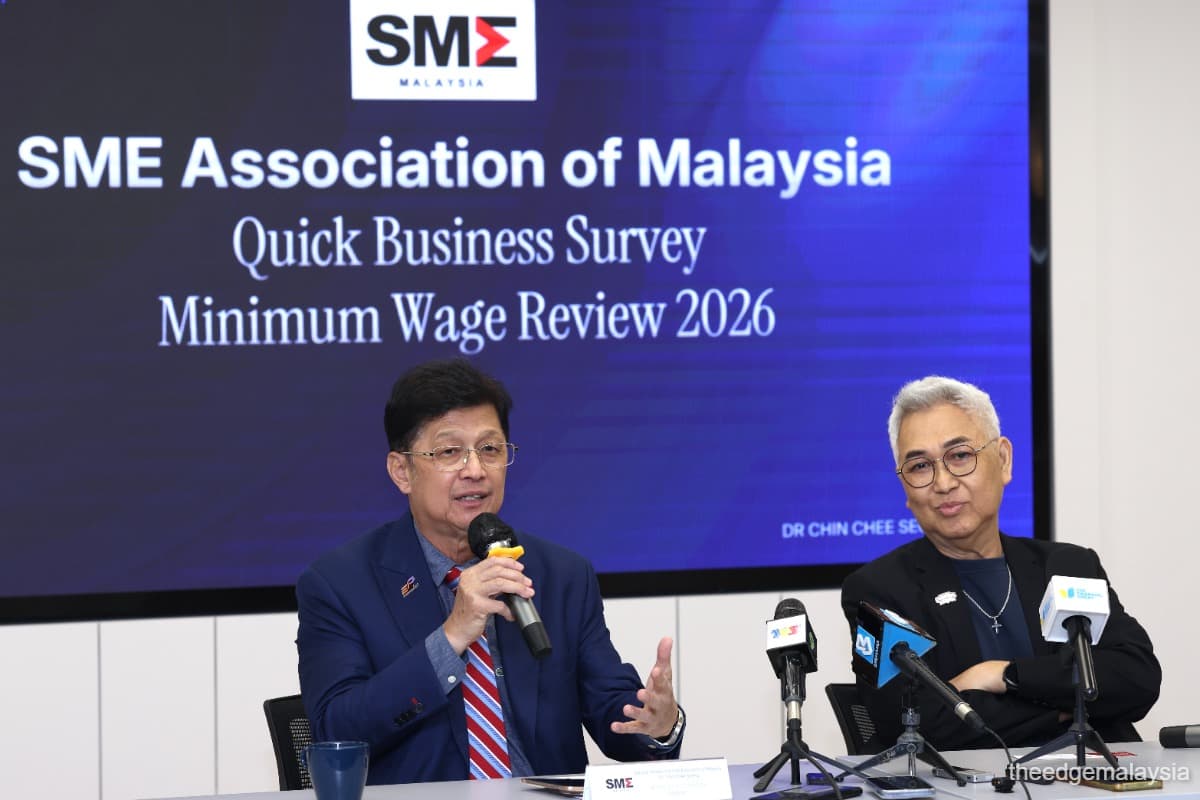
KUALA LUMPUR (Oct 2): Both the SME Association of Malaysia and Malaysia Retail Chain Association (MRCA) have called on the government to defer any minimum wage increase for now, citing challenging operating conditions.
The associations said any future increase from the current RM1,700 wage should instead be implemented gradually or in phases, giving businesses time to adjust their cash flow.
“It’s not the right time now. The business environment is so hard, especially for the MRCA,” MRCA president Datuk Liew Bin said at a joint press conference on Friday, citing higher operating costs arising from the expanded sales and service tax, increased competition from Chinese e-commerce platforms and a more challenging external environment such as war.
SME Association of Malaysia national president Dr Chin Chee Seong said the association’s quick business survey for the minimum wage review found that 95.8% of respondents prefer to delay immediate nationwide minimum wage increases, and favour a phased implementation if the government proceeds with a higher wage floor.
The association received responses from 333 businesses across various sectors.
Chin said the manufacturing sector is the most concerned about the increase.
Nearly half of the respondents oppose raising the minimum wage from RM1,700 to RM2,000, while only 6.6% support an increase to around RM2,200. About one-fifth support higher wages but said the increase should be delayed until business and economic conditions improve.
Respondents said wages should also take into account workers’ skills and productivity, as well as companies’ ability to pay.
The concerns come as nearly two-thirds of respondents said their business conditions had worsened from a year ago, while only 8.4% said theirs had improved.
About 93% expect pressure to raise the salaries of workers already earning above the new minimum wage, creating a knock-on effect across salary levels. Around three-quarters expect significantly higher operating costs.
Some respondents also said higher wages could reduce profit margins, slow hiring, lead to workforce reductions and push up prices.
Instead of an immediate wage increase, about three-quarters called for tax cuts or incentives, while more than half want lower regulatory costs. Respondents also called for greater support for digitalisation, automation, financing and working capital.
The survey covered businesses across various sectors, with 73.3% employing 50 workers or fewer. Respondents said a minimum wage increase would be poorly timed given high operating costs caused by supply disruptions and higher oil prices.
Following the government’s decision to defer the minimum wage increase for micro, small and medium enterprises (MSMEs), Chin said the move may not provide much help to businesses in the long run.
He also acknowledged that MSMEs face challenges in retaining staff and attracting talent as they compete with larger companies that can afford to meet the higher wage requirements.
Entrepreneur and Cooperative Development Minister Steven Sim Chee Keong said on Wednesday that the government would introduce other measures to help raise wages in the MSME sector, including wage subsidies under the Progressive Wage Policy, to ensure wages grow in line with productivity.
The government will announce further measures in Budget 2027, to be tabled on Oct 9, to help graduates secure jobs that match their qualifications and receive fair wages.
Read also:
SME, retail groups call for stronger enforcement amid revision of E-Commerce Act
SME association says govt assistance in Budget 2027 should focus on outcomes
MSMEs temporarily exempted from new minimum wage hike, says minister
Akmal: RM2,000 minimum wage decision rests with Budget 2027
FMM: Minimum wage review should account for productivity, capacity to pay Budget 2027
Govt to announce firm measures under Budget 2027 for fair wages — PM