


This article first appeared in The Edge Malaysia Weekly on October 5, 2026 - October 11, 2026

It has been a couple of months since Bank Negara Malaysia rolled out its MediAsas pilot programme, previously called the Base MHIT (medical and health insurance/takaful) Plan. The pilot — involving staff of selected statutory bodies, government-linked companies, and small and medium enterprises, six of the largest insurers and takaful operators in the country as well as 10 preferred in-network hospitals in the Klang Valley — began at end-July and will end this month. Nationwide launch is slated for January 2027.
While the pilot data is yet to be released publicly, there is some early feedback. Meanwhile, MediAsas has also generated a fair amount of public discussion and debate — along with, we feel, some degree of intentional or unintentional misinformation. This divergence in opinions is to be expected given the many stakeholders involved, often with competing interests.
Why do people dislike it? That’s the natural reaction when they are asked to share the cost of treatment through a mandatory deductible and co-insurance. But without these, we cannot address the most basic challenge: the surge in usage. Hence, the people may not like it, but it is necessary. Next is implementation: How can we increase the sales of MediAsas?
Healthcare affordability is one of the most pressing issues facing the nation today. Therefore, dedicating time and effort to provide greater clarity for the average Malaysian is highly worthwhile.
Why is Bank Negara so intent on this initiative, and what is the central bank trying to achieve? What exactly is MediAsas and, equally important, what is it NOT? What are its strengths and shortcomings, and are criticisms justified? These are important questions to address ahead of its planned nationwide launch. We will also offer a few suggestions that could help keep a lid on insurance premiums and ensure that medical insurance remains affordable and sustainable for Malaysians.
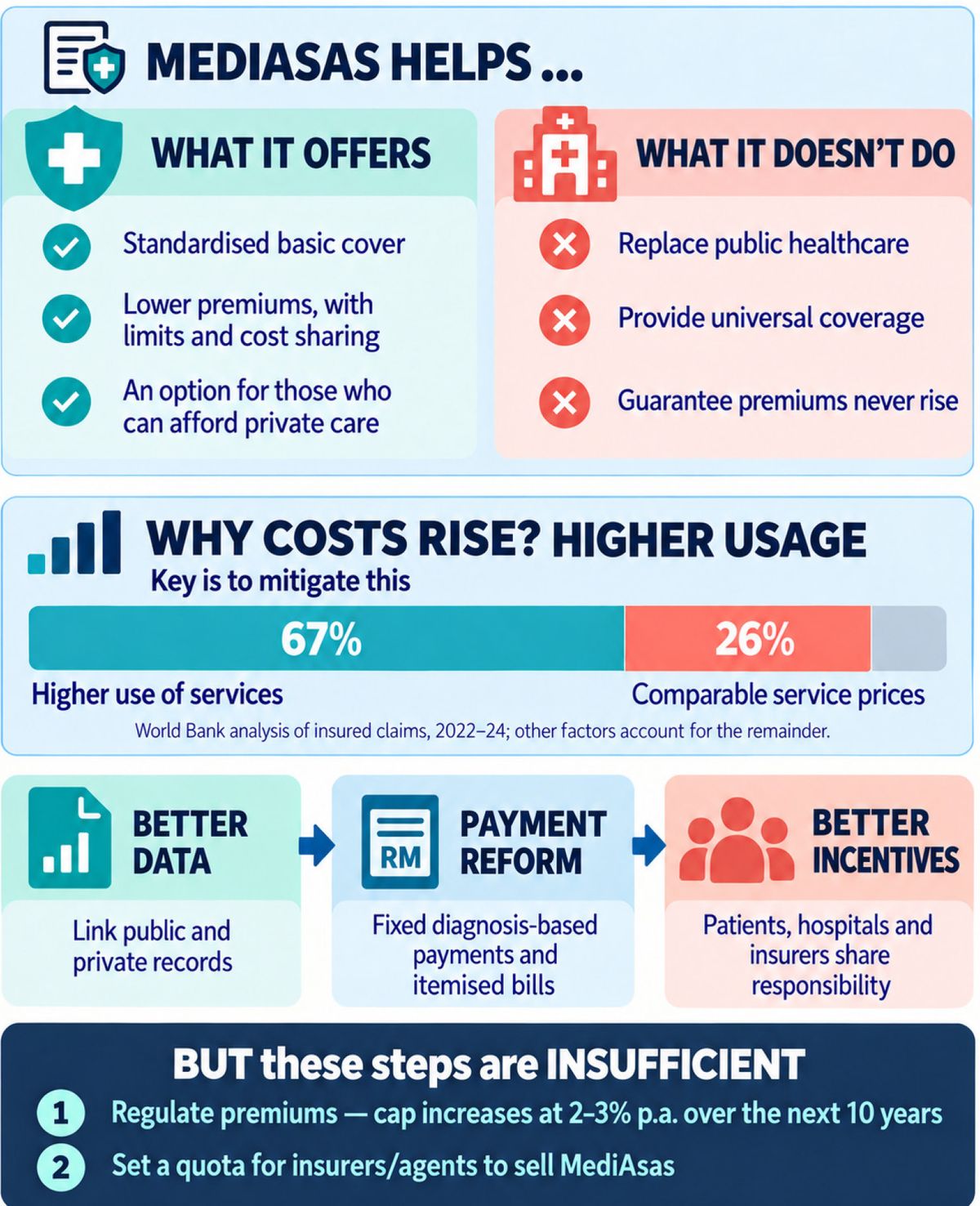
What it is: A basic, standardised standalone private medical insurance product
The two options, MediAsas Teras and MediAsas Fleksi, are developed by Bank Negara, together with private insurers and private hospitals. As the names suggest, they are:
- Basic, standalone medical plans with fixed coverage limits designed to balance medical coverage with affordability;
- Premiums are transparent and subject to Bank Negara review;
- As standardised policies offered by all the major insurers nationwide, they have the potential to create a greater pool of customers than any one insurance company. Insurance works by pooling risk and spreading claims to keep premiums more sustainable over time;
- Built-in cost control and cost-sharing features to help keep premiums relatively stable. In-network hospitals are selected for their cost-effectiveness, including being the first to adopt diagnosis-related group (DRG)-based payments and prescribe drugs/devices based on effectiveness assessed by the Ministry of Health (MoH);
- Mandatory deductible (policyholders bear a portion of the total medical bill before insurance claims kick in) and co-insurance (patients share a fixed percentage of the remaining bill) are intended to discourage the “buffet syndrome” that is driving up healthcare costs for everyone.
What it is NOT: Social insurance intended to provide coverage for every Malaysian
An oft-repeated criticism of MediAsas is that the deductible — RM500 per disability for in-network hospitals, plus an additional co-insurance of 20% of the remaining bill after the deductible (capped at RM3,000 per disability) for out-of-network hospitals — is way too high for many lower-income consumers to bear. The deductible for MediAsas Fleksi goes up to RM10,000 for in-network hospitals and RM15,000 for out-of-network hospitals but has no co-insurance. This argument is based on a Bank Negara study that showed 61% of Malaysians cannot come up with RM1,000 in cash during emergencies. And it misses the point entirely:
- MediAsas is NOT social insurance.
- It is NOT designed to provide universal private healthcare coverage.
- It most certainly is NOT meant to replace public healthcare, which is accessible to all Malaysians at highly affordable costs.
- It is intended for those who CAN afford private healthcare.
Deductibles and co-insurance are not meant to be prohibitive. They are incentives for patients to embrace a more active role in their proposed treatments and manage their healthcare expenses. People will take greater care in weighing the necessity and value of each medical decision when they have some skin in the game.
There is anecdotal evidence to suggest that overtreatment and the potential over-medication of some patients do not necessarily translate to better patient outcomes. Reducing unnecessary consultations, hospital admissions, tests, drugs or procedures — that could at times even raise the risks to patients — while maintaining appropriate care levels will relieve pressure on the entire healthcare system and, in turn, improve efficiency and help temper medical cost inflation.
Too basic? Too restrictive? Too low annual limit? There is no free lunch
Another main criticism of MediAsas is the relatively low annual claim limits: RM100,000 to RM150,000 (for policyholders aged 60 and above) for MediAsas Teras, and RM300,000 for MediAsas Fleksi. By contrast, current insurance products in the market often carry substantially higher limits — frequently in the millions of ringgit — and some are even unlimited.
Make no mistake though. There is no such thing as a free lunch. Higher limits must come at the price of higher premiums, all else being equal, even if it is not obvious at first blush. For these policies, future premium pricing, especially, will likely be less stable given the expected medical cost inflation and compounding effect. You may well start at a low premium today, but the premiums will rise with age. There is no such thing as “buying young and locking in” your premiums.
That’s the lesson from 2024 when premiums surged, even for those who have never made a single claim against their policies. Some were forced to surrender policies that they have been paying for years when premiums suddenly became unaffordable.
Lack of transparency in investment-linked policy, which actually adds risks
A key reason behind the 2024 debacle was the lack of transparency in many of the existing insurance policies, particularly when it came to investment-linked products. This type of policy is popular because people like its “all-in-one” proposition, offering life insurance, medical insurance, critical illness coverage, and a savings component. Indeed, they are often sold as long-term financial planning products.
Insurance premiums are determined using actuarial mathematics, which, frankly speaking, is already complicated for the average person to understand. Now, throw in even more complications in the form of expected returns from investments. Premiums can appear low at the start because part of the future medical premium is expected to be met by selling units from the investment account.
This creates the illusion of affordability, which may not be sustainable if actual investment returns fall short of what is initially estimated and accumulated units prove insufficient. That’s when policyholders must top up by paying higher premiums or forfeit.
To be clear, we are not saying investment-linked medical insurance is a bad product. Just make sure you understand all the risks.
The greatest irony would be buying insurance to transfer financial risks to an insurer — ensuring that unexpected events like medical emergencies do not wipe out your savings — only to voluntarily inject risk right back into the equation through an investment-linked product exposed to market volatility.
Summary: Assess what you actually need and can comfortably afford to pay for life
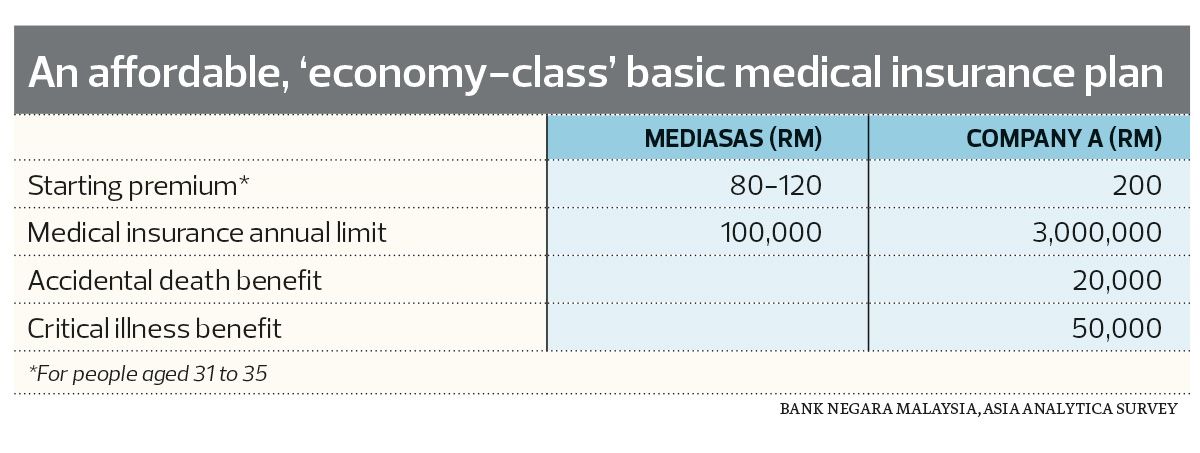
We think many of the prevailing criticisms of MediAsas miss its fundamental purpose. MediAsas is the basic no-frills, “economy-class” standalone medical plan. It offers standardised coverage at lower premiums, all else being equal (see table). It is not social insurance intended to cover every Malaysian but only for those who can afford private healthcare. Nor is it meant to replace public healthcare.
As a basic plan, the benefits under MediAsas are more limited, including a list of 35 major medical exclusions. That’s the price for its lower premiums. As we said, no free lunch. But not everyone needs all the bells and whistles, such as high annual limits.
For instance, MediAsas, with its relatively low premium, may be a good complement for Malaysians who have permanent, stable jobs that already provide employer insurance coverage.
Additionally, per Bank Negara statistics, 99% of medical claims are below RM55,225 with the median claim of only RM5,695. In other words, RM100,000 is more than sufficient to cover most instances. MediAsas has no lifetime limit.
For those who want unrestricted options for treatments, hospitals and premium services — as well as high annual limits for peace of mind — the “business” or “first-class” comprehensive plans are a great choice. This is especially true if you can comfortably afford the higher premiums.
And this is precisely the objective — to offer Malaysians optionality, from affordable basic to pricey comprehensive plans. There is no one-size-fits-all. Consumers must understand that the best insurance policy for them is not the one with the highest annual limit or even the most benefits, but one they can sustainably afford for life.
Always bear in mind that premiums will rise over time with age, no matter how the insurance plan is packaged or marketed to you. (All insurance policies have a schedule that clearly states how premiums increase with age.)
Healthcare is an essential service that needs stronger regulations
Malaysia has initiated a series of responses to the 2024 premium hike shock. This includes an interim measure to spread the projected 40%-70% premium increase over three years, as well as the broader RESET Strategy — a national initiative by Bank Negara, the Ministry of Finance (MoF) and MoH to tackle rising medical cost inflation. It includes 11 key strategies. Obviously, identifying and execution are not the same thing.
MediAsas is designed to work hand in hand with DRG-based payments, whereby the hospital treatment amount is predetermined based on the patient’s medical condition and the typical type of care required rather than per test, procedure or days hospitalised. This shift away from current fee-for-service billing should provide greater pricing transparency and prevent overcharging.
These are steps in the right direction, but we think they are insufficient. Readers of this column would know that we almost always favour market-driven solutions. Competition provides among the strongest incentives to innovate and builds the most efficient and productive ecosystems.
But healthcare is not your typical business. It is an essential service — and more stringent regulations, we think, are justifiable. After all, medical practitioners take the Hippocratic Oath to place patient welfare above all else. Regulations — for insurers (by Bank Negara) and hospitals (by MoH) — will shape the incentives and constraints governing behaviour of all stakeholders, including patients.
It would be hubris to think we know more than the many healthcare experts. Importantly, we do not have access to all the necessary data. That is precisely the point. Malaysia does have several useful databases that are unfortunately fragmented, not inter-operable nor connected. Rectifying this should be a top priority, even if that means taking a stronger hand with the private sector. We are data-driven analysts. Data tells the story, and without comprehensive data, one cannot reliably diagnose the underlying problems, the drivers and make the appropriate policy response.
Only 15% of public hospitals in the nation have fully digitalised medical records. All remaining government health facilities are targeted to digitalise by 2029. Critically, there is no linkage to private hospital records, even though many major healthcare groups are fully digitised. And there is yet a firm timeline for nationwide database connectivity, covering all public and private hospitals, even though this is the aspiration of the “One Citizen, One Record” system.
Private hospitals are understandably protective of, and likely reluctant to share their data. There is currently no mandatory requirement for them to do so. Similarly, there is no timeline for universal DRG adoption or standardised itemised billing by private hospitals. Privacy is a genuine concern but can be addressed through legislation and access control. Data can be anonymised for statistical analysis. It is not justification for preventing interoperability altogether.
Fact is, private hospitals often invest in the latest technologies and equipment as a competitive tool to differentiate services and attract patients. But this raises the required returns and expectations of revenue. Indeed, revenue per patient and revenue per bed are key performance metrics for many. Private hospitals, and especially listed ones, are profit-maximising entities primarily in the interests of shareholders. This objective may not necessarily align with optimal patient care and outcomes.
World Bank: (Over?) Utilisation accounts for nearly 67% of medical cost inflation
A World Bank report published in April 2026, “Cost drivers in Malaysia’s medical and health insurance/takaful sector: A first look at the centralised claims database”, analysed insurer paid claims for empirical evidence on the causes of the surge in medical cost inflation between 2022 and 2024. It found that service-level medical inflation (the change in price for comparable healthcare services) to be relatively moderate, accounting for only 26.1% of total cost growth over the period.
Instead, utilisation was the dominant driver, accounting for nearly 67% of the total spending increase. In other words, the medical cost inflation was overwhelmingly due to increased volume. More alarmingly, the analysis showed that a large and rising share of inpatient episodes are potentially avoidable.
The share of ambulatory care sensitive conditions (ACSC), such as diarrhoea, gastroenteritis and upper and lower respiratory infections that can typically be managed at lower levels of care (outpatient), accounted for 23.6% of total admissions in 2024, up from 20% in 2022. In some hospitals, ACSC-related hospitalisations exceed 40% of total admissions.
Most MHIT products in the market are skewed towards inpatient care coverage and typically do not cover outpatient visits. Additionally, analysing the average length of stay shows a large difference between hospitals, suggesting that some may be generating longer-than-necessary hospital stays because the incentive for hospitals is to increase utilisation of hospital beds.
According to the World Bank, these patterns are suggestive evidence of moral hazard — on the part of both the private hospitals and patients.
In Malaysia, doctors’ professional fees for private providers are regulated by MoH but other components such as laboratory tests, imaging, pharmaceuticals and nursing services are not. These are lumped under hospital supplies and services (HSS), which now make up more than 74% of total hospital bill — and rapidly rising (71.5% in 2022 to 72.1% in 2023 and 74.2% in 2024).
Put simply, because doctors’ professional fees are regulated, medical practitioners and hospitals are incentivised to boost incomes and profits from increasing volume of supplies, service intensity and high-margin services.
This is enabled by the existing fee-for-service model. The DRG-based payment and transparent pricing, on the other hand, can reduce incidences of excessive or unnecessary services. We have reasons to suspect private hospitals will resist these proposals. That’s why we believe it would take a mandatory requirement to move implementation forward.
At the same time, patients are incentivised to accept unnecessary multiple specialist consultations, diagnostic tests and procedures, as well as higher cost- and overtreatments, because it’s no skin off their noses. Insurance covers everything. Ultimately, though, such behaviour raises medical costs and premiums for everyone, including those who never made any claims.
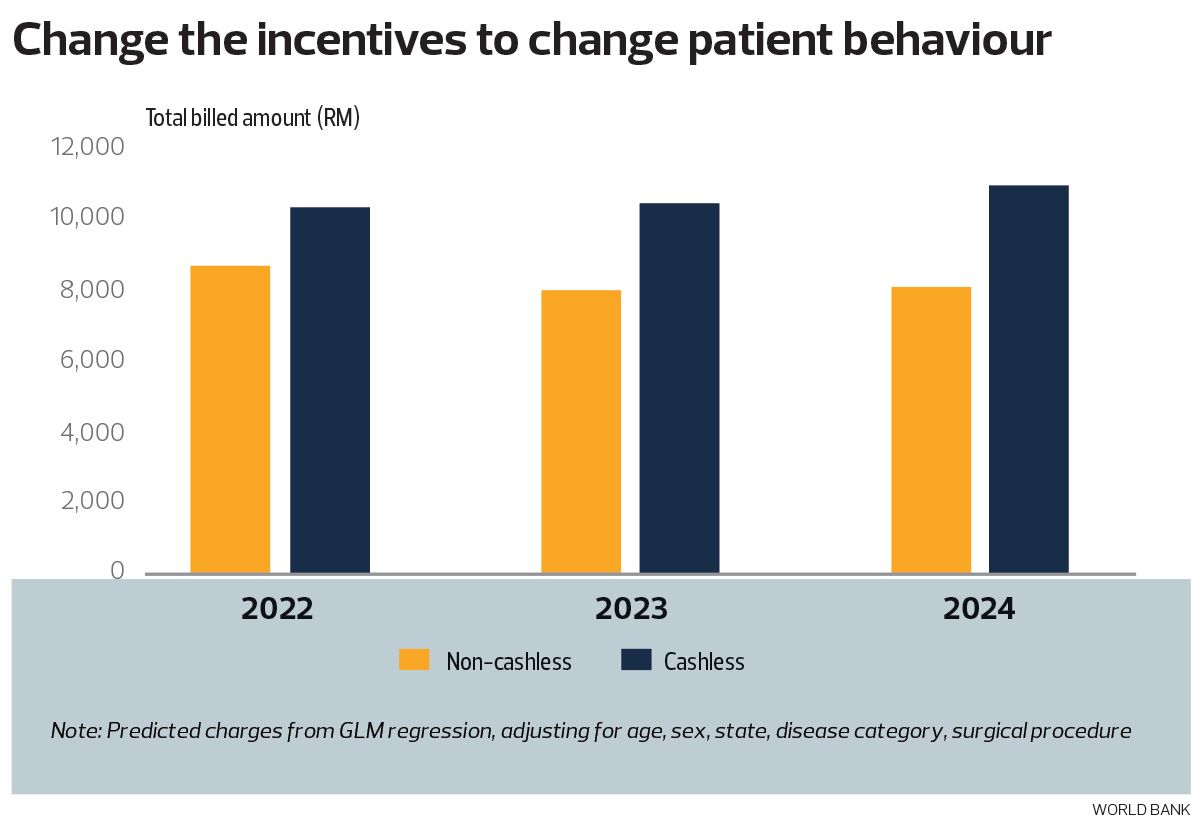
The data also shows that non-cashless policies — where patients pay first and are reimbursed by insurers — generate relatively lower total billed amounts than cashless policies. The latter is where insurers settle the bill directly with the private hospital. This again is suggestive of moral hazard (although the relationship does not by itself prove causation) and where patients have incentives to reduce costs, they will. We reproduce the chart from the World Bank report here (see previous page).
The MHIT claims dataset has provided some important insights as to how Malaysia can more effectively tackle the issue of medical cost inflation. But it currently consists only of insurer paid claims. Fewer than one in four Malaysians are covered by individual private MHIT. And insurer paid claims, including under employer group benefit schemes, account for only 13%-15% of total health expenditure in the nation.
In other words, the data is still very limited. The public sector makes up about half of total current health expenditure while household self-pay and medical tourists make up the bulk of the balance. The insurance claims data also has no patient identifier and is thus not linked to patient outcomes. Surely, much more valuable insights can be gained from greater completeness and quality of data.
This goes back to our point that Malaysia should prioritise broad data collection and integration — that is now significantly more feasible with AI advances — for more robust assessments and effective policymaking. And not just where it pertains to the healthcare sector. Data and statistics are not merely for reporting outcomes. They can be critical monitoring and forecasting tools. A dashboard of measurements can provide early warning signals before a problem grows into a crisis.
Conclusion
To effectively address the underlying causes of medical cost inflation and ensure long-term premium affordability and sustainability, there must be buy-in from all stakeholders, from the regulators to the insurers, the private hospitals, and the consumers themselves. Change the system incentives to change behaviour.
Here are some suggestions:
- Hasten the implementation of DRG-based payments. Fix a timeline for the transition away from fee-for-service payments. Mandatory for all public and private hospitals.
- Standardise itemised billing. Mandatory.
- Enhance data collection for more transparency and data quality. Inter-operable and connected databases. Mandatory.
- Make the databases on claims, utilisation, average amounts, pricing for comparable diagnoses and services, length of stay and so on publicly available. And name those that fail to comply. The consumers can decide.
- Last but not least, regulate the premiums charged by insurers.
There is significant asymmetry in information and bargaining power between the insurers, hospitals and patients. Insurers have immense bargaining power over private hospitals.
Malaysia currently regulates returns for essential utilities such as electricity, gas and water. Why not healthcare, which is an equally essential service that saves lives? Bank Negara’s responsibility as the regulator is to prevent insurer failure and systemic risks, not guarantee insurer profits. Regulate the premiums charged by insurers, say, by capping increases at 2%-3% per annum for the next 10 years. This is a market-driven initiative. Set the rules and let the insurers compete within the rules.
This will incentivise insurers to package their products based on what is really sustainable, rather than over-promising on benefits. For instance, they can design MHIT plans to include mandatory deductible (a low level is still better than none) and/or improve on outpatient coverage to reduce moral hazard and costly hospital admissions.
Capping premiums will also incentivise insurers to scrutinise claims more closely — if they know that they cannot simply pass on the costs to policyholders. This will, in turn, provide a check on excessive and unnecessary private hospital services. Limiting insurer ability to fully pass on cost escalation could also discourage them from promoting “pool jumping” to new policies, which worsens adverse selection (resulting in sharply higher premiums) in existing risk pools.
Seven out of every 10 MHIT in the market today are investment-linked. Insurers like them because they are more profitable. Agents are incentivised to market these products aggressively because they earn significantly higher commissions compared to standalone medical insurance policies.
Early feedback from the MediAsas pilot underscores this exact concern — agents have little incentive to promote the less profitable plan. How, then, to ensure agents will sell standalone products like MediAsas to potential customers? Here’s a suggestion: Bank Negara sets a quota for insurers/agents — they must sell, say, at least one MediAsas for every two proprietary MHIT plans.
Technology is an enabler. The Employees Provident Fund’s (EPF) i-Lindung platform allows members to buy life insurance and critical illness insurance through its app, paid using funds in Akaun Sejahtera. This is a convenient distribution channel for MediAsas — accessible for all members and not dependent on agents. Bank Negara and the EPF could conduct nationwide campaigns to raise public awareness.
The crux of the matter is this: MediAsas addresses some weaknesses in private health insurance. But sustainable premiums will ultimately require stronger data, payment reform and better incentives for hospitals, insurers and patients. Moral suasion works to a certain extent. But we think a more forceful regulatory hand is necessary, if the government is truly committed to executing all the reforms proposed in its RESET Strategy framework to strengthen healthcare in the nation.
Portfolio commentary
The Malaysian Portfolio lost 1.7% for the week ended Sept 30, broadly in line with weaker sentiment in the broader market. All stocks in our portfolio ended the week in the red. The biggest losers were United Plantations (-4.9%), OCK Group (-3%) and Public Bank (-2.7%). Last week’s loss pared total portfolio returns to 213.2% since inception. Nevertheless, this portfolio is outperforming the benchmark FBM KLCI, which is down 9.8% over the same period, by a long, long way.
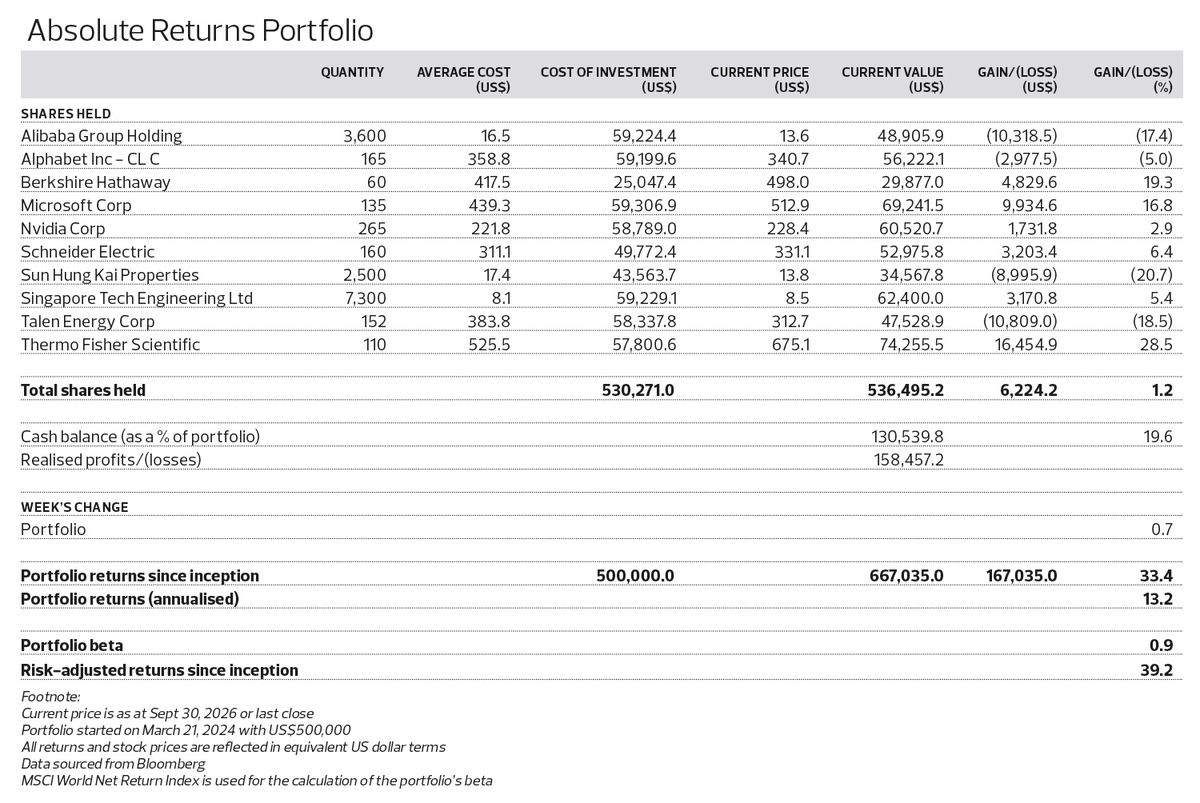
The Absolute Returns Portfolio, on the other hand, gained 0.7%. The gains lifted total portfolio returns to 33.4% since inception. The top gainers were Talen Energy Corp (+4.1%), Microsoft Corp (+2.5%) and Alphabet Inc – CL C (+1.7%), while the top losers were Alibaba Group Holding (-3%), Berkshire Hathaway (-1.8%) and Schneider Electric (-0.8%).
The AI Portfolio also performed well last week, up 1.8%. Total portfolio returns now stand at 31.5% since inception. The biggest gainers were Datadog (+8.9%), Unusual Machines (+7.9%) and Cadence Design Systems (+6.8%). At the other end, Akamai Technologies, Inc (-10.2%), Naura Technology (-7.7%) and Alibaba (-3%) were the top losing stocks.
Disclaimer: This is a personal portfolio for information purposes only and does not constitute a recommendation or solicitation or expression of views to influence readers to buy/sell stocks. Our shareholders, directors and employees may have positions in or may be materially interested in any of the stocks. We may also have or have had dealings with or may provide or have provided content services to the companies mentioned in the reports.
Save by subscribing to us for your print and/or digital copy.
P/S: The Edge is also available on Apple's App Store and Android's Google Play.