

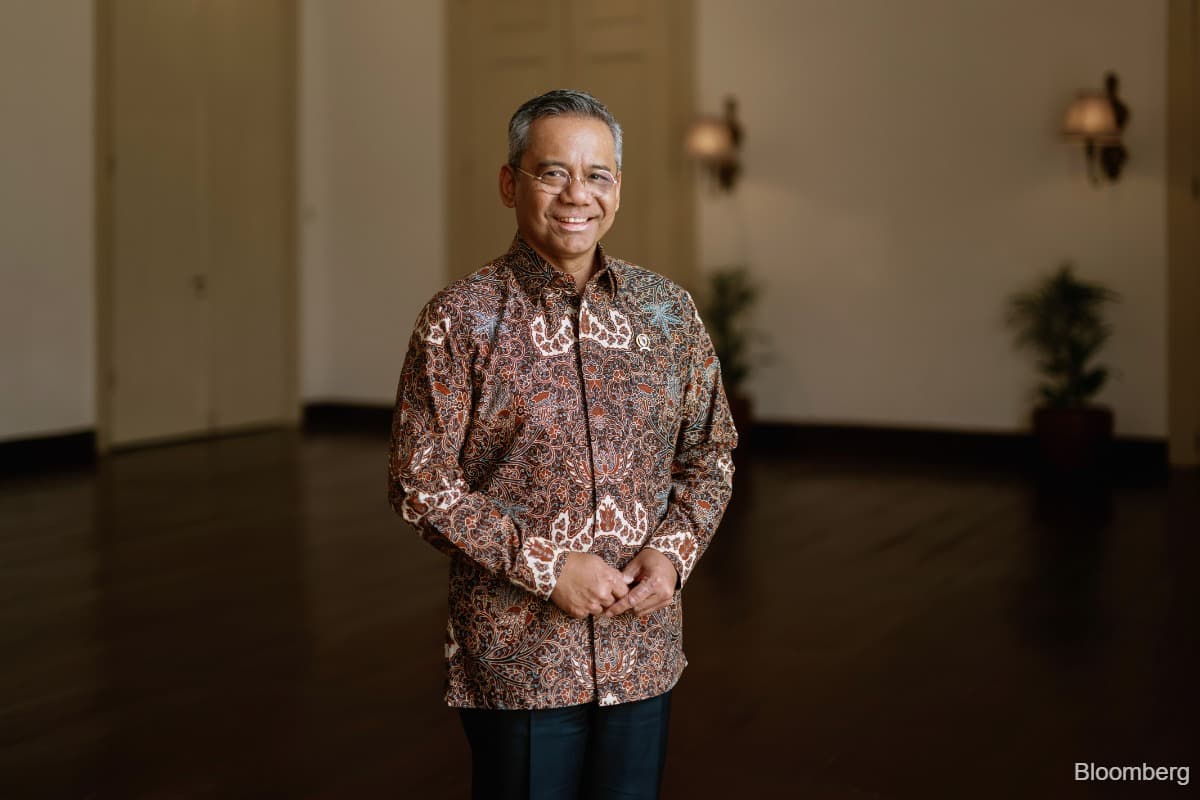
(Oct 2): Indonesia’s new finance chief signalled he’ll stay in his lane and let the central bank and the Danantara sovereign wealth fund handle their own mandates, a bid to restore investor confidence in President Prabowo Subianto’s broad economic policy.
In his first interview with foreign media since taking the post last month, Finance Minister Suahasil Nazara said he would focus on managing the state budget and keeping its deficit within the legal limit of 3% of gross domestic product — a metric he said was a “symbol of how disciplined we are”.
He signalled a departure from his predecessor’s plans to use Danantara dividends to boost government revenue, saying they aren’t included in either the 2026 or 2027 state budget. He also declined to weigh in on Bank Indonesia’s next interest-rate moves, even as he vowed to bring government borrowing costs down amid a global bond sell-off.
“We understand each of our mandates. We are willing to coordinate, we are willing to communicate,” he told Bloomberg Television’s Haslinda Amin on Friday.
How much latitude Suahasil has to set his own course remains unclear. Nearly two years into office, Prabowo has centralised economic decision-making around his priorities, many of which are already embedded in the 2027 budget. His signature free-meals programme, village cooperatives drive and defence-related spending together account for roughly 15% of planned state spending. Suahasil acknowledged that policy must remain within the president’s “big vision”.
The framework Suahasil outlined was in stark contrast to former Finance Minister Purbaya Yudhi Sadewa, who had at times pressed Bank Indonesia and Danantara to help in managing the budget and growing Southeast Asia’s largest economy.
Purbaya, who was removed last month after just a year in his post, had sought nearly US$7 billion (RM28.59 billion) in dividends from the wealth fund to augment the state budget, which was straining under the burden of Prabowo’s priority programmes and larger-than-expected fuel subsidies.
He also publicly criticised the central bank for letting the rupiah slip to record lows and blamed its rate hikes for slowing economic growth.
Suahasil struck a different tone Friday when asked about the rupiah trading near the key level of 18,000 per dollar. “I’m comfortable that Bank Indonesia is doing what they can,” he said. When pressed on whether the central bank may need to consider rate hikes, he said he doesn’t talk about “specific numbers” with Bank Indonesia.
He added that the government was “comfortable with every move” Bank Indonesia made within its mandate.
Suahasil said he met with new Bank Indonesia Governor Destry Damayanti shortly after taking office to demonstrate coordination between the two institutions. The two top policymakers have also held a rare joint press briefing to outline their policy plans.
The two institutions now face the same global pressures on different fronts. The Finance Ministry must safeguard fiscal credibility and contain borrowing costs, while Bank Indonesia manages pressure on the rupiah without losing sight of growth.
Suahasil also ruled out reviving the daily bond buybacks initiated by Purbaya in May to anchor yields, saying current market conditions didn’t warrant activating the government’s bond-stabilisation framework. He described the spread between Indonesian and US 10-year government bond yields as “very healthy” at about 220 to 225 basis points.
Indonesia has room for another global bond sale this quarter, Suahasil said, as the government designs its borrowing programme for the rest of this year and 2027. The country last tapped international markets in May, when it sold US$3.45 billion of dollar- and euro-denominated debt.
“The global economy is my big question now,” Suahasil said, citing geopolitical tensions and their impact on commodities Indonesia imports, such as oil and gas, and exports, including nickel and coal.
Two arms
Suahasil also characterised the state budget and Danantara, the sovereign wealth fund created by Prabowo last year, as “two arms” of the administration that work separately but in close coordination.
He defended the government’s use of Danantara as a parallel investment vehicle, without directly addressing concerns that it could leave fiscal risks outside the headline budget deficit — something flagged by both Fitch Ratings and Moody’s Ratings when they lowered the country’s outlook to negative earlier this year.
“Danantara is a sovereign entity,” Suahasil said. “Close communication with Danantara will open up new options, new ideas, new ways of thinking, but it must be within the right rule book of the financial sector.”
He added that the Finance Ministry has decided not to take a stake in the Indonesian stock exchange, coming after Danantara’s chief executive said a consortium of government entities such as the wealth fund and the ministry could jointly take a stake of up to 40%.
Governments across Asia have had to increase spending this year as they deployed fuel subsidies and other stimulus measures to mitigate the economic fallout from the Iran war. That fiscal space is fast shrinking with no clear end in sight for the conflict, and prices of oil, food and fertiliser seen staying elevated through 2027.
Indonesia’s budget deficit is expected to come in at 2.85% of gross domestic product this year, just below the 3% legal ceiling. The government expects the shortfall to narrow to 2.4% next year, although it rests on the assumption that crude prices average US$75 a barrel and the rupiah strengthens to an average 17,500 against the dollar. Oil is currently above US$100, and the currency is near the 18,000 level.
The location of Friday’s interview — a building at the ministry compound named after the country’s first finance chief, AA Maramis — was Suahasil’s choice. The ministry had revitalised the “dead” building during the pandemic, he said, under the guidance of his former boss, Sri Mulyani Indrawati. She was fired last year to make way for Purbaya.
Uploaded by Chng Shear Lane