

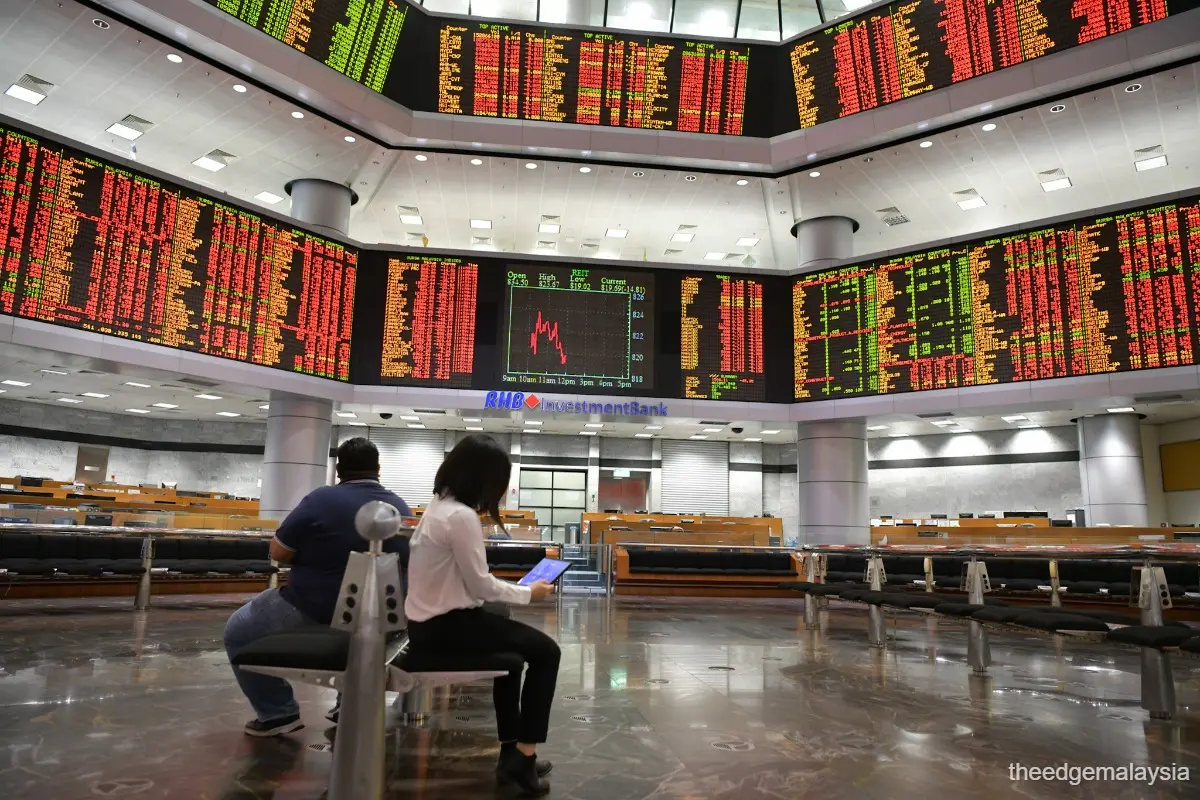
KUALA LUMPUR (Oct 2): Selling pressure on Malaysian large-cap stocks could persist over the next one to three months amid cautious global sentiment but is unlikely to trigger a sharp market correction, according to BIMB Securities.
“The recent weakness in the FBM KLCI is partly attributable to profit-taking and selling in banking stocks, but I would not characterise it as a banking-specific correction alone,” BIMB Securities analyst Mohd Redza Abdul Rahman told The Edge.
Banks account for roughly 40% to 45% of the KLCI’s market capitalisation, meaning relatively modest movements in major banking stocks can have an outsized impact on the benchmark, he said.
However, Redza said the weakness extended beyond banking stocks, with declining stocks outnumbering gainers by two to one on Thursday, reflecting broader weakness in market sentiment.
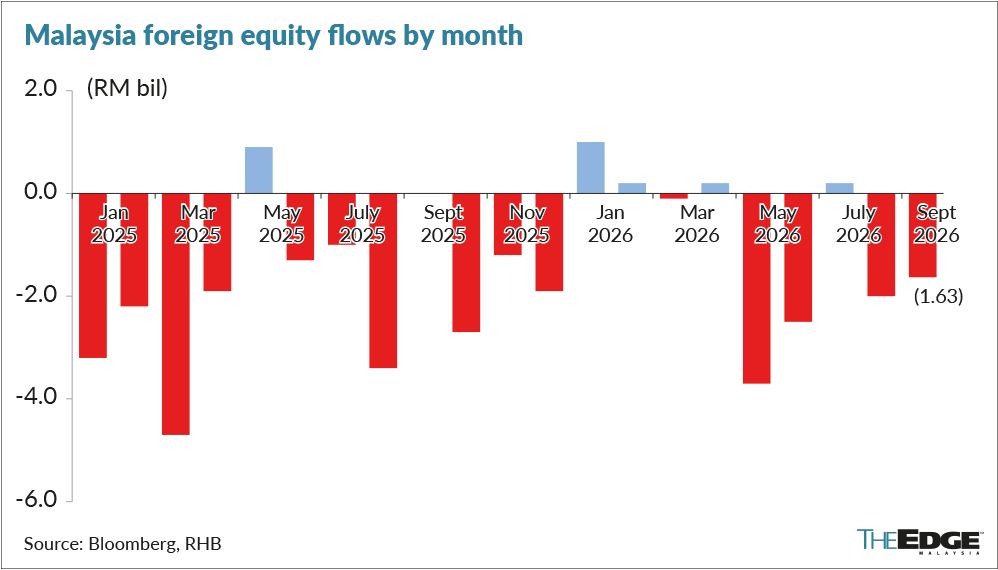
He pointed to persistent foreign fund outflows, higher global bond yields and external uncertainties as among the factors weighing on the market.
Foreign investors were net sellers of RM228 million on Thursday, while foreign ownership of Malaysian securities fell to 17.8% as at end-September, its lowest level, according to Redza.
Higher global bond yields have also made fixed-income assets relatively more attractive and reduced investors’ appetite for equities, particularly in emerging markets, he said.
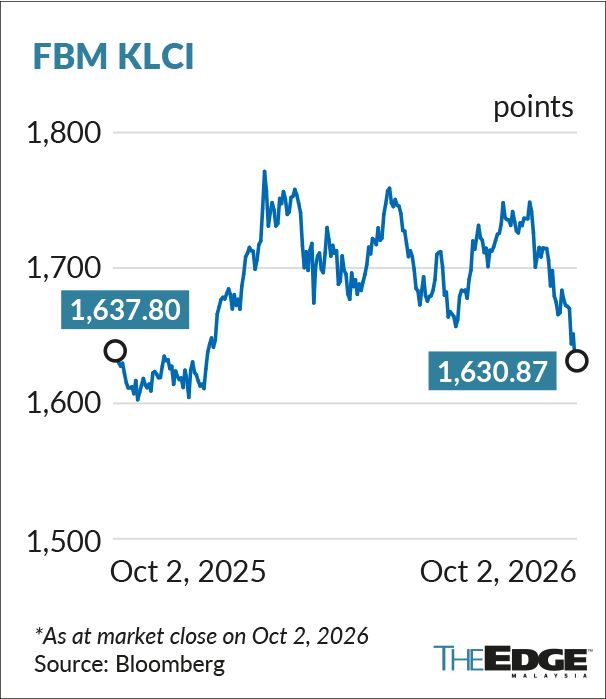
The KLCI fell 1.26% to 1,630.36 on Thursday before recovering marginally on Friday.
The benchmark closed 0.61 points, or 0.03%, higher at 1,630.87 points.
Malayan Banking Bhd (KL:MAYBANK), CIMB Group Holdings Bhd (KL:CIMB) and Public Bank Bhd (KL:PBBANK) were among the key drags on Thursday, Redza said. Maybank fell below RM10 for the first time in nearly nine months, while CIMB and Hong Leong Bank Bhd (KL:HLBANK) declined more than 1% each.
“While banking stocks have mechanically contributed to the KLCI’s decline due to their heavy index weightage, the underlying driver is a broader deterioration in risk sentiment rather than a negative outlook on banks specifically,” Redza said.
Despite the external headwinds, Redza expects selling pressure on large-cap stocks to remain range-bound rather than develop into a sharp correction.
He said the Malaysian market is far from overvalued, while attractive dividend yields among large-cap stocks could provide support as local institutional investors step in during market weakness.
Earnings growth among domestic heavyweights such as Tenaga Nasional Bhd (KL:TENAGA) and Telekom Malaysia Bhd (KL:TM), supported by themes including renewable energy, data centres and artificial intelligence, could also provide support, he said.
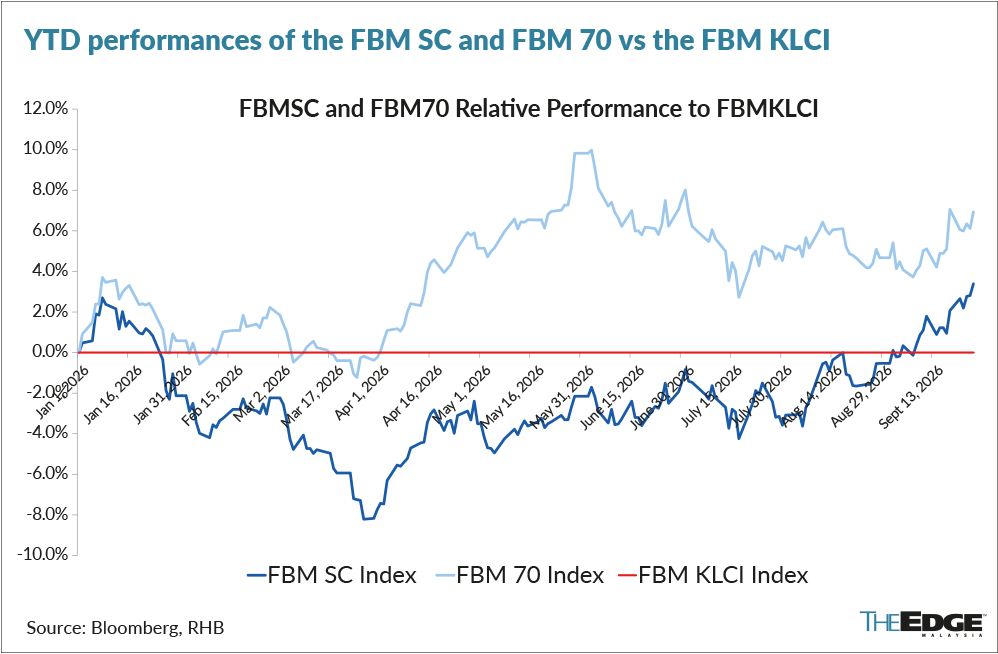
Meanwhile, Redza attributed the relative resilience of the FBM Small Cap Index partly to differences in investor ownership and business exposure.
Foreign investors tend to sell liquid large-cap stocks first when reducing their exposure, while small caps are more heavily held by domestic retail and institutional investors, he said.
Small-cap companies also tend to have greater domestic exposure, including construction, consumer and industrial technology businesses, making them relatively more insulated from external headwinds.
“With domestic demand supported by steady consumption, infrastructure rollout and localised supply-chain investments, small-cap earnings fundamentals remain relatively insulated from external macroeconomic headwinds,” Redza said.
However, prolonged weakness in the broader market could eventually weigh on small-cap sentiment, he cautioned.
Rakuten Trade head of research Kenny Yee said the recent selling was predominantly driven by foreign funds, with some of the pressure potentially linked to the unwinding of yen carry trades following the Bank of Japan’s three rate hikes, lifting its key rate to 1.25%, the highest in over three decades.
A yen carry trade involves funds borrowing at low interest rates in Japan and investing the proceeds in other markets.
As these trades are unwound, the resulting foreign selling of Malaysian equities could put downward pressure on the FBM KLCI, particularly its large-cap constituents.
“I assume we may be at the tail end of the selling,” Yee said, adding that current market levels present opportunities for bargain hunting as valuations remain reasonable.
Meanwhile, TA Securities chief investment officer Choo Swee Kee said foreign selling and profit-taking were “the symptom and not the cause”, pointing instead to concerns over domestic political developments and their potential impact on policy execution.
“Fund managers are worried that the latest political development may distract the ruling government from focusing on administering business policies,” he said, adding that delays in approvals could affect business growth. Choo also cautioned that economic growth remains uneven across sectors.
RHB Research, meanwhile, maintained its end-2026 KLCI target at 1,750 points but expects geopolitical and global macroeconomic challenges to cap the market’s upside.
It expects the market to remain range-bound, and advocated a defensive trading stance while noting that the prospect of the 16th general election being held in 2027 could ease near-term political risk.
Banking sector faces funding pressure
Separately, RHB Research downgraded the banking sector to “neutral” from “overweight”, citing rising funding costs and thinning buffers against potential loan losses.
It said strong loan demand and higher wholesale deposit rates could intensify competition for deposits and keep banks’ funding costs elevated. Rising bond yields could also result in paper losses on banks’ bond holdings.
CIMB Securities similarly flagged funding pressure, noting that banking-system loans grew 5.7% year-on-year in August, outpacing the 4.2% growth in deposits.
Still, CIMB Securities maintained its “overweight” rating on the sector, citing strong capital, sufficient liquidity, manageable bad loans and resilient earnings.