

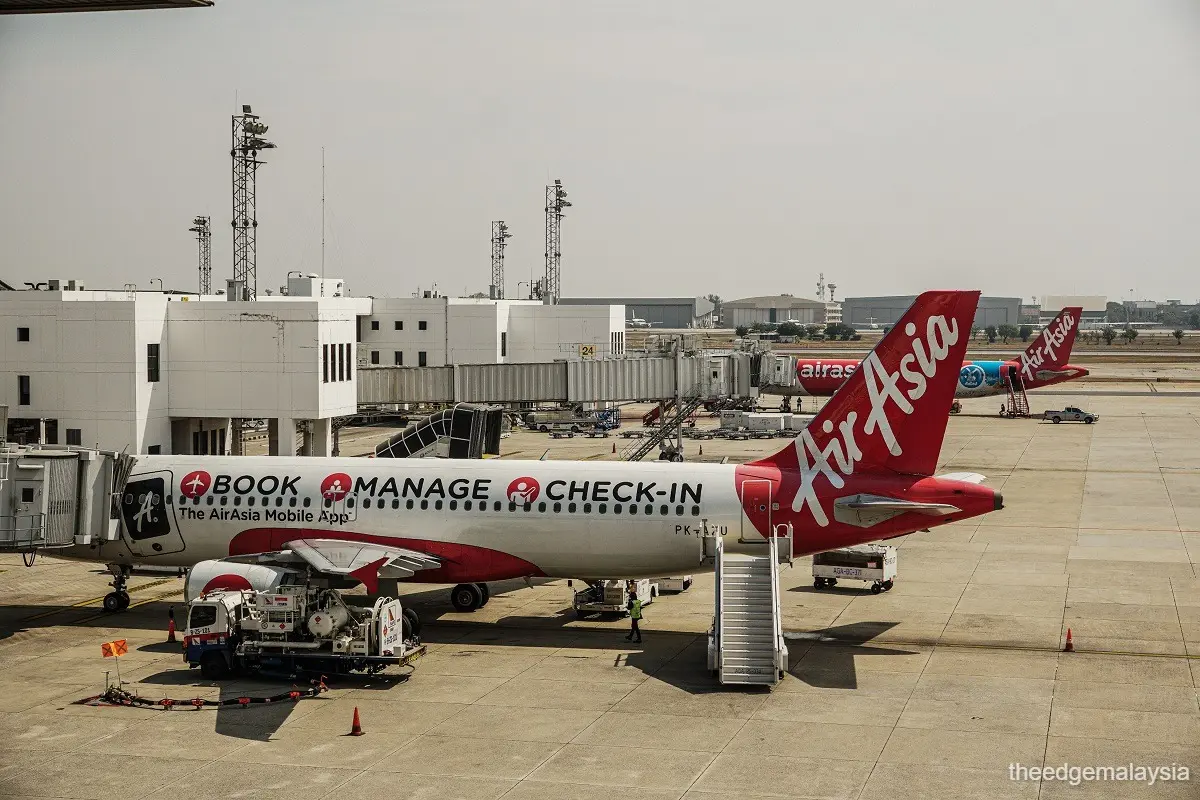
KUALA LUMPUR (Oct 1): Global aviation advisory firm Alton Aviation Consultancy has launched a campaign to help low-cost carrier AirAsia Group Bhd (KL:AAGB) raise as much as US$1 billion (RM4.1 billion), according to people familiar with the matter.
The fundraising effort is backed by Malaysia’s Ministry of Finance (MOF), which is helping Alton attract lenders and investors as banks and other financiers become more selective in funding airlines amid tougher market conditions and surging jet fuel prices, the sources told The Edge.
AirAsia has reportedly said it is seeking as much as US$1 billion primarily to support debt restructuring, refinancing, balance sheet consolidation, with the rest for operational needs.
The move follows the MOF’s appointment of Alton to assess AirAsia’s funding requirements. The Edge, in its Aug 24 weekly, reported that the specialist advisory firm had been engaged to help the airline secure the proposed US$1 billion financing from international debt markets.
The MOF has mandated Alton to seek potential sources of funding and has provided an undertaking or some form of guarantee that could help Alton secure borrowings of significant size, the sources said.
Alton would also be entitled to a success fee if it secures the financing, with the fee calculated as a percentage of the amount raised, the sources said.
Alton did not reply to The Edge's request for comment.
"If true, the government’s involvement reflects AirAsia’s importance to Malaysia’s economy, particularly its role in domestic and regional air connectivity," Shukor Yusof, founder and analyst at aviation consultancy Endau Analytics.
“They realise that they have a fiduciary duty to make sure that nothing bad happens to AirAsia because it would have a bigger impact on the domestic economy,” he added.
A government-backed structure could also help AirAsia reach a wider pool of investors. Most bond issues require a credit rating to attract institutional investors and determine borrowing costs, Shukor noted.
If AirAsia’s debt were able to benefit from Malaysia’s sovereign credit rating of A- from S&P Global Ratings, it could appeal to a wider pool of international institutional investors, he said.
AirAsia’s funding needs have become more pressing as higher fuel costs and foreign exchange (forex) losses weigh on its finances.
The airline, which employs about 17,000 people across its regional network, reported a net loss of RM527.16 million for the second quarter ended June 30, 2026, widening from RM154.88 million in the previous quarter. Revenue fell 14.5% to RM5.09 billion. AirAsia’s average fuel price surged 66% to US$183 per barrel in 2QFY2026 from the previous quarter, while net forex losses widened to RM331 million as major currencies weakened against the US dollar.
Global average jet fuel price remained elevated at US$185.43 per barrel in the week ended Sept 25, more than double the level a year earlier, according to the S&P Global Platts Jet Fuel Price Monitor. AirAsia has been particularly exposed to the surge because it entered the year without fuel hedges, leaving it to absorb the full impact of higher prices.
As at June 30, 2026, AirAsia was in a net debt position of RM2.27 billion. Cash stood at RM953.67 million, while total borrowings were RM3.13 billion, including RM803.2 million due within 12 months.
Lease liabilities stood at RM13.3 billion, including deferred aircraft leases.
AirAsia shares closed down 1.5 sen or 2.86% to 51 sen on Thursday, giving the airline a market capitalisation of RM1.7 billion. The stock has fallen 70% so far this year.