


(Oct 1): The European Central Bank asked the region’s leaders to start choosing a successor to Isabel Schnabel, initiating a likely package deal over jobs including that of Christine Lagarde.
“I can confirm that President Antonio Costa has received the letter from President Lagarde requesting to launch the formal procedure for appointing a new member of the ECB executive board,” said a spokesman for the chief of the European Council, who chairs summits of European Union heads of government.
An EU official confirmed that the request was to launch the process without delay.
The move puts the onus on the Eurogroup, which comprises euro-area finance ministers and is led by Greece’s Kyriakos Pierrakakis, to discuss the issue as soon as its Oct 8 meeting in Luxembourg. The result of such discussions could be a call for candidates to fill the role.
Euro-area finance ministers invite nominations and discuss candidates before recommending their preferred choice. The European Parliament and the ECB’s governing council both get to weigh in. EU leaders make the final appointment.
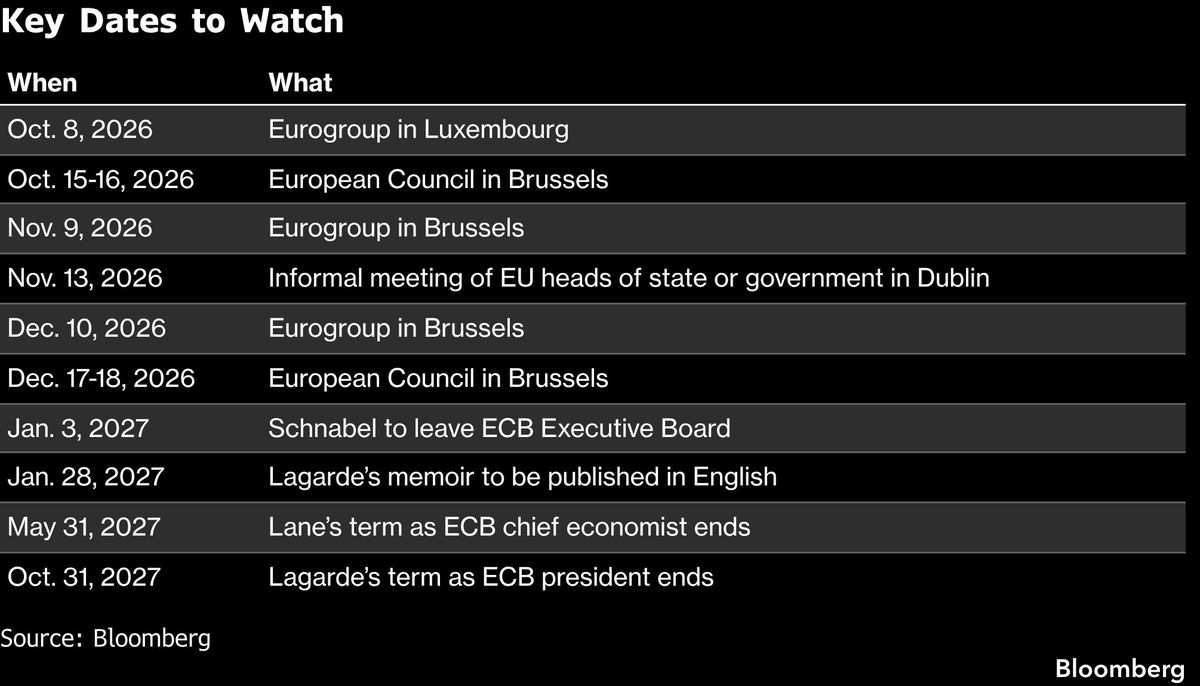
Schnabel said last week that she’ll leave the ECB almost one year before the end of her term to take a senior job at the International Monetary Fund. That adds urgency to the impending leadership overhaul at the Frankfurt-based ECB, with Lagarde and chief economist Philip Lane also set to go.
European Union leaders have the last word on any appointment and may try to agree on all three jobs at once, in what Greece’s premier calls “a grand bargain.” Given Schnabel’s position will be vacant as of early January, a decision by the final summit of the year in December is plausible.
Since Schnabel is German, the most immediate pressure arguably now shifts to Berlin to make a move despite the ongoing distraction of government turmoil there after three state election setbacks.
Both France and Germany are determined to maintain a presence on the executive board, and Spain — which is pushing for a seat after Vice President Luis de Guindos retired earlier this year — is fielding Bank for International Settlements chief Pablo Hernandez de Cos for the top job.
De Cos’s main competitor for the ECB role is former Dutch central bank chief Klaas Knot, though it’s too early to say who has the advantage. The prime ministers of both countries last week used the sidelines of the United Nations General Assembly in New York to endorse their candidates.
Lagarde on Wednesday gave the clearest indication yet that she might resign early instead of lasting until October 2027, telling La Croix newspaper that “I don’t rule out the possibility of leaving a few months before the end of my term.”
A spokesperson for the ECB declined to comment.
Uploaded by Evelyn Chan