

This article first appeared in The Edge Malaysia Weekly on October 5, 2026 - October 11, 2026

PETROLIAM NASIONAL BHD
Petroliam Nasional Bhd (PETRONAS), the only Malaysian company listed on the Fortune Global 500, took centre stage at the height of the fuel supply crisis in early 2026, when it was tasked with helping to coordinate and secure the country’s fuel supplies, going beyond its normal business activities amid disruptions in West Asia.
Prime Minister Datuk Seri Anwar Ibrahim acknowledged that role in March, saying Malaysia had been able to secure sufficient fuel supplies, “thanks to the stewardship of PETRONAS and the state”.
That was just one of the many examples of how PETRONAS responsibilities extend well beyond that of a conventional oil company.
Established in 1974 as the custodian of Malaysia’s hydrocarbon resources, PETRONAS has played an indispensable role in nation-building, with its impact felt everywhere — from the government’s balance sheet to economic growth, energy security, talent development and beyond.
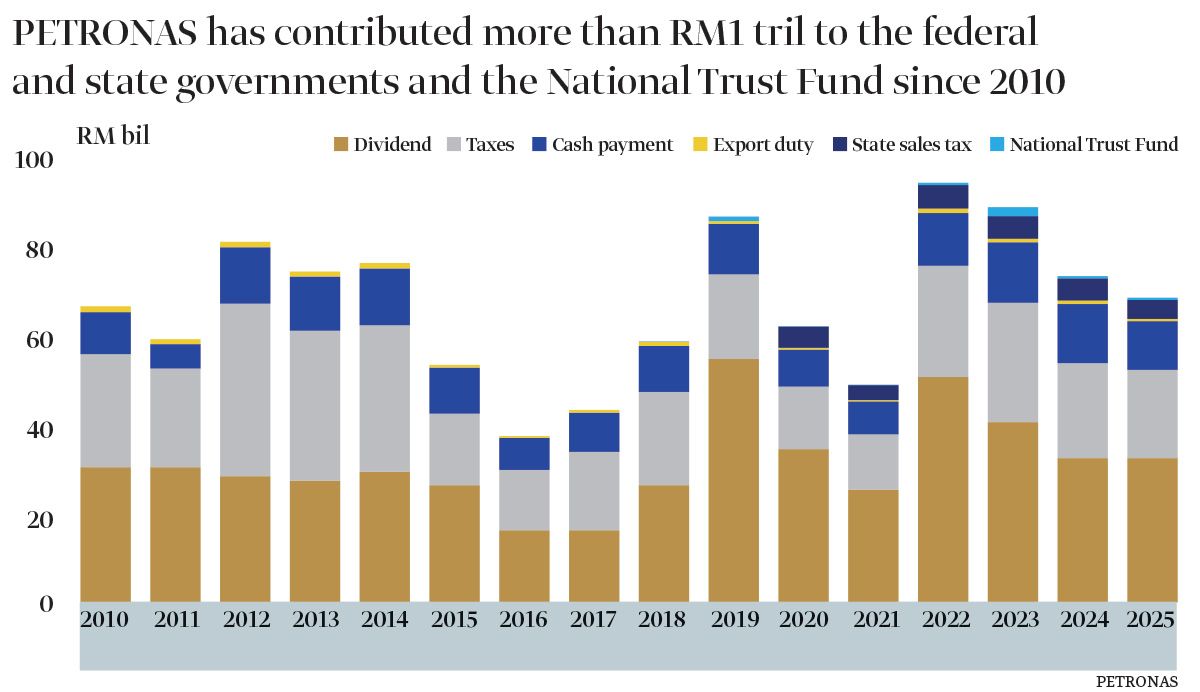
More than any other government-linked company, PETRONAS has contributed nearly RM1.6 trillion to the nation through dividends, royalties, taxes, cash payments and other contributions.
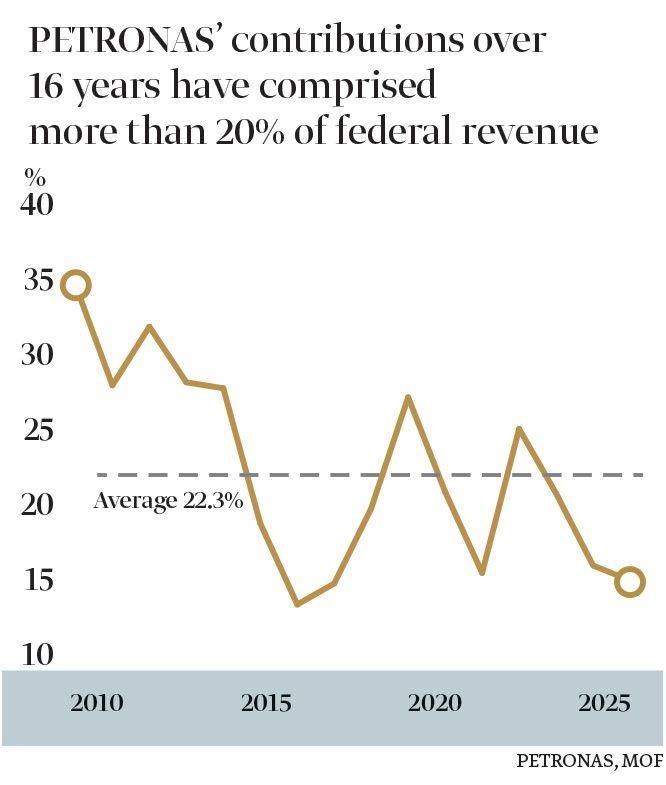
Its dividends alone — excluding those from its listed companies — have totalled close to RM500 billion since 2010, averaging RM30 billion a year, or roughly 12% of federal government revenue in the period. It has also contributed nearly RM14 billion to the National Trust Fund, which serves as savings for future generations.
Together with other upstream production-sharing contractors, the sector paid about RM321 billion in petroleum income tax between 2010 and 2025 — another 7.6% of government revenue in the period — or about RM20 billion a year.
Next, the development of Malaysia’s hydrocarbon resources has, in turn, created an extensive domestic ecosystem spanning upstream, midstream and downstream activities. A number of local oil and gas (O&G) companies that first built their capabilities serving the domestic industry have since taken their expertise abroad.
PETRONAS itself has played a direct role in building this supply chain. Its Vendor Development Programme, established in 1993, has benefited more than 170 small and medium enterprises, helping local companies compete beyond Malaysia.
Supporting the industry’s talent pipeline, it operates Universiti Teknologi Petronas (UTP), whose petroleum engineering course ranks ninth globally in the QS World University Rankings, and technical training institution Institut Teknologi Petroleum PETRONAS (INSTEP), which ranks among the top 5% in the world, according to Explorance’s Metrics That Matter (MTM) benchmark.
Today, the O&G sector accounts for around 20% of national GDP, according to data from the Malaysian Investment Development Authority, with more than 3,500 businesses operating across its ecosystem.
And indirectly, thanks to a strong national oil company, Malaysia has been able to accelerate its economic development through competitive energy prices — from fuel for the transportation sector to natural gas that energises industries and fuels gas-fired power plants that provide around 40% of the electricity used in Peninsular Malaysia today.
Yet, PETRONAS has had to fulfil this national role while competing with some of the world’s largest energy companies, proving itself against oil majors such as BP, Chevron, ConocoPhillips, Eni, Equinor, ExxonMobil, PTT, Saudi Aramco, Shell and TotalEnergies in key metrics such as profitability and growth.
Certainly PETRONAS’ journey, now in its 52nd year, has not been without challenges. While competing globally, it must navigate volatile commodity prices, the energy transition and competing demands that come with being both a commercial enterprise and a national institution.
The human impact is significant, too.
PETRONAS employed close to 50,000 people at end-2025, 87% of them Malaysians. Changes in investment, operations or workforce, therefore, reach far beyond the company’s own financial statements.
It is precisely because so much is expected of PETRONAS that safeguarding the trust placed in the organisation is paramount.
As one of the government’s largest profit-generating entities, PETRONAS inevitably faces calls to support fiscal needs, domestic investment and, at times, short-term priorities. The company has also found itself dragged into political debates beyond its core commercial obligations.
The trust placed in PETRONAS requires its board to be judicious in its judgment and steadfast in its principles, especially when certain demands may jeopardise the organisation’s ability to fulfil its mandates.
For these reasons, The Edge Billion Ringgit Club 2026 presents PETRONAS with the Special Award for Outstanding Contribution to National Building — for going above and beyond its role in supporting Malaysia’s socioeconomic development through the operations of a dynamic global energy group that is professional, sustainable and on a par with the largest oil majors around the world.
Today, PETRONAS has a presence in more than 100 countries, ranks among the world’s largest players in segments such as natural gas and lubricants, and has taken Malaysia’s name beyond O&G into areas such as renewable energy and motorsports.
While Malaysia plans to reduce its reliance on oil-related revenue as part of its fiscal diversification, it is undeniable that, just as in other oil-producing countries such as Norway and Saudi Arabia, Malaysia’s O&G sector — and PETRONAS in particular — will continue to play an important role in facilitating that transition.
As a large and consequential institution, PETRONAS has not been spared criticism, as there are likely to have been flaws and missteps in the past. Perhaps the national oil firm would have done even better had certain decisions played out differently. Nonetheless, these shortcomings should not obscure the scale of PETRONAS’ achievements over the decades.
Looking ahead, the national oil firm will face no less demanding challenges, ranging from rising production and financing costs to highly volatile oil prices, geopolitical tensions and growing environmental concerns. PETRONAS must continue to operate professionally and be led by professionals, guided by sound judgment and a clear sense of its responsibility to safeguard the country’s finite natural endowment and national interests for future generations.
Save by subscribing to us for your print and/or digital copy.
P/S: The Edge is also available on Apple's App Store and Android's Google Play.