

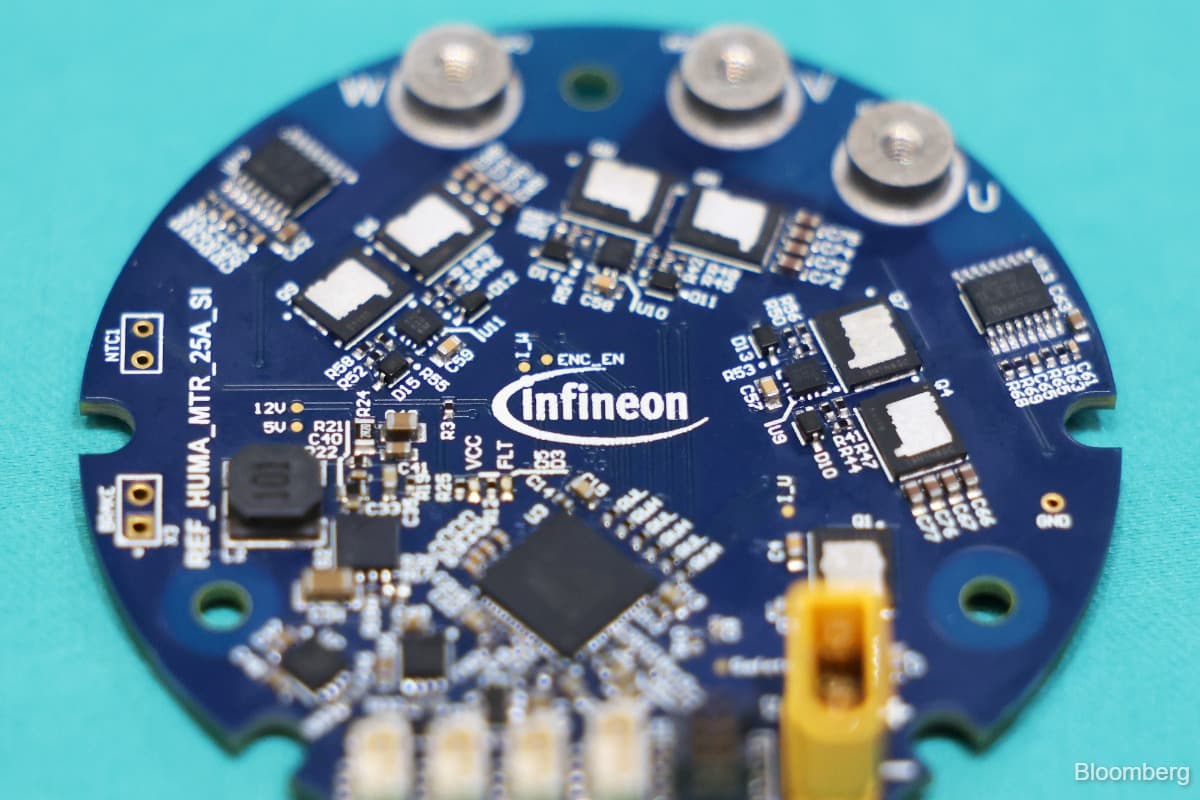
(Oct 1): German chipmaker Infineon Technologies AG sees the potential to eventually start making semiconductors in Thailand, following an investment of 48 billion baht (US$1.44 billion or RM5.84 billion) to expand its assembly and packaging footprint in the country.
The expansion could be a first step towards setting up wafer fabrication, although such a move is unlikely in the next three years, Infineon chief operations officer Alexander Gorski said in Bangkok Wednesday. Thailand’s position as an Asian logistics hub, its developed semiconductor supply chain and its neutral geopolitical stance all work in the country’s favour, he added.
“Bangkok is more than a manufacturing hub for Infineon; it helps strengthen the diversification of our strategic long-term investment,” Gorski said.
Thailand has emerged as a key global exporter of electronic components for artificial intelligence and data centres, alongside Malaysia, Taiwan and South Korea, according to the International Monetary Fund’s annual World Economic Outlook report in July.
The Thai government is pushing to make the country a key part of the AI supply chain, using incentives to spur the industry after decades of relatively low economic growth. The government’s semiconductor strategy targets at least 500 billion baht of investment in its first five years and 2.5 trillion baht by 2050.
Front-end production entails fabricating circuits on wafers, while the back end involves preparing, packaging and testing finished chips. Front-end work requires larger investments and more advanced technology, while back-end operations are often more labour-intensive.
Infineon’s current investment covers the construction of five modules, the first phase of which will open Oct 1.
The investment covers power-module manufacturing, semiconductor testing and a research and development centre, serving the production of chips for electric vehicles, energy systems and data centres.
“We plan to tailor-make incentive packages for the semiconductor industry, especially for upstream semiconductor production and advanced back-end manufacturing,” said Board of Investment Secretary-General Narit Therdsteerasukdi at the same event. He added photonics, power electronics and sensors are priority segments.
Uploaded by Chng Shear Lane