

KUALA LUMPUR (Sept 30): Malaysia must strengthen its readiness for quantum technology to build on the country’s existing foundations and work towards technological sovereignty.
Quantum technology should not be viewed merely as another technology trend, but instead treated as a strategic capability that could shape Malaysia’s economic competitiveness, scientific capacity, resilience and technological sovereignty, said Datuk Amirudin Abdul Wahab, former chief executive officer of CyberSecurity Malaysia and special adviser on cybersecurity and digital technology to the crown prince of Selangor.
“True readiness is much broader. It is about whether we have the knowledge, capability, ecosystem and strategic direction to turn quantum technologies into national value. In my view, that is the real question before us today,” he said during his keynote speech at Mimos Bhd’s Quantum Day 2026.
Quantum technology uses principles of quantum physics to enable new capabilities such as quantum computers that can tackle certain highly complex calculations, quantum sensors that can make extremely precise measurements, and quantum communications that can offer stronger protection for sensitive data.
Amirudin added that technological sovereignty does not mean technological isolation, and that Malaysia does not have to build every quantum processor or fabricate every component locally.
The importance lies in having sufficient knowledge, capability and control to protect national interests while remaining connected to the global technology ecosystem.
“What matters is whether Malaysia understands its strategic dependencies, which technologies we must be able to control, which capabilities we should develop locally, where international cooperation makes strategic sense, and where excessive dependence could create national risk,” he said.
“For a country like Malaysia, the more realistic objective is not to lead every layer of quantum technology, but to identify layers and application domains where we can build genuine depth, create value, and remain strategically relevant.”
Some of the emerging opportunities in quantum technology include complex optimisation, scientific simulation, drug discovery, financial modelling, logistics, climate analysis, cybersecurity and semiconductor design.
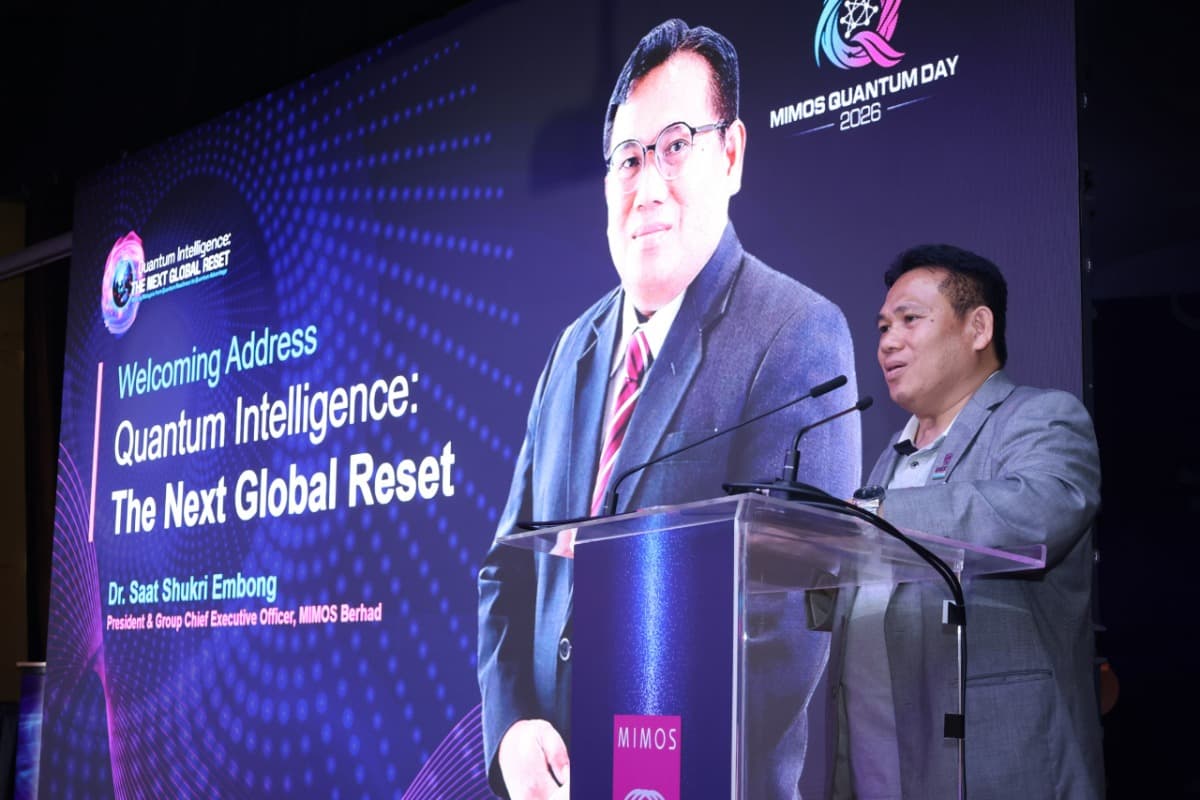
Saat Shukri Embong, Mimos president and group CEO, said that for Malaysia to progress, the country must move beyond simply understanding quantum technology and towards testing, applying and building capabilities around it to prepare for post-quantum cryptography (PQC) and a post-quantum world more broadly.
Mimos’ direction for quantum technology will focus on four priorities: developing shared facilities for testing and experimentation, advancing research and development, addressing real-world use cases and building the talent pipeline in quantum studies.
One initiative undertaken by Mimos is the 52km Quantum Key Distribution project.
Through the MIMOS Quantum Intelligence Centre, quantum technologies have been demonstrated, tested and validated under real operating conditions.
“We are looking at quantum-safe so that organisations can begin preparing their digital security for a post-quantum world. We are also exploring [quantum sensing, quantum computing, as well as] bringing quantum and artificial intelligence (AI) together,” shared Saat.
He added that Malaysia has already made some progress through its existing community of researchers and called for greater industry collaboration.