

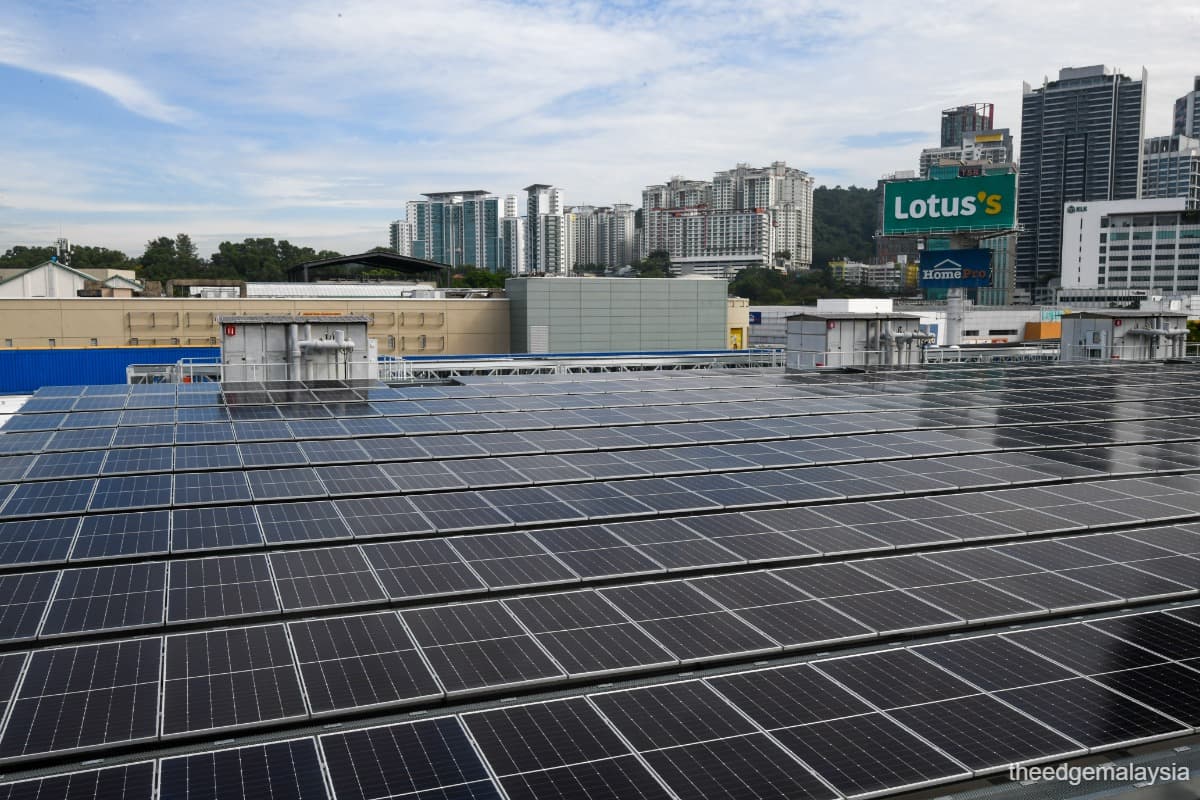
Malaysia already has some of the ingredients for a leadership position among the Association of Southeast Asian Nations (Asean) in sustainable commercial buildings: a substantial domestic energy base, strong year-round solar resources and, increasingly, developments that combine rooftop solar, efficient cooling and thermal energy storage (TES). The problem is not a lack of examples. It is that these examples remain exceptions.
That matters because commercial buildings are not a marginal part of the energy equation. Malaysia’s energy-efficiency planning has estimated that the commercial sector accounts for roughly one-third of national electricity consumption, much of it associated with cooling, ventilation, lighting and appliances. In a tropical economy, cooling is not optional, and demand is unlikely to stand still as more malls, hospitals, hotels, offices and mixed-use developments are built. Malaysia can continue expanding supply to meet that demand as it arrives, or become much better at reducing and managing the demand itself.
Malaysia’s tropical climate makes that challenge more interesting. Heat and humidity create substantial cooling loads, but the same geography provides a valuable energy resource: year-round solar irradiation. The Sustainable Energy Development Authority (Seda), in the Malaysia Renewable Energy Roadmap, identified around 42 gigawatts (GW) of rooftop solar photovoltaic potential nationally, including an estimated 5.2GW across commercial buildings alone. Large commercial properties are particularly well placed to use it because they often combine substantial roof space, predictable daytime occupancy and heavy cooling demand.
Several developments are already demonstrating what this can look like.
Sunway Square in Sunway City Kuala Lumpur uses a district cooling system with TES, allowing chilled water produced during off-peak periods to be stored and used later when cooling demand is higher, according to Sunway Construction Group Bhd’s (KL:SUNCON) 2025 Integrated Annual Report. At 1 Utama, the mall’s 2024 Sustainability Report states that its ice and chilled-water thermal energy storage system can meet around 40% to 50% of peak daytime cooling demand and reduce peak cooling costs by approximately 40%. The mall has also installed more than 5.7 megawatt-peak (MWp) of on-site solar photovoltaic capacity across its rooftops and carparks.
IOI City Mall provides another useful example. IOI Properties Group Bhd (KL:IOIPG) reports that its rooftop solar photovoltaic installation has reached 7.56MWp. The system generated 9,902 megawatt-hours (MWh) in financial year 2025, while separate reporting estimates that solar supplies around 8.2% of the mall’s electricity needs and produces electricity-cost savings of approximately RM5.4 million annually.
What makes these examples interesting is not their green credentials but their numbers. Cooling demand is being shifted, electricity is being generated on site and, in IOI City Mall’s case, the savings are measured in millions of ringgit. They show that better energy performance need not be treated as an environmental extra detached from commercial reality.
Cooling should be treated as part of energy infrastructure
In a tropical economy such as Malaysia’s, cooling is a significant part of electricity demand. TES can help by shifting part of that demand away from peak periods: chilled water can be produced earlier, stored and used later when cooling demand is higher.
That matters because electricity infrastructure must be capable of meeting peak demand, not simply average consumption. For large commercial buildings, reducing or shifting cooling loads can therefore ease pressure on the grid while maintaining the same level of service. Rooftop solar, efficient cooling and TES make more sense when treated as parts of one energy strategy rather than separate sustainability features.
Malaysia’s energy buffer should buy progress, not delay it
Malaysia also has the advantage of pursuing these improvements from a position of relative energy resilience. PETRONAS said in its 2026–2028 Activity Outlook that it aims to sustain domestic production at approximately two million barrels of oil equivalent per day while continuing investments related to decarbonisation and lower-carbon energy. That existing oil and gas base gives Malaysia useful transition headroom.
It does not make the country immune to international fuel prices, shipping disruptions or volatility in global energy markets. The point is not that domestic hydrocarbons remove Malaysia’s exposure, but that they provide some breathing room in which improvements can be made deliberately rather than under crisis conditions.
That headroom should be spent reducing structural demand, not preserving inefficient consumption. Maintaining reliable oil and gas supply while making a shopping centre, hospital or office tower consume less electricity is not contradictory. It is precisely what a managed transition should look like: using the strength of the existing system to make the next one less demanding.
Malaysia therefore does not need to frame energy transition as a choice between hydrocarbons and renewables. A more practical question is how the resilience provided by one can help accelerate better use of the other.
Scale what works, in phases
This does not mean requiring every commercial building to install solar panels or thermal storage. Not every rooftop is suitable for solar, not every cooling profile warrants TES and retrofitting an ageing property is very different from designing a new development.
Malaysia is also no longer starting from a purely voluntary position. The Energy Efficiency and Conservation Act 2024 (EECA), which came into force on Jan 1, 2025 in Peninsular Malaysia and Labuan, strengthened the regulatory basis for building energy performance, while established frameworks such as the Green Building Index (GBI) and GreenRE already provide local mechanisms for assessing sustainability performance.
The next step is to make those frameworks translate into measurable operational results.
Large malls, hospitals, hotels, office campuses and mixed-use developments need clear data on energy intensity, cooling demand and peak electricity use. Incentives should then favour measures with demonstrable returns: high-efficiency chillers, better controls, rooftop solar where viable, and TES where the load profile warrants it.
New large developments should face a higher bar from the outset. Efficient cooling, renewable generation, controllable loads and energy-management infrastructure are easier to design in than retrofit later. And retrofits should not end at installation: commissioning, monitoring and maintenance determine whether projected savings are actually sustained.
A Malaysian model could travel
The regional opportunity makes this more than a domestic building-efficiency question. According to the Asean Centre for Energy, residential and commercial buildings accounted for about 22% of Asean’s total energy consumption in 2022, with building energy demand projected to increase by 56% by 2050.
Malaysia has already helped place the issue on the regional agenda. The Asean Building Investment for Low-Carbon Transition (Asean Built) platform was launched in Kuala Lumpur during Malaysia’s 2025 Asean chairmanship to help mobilise financing for low-carbon buildings.
Malaysia is now in a position to complement that regional framework with something especially valuable: operating evidence from a hot, humid and rapidly urbanising economy.
Sunway Square, 1 Utama and IOI City Mall should not be copied building for building across Southeast Asia. Their value lies in showing that renewable generation, efficient cooling and thermal storage can operate in heavily used commercial properties while retaining a commercial case. The technologies may vary from one city to another, but the engineering knowledge, operating experience and financing lessons can travel.
Malaysia has the solar resource, energy resilience, engineering capability and working examples to become particularly good at designing and operating high-performing tropical commercial buildings. What it lacks is scale.
The Asean leader in sustainable buildings will not be the country with the greatest number of green plaques or the most impressive renderings of future developments. It will be the one that makes high-performing buildings commercially ordinary.
Malaysia already knows that this can work. Continuing to treat the best examples as exceptions would be a policy choice, not a technical limitation.
Dr Mirza Rayana Sanzana is a lecturer (teaching and research) at the School of Information Technology, Monash University Malaysia, specialising in hybrid energy storage systems and AI-enabled energy management for buildings. Her work spans energy forecasting, thermal energy storage and sustainable energy systems.