

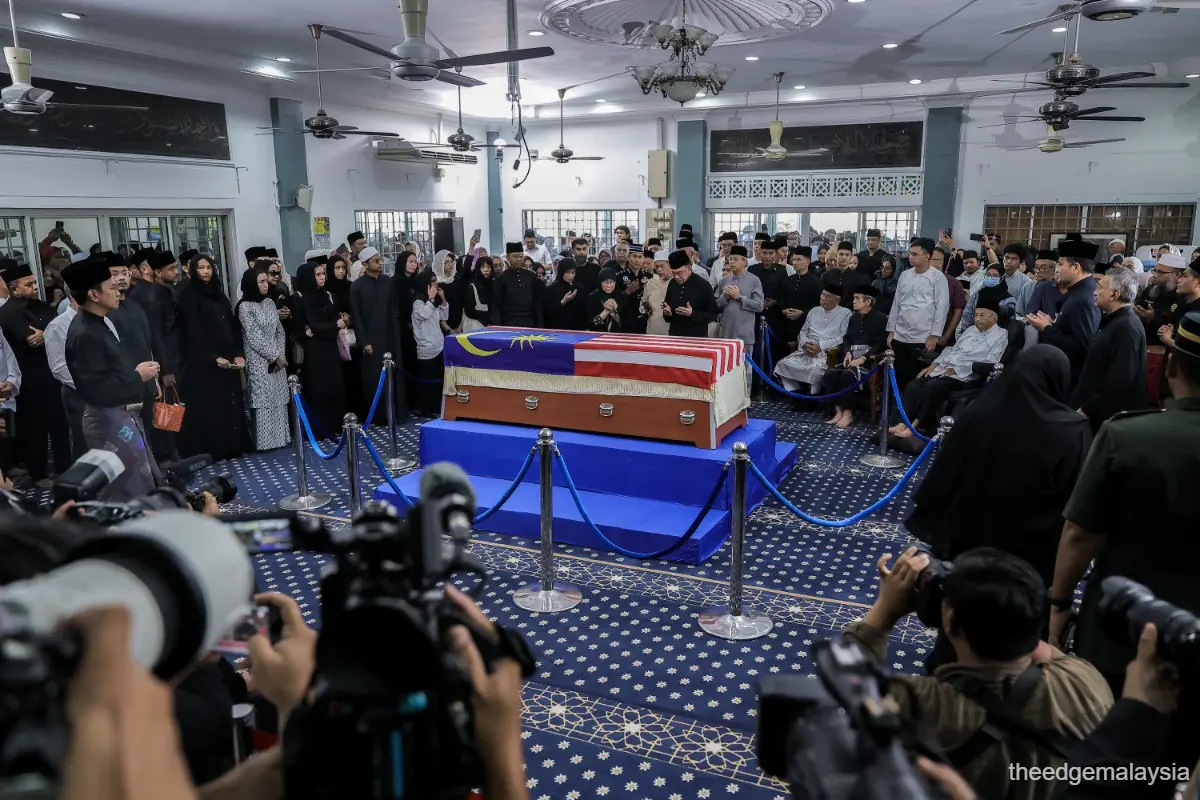
On Sept 28, Malaysia said goodbye to Tun Dr Siti Hasmah Mohd Ali.
Throughout the day, members of royalty, national leaders, friends, family and ordinary Malaysians came to pay their respects before funeral prayers were held at Masjid As-Syarif in Taman Sungai Besi Indah. That evening, after a life that had stretched across an extraordinary Malaysian century, she was laid to rest at Pusara Negara in Putrajaya with the honours of a state funeral. She was 100.
Beside her until the end was Tun Dr Mahathir Mohamad, her husband of seven decades. The photographs from that final journey needed few words. A nation can provide ceremony, prayers, uniforms and protocol; grief remains intensely personal. Eventually the crowds disperse, friends and relatives go home, and a husband is left without the person who had shared almost his entire adult life.
That thought stayed with me.
The following morning, more than 1,600km away in Kota Kinabalu, I was having coffee with a few friends. As conversations among friends of a certain vintage often do, ours wandered through family, health, who ought to exercise more, what was happening in the country and several matters on which coffee seems to give us temporary expertise. Then somebody mentioned Siti Hasmah, and the table changed.
One remembered her smile. Another recalled the violin. Someone spoke of badminton and the affection generations of national players had for her. Someone else remembered seeing her beside Dr Mahathir through decades of official functions and moments in the life of the nation. None of us had known her personally, yet somehow all of us felt we knew something of her.
Perhaps, more simply, we had grown older with her. There are public figures whose passing we register mainly as news. We read the headline, acknowledge their achievements, perhaps say a prayer and continue with the day. Then there are others whose departure lands differently because they have occupied some corner of the national landscape for so long that their presence has become quietly familiar.
Siti Hasmah was such a person.
For Malaysians of my generation, she seemed almost permanently somewhere in the national frame — beside her husband, at a hospital, sporting event, charity function or official gathering. Sometimes she was listening, sometimes laughing, occasionally with a violin in her hands. She never seemed to need the centre of the photograph, yet one noticed her. Perhaps only after she was gone did many of us realise how long she had been there.
What struck me around our little table in KK was what we found ourselves talking about. Not positions or politics, but character — grace, humour, service, marriage, medicine, ageing and companionship. There was also that strange recognition that the generation which populated our younger years was slowly leaving the stage.
Perhaps that is one of the quieter realities of growing older. When we are young, history seems to belong to older people — teachers, ministers, doctors, sportsmen and personalities whose names fill newspapers and whose faces appear on television. They seem permanent because youth assumes permanence rather generously. Then, one by one, they leave, and history is no longer merely something we learnt from books. It becomes something we remember.
Siti Hasmah's passing at 100 carried something of that feeling. Born in Klang in 1926, her life stretched from colonial Malaya through the Japanese Occupation, Merdeka, the formation of Malaysia and decades of extraordinary social and technological change. She knew a world of handwritten letters and radio and lived into one of smartphones and instant messages.
Few lives span such distance. Yet longevity alone does not explain the affection with which she has been remembered.
The doctor before the titles
To remember Siti Hasmah mainly through the public career of her husband would leave too much of her own story untold. Long before the ceremonial occasions and national prominence, she was a doctor.
She entered the King Edward VII College of Medicine in Singapore in 1947 and graduated in 1955. Her career took her into maternal and child health in Kedah, including service among rural communities. In 1965, she became the first woman appointed Medical Officer in the Maternal and Child Health Department and, in 1974, the first woman appointed State Maternal and Child Health Officer in Kedah.
Those achievements may now look like tidy lines in a curriculum vitae, but they belonged to a period when Malaya and later Malaysia were still building the foundations of modern public healthcare. Maternal and infant health needed people willing to enter communities, win trust, educate families and bring safer practices closer to mothers and children.
We often remember nation-building through grand structures — Parliament, highways, universities, factories and airports. But nations are also built in smaller rooms: a rural clinic, a mother receiving advice, a child being vaccinated and a health worker arriving in a kampung. Long before public life placed Siti Hasmah on the national stage, she had already served in that quieter Malaysia — the Malaysia close to the ground.
Beside, not behind
For many years, convention liked to describe the wife of a prominent man as the woman “behind” him. With Siti Hasmah, I prefer another word: beside. Seventy years is a very long time to stand behind anybody.
She stood beside Dr Mahathir through medical school, marriage and family life, through his long years of public service, retirement and later return to office, and finally through the vulnerabilities of advanced age. They married in August 1956. Seven decades followed.
The loss of a wife after such a lifetime together is not simply the loss of the person whose name appears beside yours on invitations. It is the loss of the person sitting across from you at breakfast, the one you turn towards when something amusing happens, the companion who already knows the story you have begun telling, the person who remembers what you were like before the offices, motorcades, headlines and honorifics.
After so many decades, marriage becomes embedded in the rhythm of everyday life. One reaches for the other person almost without thinking. Then suddenly the chair remains, but the person does not.
That is what made the images from the funeral so affecting. Malaysians have known Dr Mahathir for most of his life as a public figure. On Monday there was another, much simpler reality before us: a 101-year-old husband accompanying his wife of 70 years on her final journey.
There is no need for politics in that moment. There is only loss and the compassion one human being can extend to another.
There was still music
Then there was the violin.
I have always found that part of Siti Hasmah's story especially endearing. She played when younger and returned to the instrument later in life. There is something beautiful about someone retrieving music at an age when society sometimes begins gently encouraging people to put things away.
Perhaps there is a lesson there for those of us entering our own later chapters. Ageing need not consist entirely of subtraction. There can still be another friendship to renew, another book to read, another article to write and another tune to play.
Back in Kota Kinabalu, our coffee was probably becoming rather less drinkable. Nobody delivered a formal eulogy or produced her list of honours. We were simply remembering — the spectacles, the smile, the violin, badminton, her years as a doctor and her long companionship with Dr Mahathir.
That morning I realised this may be one of the gentlest measures of legacy: not only whether people remember the positions you occupied, but whether, after you have gone, people who never really knew you can sit around an ordinary coffee table and remember you with affection.
Titles eventually become entries in history. Human warmth travels by another route. It survives in anecdotes, photographs, family stories, remembered gestures and the simple sentence: I remember her.
There was sadness at our table, certainly, but it was more than sadness at the passing of an exceptional centenarian. It was the recognition that another familiar figure from our own journey through Malaysia had gone.
The formal record will preserve the facts: doctor, public-health pioneer, wife and companion, mother, grandmother and national figure.
But memory keeps another ledger — how someone laughed, what interested her, the people she encouraged, the medicine she practised, the music she returned to, the sportsmen who remembered her warmth, and a few friends around a coffee table in Kota Kinabalu wondering why the passing of someone we did not personally know could leave us feeling quite so sad.
Perhaps that is the saddest part of certain farewells. Only when someone is gone do we realise how quietly that person had accompanied our own lives.
The violin has been put away. The doctor has finished her rounds. A century has closed.
To Dr Mahathir, who has lost not simply his wife but his companion, confidante and closest witness to seven decades of shared life, and to their children, grandchildren and entire family, I send my deepest condolences, prayers and love.
May Dr Mahathir be granted strength, health and fortitude in the days ahead. No words from those outside the family can fill the silence left when the person who has always been beside you is suddenly no longer there. But perhaps there may be some comfort in knowing that, beyond the family circle, Malaysians too are remembering her with gratitude and affection.
Rest in peace, Tun Dr Siti Hasmah. Malaysia remembers.
Joseph Tek Choon Yee is a former president of the Malaysian Estate Owners’ Association and past chief executive of the Malaysian Palm Oil Association