

_0.jpg&w=1920&q=75)
(Sept 29): China has started offering low-cost funding to help local government-affiliated firms settle unpaid bills, according to people familiar with the matter, expanding efforts to mend corporate balance sheets and remove one of the biggest bottlenecks for investment.
The People’s Bank of China (PBOC) set up a new relending facility to provide cheap capital to commercial and policy banks, they said, asking not to be identified discussing a decision that hasn’t been made public. The goal is to encourage the lenders to extend credit to mostly state-owned companies known as local government financing vehicles, or LGFVs, and other firms linked to local authorities, according to the people.
The central bank is setting no quota and will instead disburse funds as needed, they added, in a departure from its other so-called structural tools that cap the amount available to eligible financial institutions. Banks can already apply for the funding from the PBOC, which has made no official announcement about the facility and doesn’t list it among its other targeted lending programmes.
Estimates vary about how much is at stake. Researchers at China Chengxin International Credit Rating Co, one of the country’s largest rating firms, said last year that local governments and their affiliates had 4.5 trillion yuan (US$670 billion or RM2.7 trillion) of overdue payments, equivalent to more than 3% of China’s gross domestic product.
The novel source of financing means a bigger role for the PBOC in working through the backlog of arrears that’s cascaded through the economy, putting the squeeze on corporate cash flow and damaging trust in business dealings with the government. It’s also a sign of closer coordination between fiscal and monetary policy in supporting the economy that needs to unlock investment after an intensifying slowdown.
The PBOC didn’t immediately respond to a Bloomberg request for comments.
The programme is designed to help companies make overdue payments owed to contractors and suppliers, the people said. The arrangement, details of which haven’t previously been reported, merited a brief mention in a statement made in August by the State Council, China’s Cabinet headed by Premier Li Qiang.
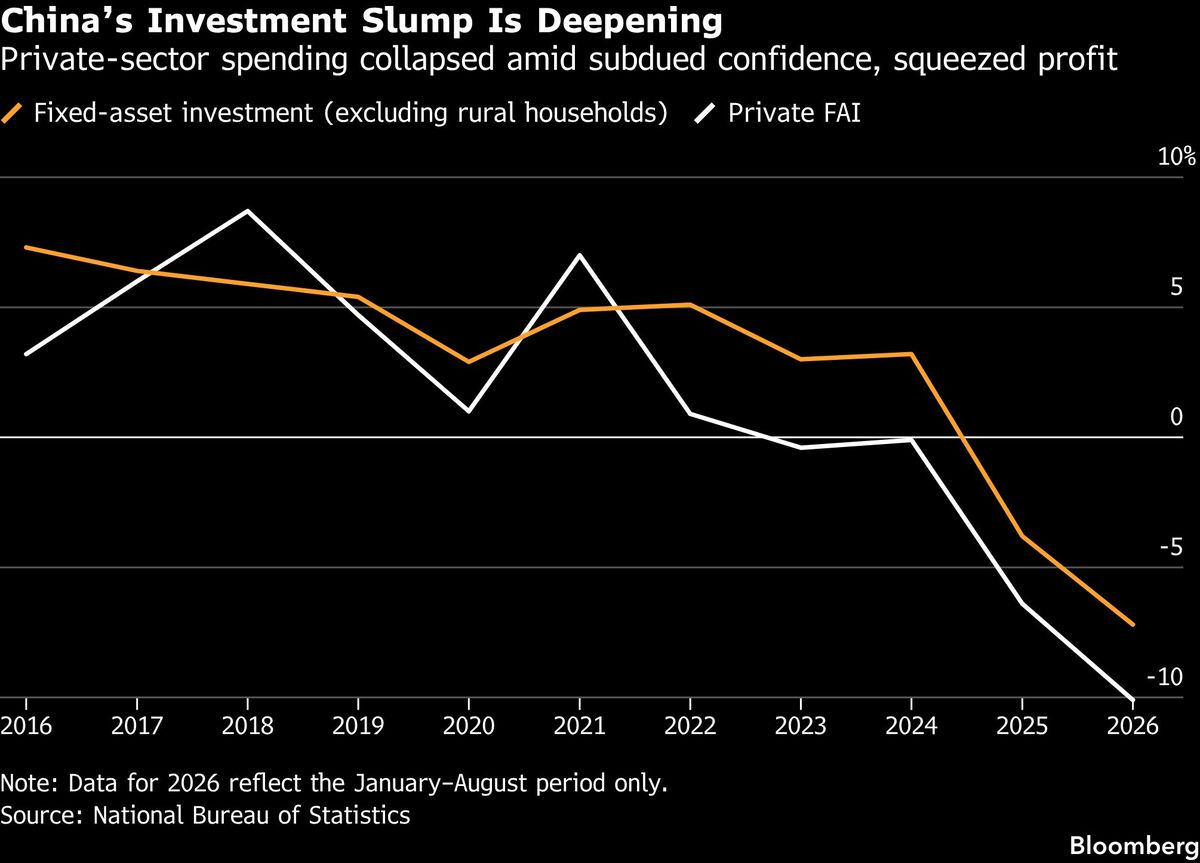
Without elaborating, it revealed that local authorities could tap a targeted relending facility as the government vowed to “accelerate and intensify” the campaign to clear arrears owed to companies. Coming a month after the Communist Party’s powerful Politburo called on officials to address the problem “on a regular basis”, it marked the latest government push to boost business confidence as China’s unprecedented investment slump worsens.
After shrinking in 2025 for the first time in data going back almost three decades, fixed-asset investment fell 7.2% from a year earlier in the first eight months of 2026. The drop-off in private capital spending was even worse, with a slump of over 10% in January-August leaving it on track for its fourth straight year of decline.
Payments in arrears have soared as a years-long housing downturn and slowing growth dented local government income and cut into the cash flow of property developers.
Nomura Holdings Inc has argued that developers are at the center of China’s complicated inter-firm debt network, estimating they alone had around 7.8 trillion yuan in overdue payments.
The delinquent debt is adding to pressure on companies already having to navigate the challenges posed by excess capacity and fierce competition with rivals. That’s thinned profit margins and trapped working capital while further undermining the confidence and willingness of businesses to invest.
Wu Zhiwu, a senior research and development director at CSCI Pengyuan Credit Ratings, wrote in a report last October that the authorities identified 1.8 trillion yuan in arrears owed by self-funded and partially government-backed public institutions, local state-owned enterprises and LGFVs, with a plan to see the debt resolved by providing specialised bank loans.
Proceeds from local bond sales would go towards covering past-due payments of regional governments and fully state-backed public institutions, for which no official tally was available, Wu said. Local administrations had no less than 2.8 trillion yuan in arrears for construction projects as of end-2024, he estimated.
Nomura economists including Lu Ting said in a report earlier this month that “the key to rejuvenating China’s economy” is in clearing out the backlog.
“Given the unique systemic importance of trade credit and the severity of current inter-firm arrears, we strongly believe that cleaning up these arrears is the prerequisite for a genuine recovery in China’s domestic demand and the stabilisation of the property sector,” they said.
Uploaded by Tham Yek Lee