

This article first appeared in Capital, The Edge Malaysia Weekly on September 28, 2026 - October 4, 2026
THE case for elevated crude palm oil (CPO) prices heading into 2027 is becoming increasingly difficult to ignore. At the time of writing, benchmark CPO futures are 19.5% higher than before the start of the US-Iran conflict. A widening chorus of experts, traders and analysts now expect prices to climb further still as the forces driving the move feed into each other.
Brent crude is trading near US$104 a barrel on Middle East supply tensions. Non-subsidised diesel in Indonesia now costs more than three times as much as subsidised biodiesel. Higher fossil-fuel prices have also narrowed the subsidy gap between biodiesel and diesel, making B50 fiscally easier to run, not just more appealing. This prompted Jakarta to revive and accelerate the rollout after previously shelving the idea. The mandate is set to require a record volume of Indonesian palm oil for domestic biodiesel. Additionally, an intensifying El Niño, already declared rather than merely forecast, threatens the production growth Indonesia needs to keep the mandate from squeezing exports further still. But the B50-driven constraint on exportable supply may not have much room left to push prices further.
David Ng, senior proprietary trader at IcebergX, reckons the mandate is largely priced in already: “We probably need to see actual signs that production is not keeping up, or that Indonesian exports and stocks are starting to fall for CPO to make another strong move higher.”
What moves CPO prices from here, in his view, is whether the numbers hold up.
Macro overview
Zoom out, and palm oil is a shrinking slice of a still growing vegetable oil complex.
Global vegetable oil production is forecast to rise to 245.4 million tonnes in 2026/27 from 239.8 million tonnes previously, according to the US Department of Agriculture (USDA). Palm oil is the only one of the four largest vegetable oils actually shrinking, even as the rest of the complex grows.
Palm oil also stands out on the trade side. USDA expects global palm oil exports to fall 2% in 2026/27, even as exports of sunflower and rapeseed oil increase. The proportion of palm oil consumption supplied through international trade has already fallen from almost three-quarters in 2017/18 to below 60% in recent years, largely because producing countries are consuming more of their own output.
Global palm oil production, meanwhile, is set to slip marginally to 81.12 million tonnes in 2026/27 from 81.44 million tonnes, while exports fall to 45.26 million tonnes from 46.25 million tonnes and ending inventories decline to 14.47 million tonnes from 14.95 million tonnes.
For Indonesia, the picture is even more telling. Production is still expected to increase to 47.2 million tonnes from 46.7 million tonnes. Domestic consumption will rise by virtually the same amount, to 23.73 million tonnes from 23.23 million tonnes. Exports, meanwhile, fall to 23.5 million tonnes from 23.8 million tonnes, while ending stocks remain broadly unchanged at 4.07 million tonnes.
The entire 500,000-tonne increase in production is matched by a 500,000-tonne increase in domestic consumption.
So USDA’s base case is not one of falling Indonesian output. It is one where the world’s largest producer grows more palm oil and still has less to sell abroad.
B50 effect
The B50 rollout is already near completion. By Sept 15, the blend had reached 6,050 filling stations, or about 94% of the 6,412 stations covered by the rollout. The government expects the remaining transition arrangements to end by Oct 1.
That scale carries a cost for the export market. Energy Minister Bahlil Lahadalia estimates B50 will require between 16.3 million and 17 million tonnes of CPO annually, up from 15.2 million tonnes under B40.
The additional 1.1 million to 1.8 million tonnes of CPO does not look large against Indonesia’s annual output, but it sits atop the 15.2 million tonnes already required under B40, leaving a smaller share of incremental production available for export.
Ng echoes the sentiment. “I think B50 should continue to provide a decent floor for CPO prices. Indonesia could require somewhere around 16 million to 17 million tonnes of palm oil for the programme, so even if production improves, quite a lot of the supply will still be absorbed domestically. That should keep the overall supply situation fairly tight.”
El Niño worries are real
El Niño — a natural climate pattern that is typically associated with significantly warmer and drier weather across Malaysia and Indonesia — is now firmly established, according to the World Meteorological Organization, which sees a near-100% likelihood that the event persists until February 2027 and expects it to strengthen further.
Indonesia is already showing the early warning signs. Its rainy season is expected to arrive later than normal across around 61% of the country after a prolonged dry spell, with the current El Niño described as the strongest in 11 years.
Palm oil’s response to a prolonged drought is not immediate, though. Ng says the production effect typically appears with a lag of around a year or more. The Malaysian Palm Oil Council similarly puts the lag at around nine to 12 months, pushing the larger production risk into 2027 rather than current output. Estimates cited by Reuters suggest Indonesian palm oil production could decline by 2% to 8% in 2027, depending on the duration and severity of the weather.
“If production only falls by around 1%-2%, I’m pretty sure the market can absorb most of it, especially if stocks remain comfortable. But if we start talking about something closer to a 5% decline or more, then I think it becomes much more significant,” Ng explains.
The last comparable episode shows how severe the production impact can become.Following the 2015 El Niño, Malaysian CPO production fell 13.2% in 2016 to 17.32 million tonnes, while fresh fruit bunch (FFB) yields dropped 13.9% to 15.91 tonnes per hectare, according to the Malaysian Palm Oil Board.
The current event is not guaranteed to produce the same result. But forecasters are already describing it as very strong, the same broad intensity category associated with the 2015/16 episode, while the US National Oceanic and Atmospheric Administration puts the probability of a very strong event this northern hemisphere autumn and winter at above 90%.
Malaysia is also entering that period from a weaker USDA base case. CPO production is forecast to fall to 19.6 million tonnes in 2026/27 from 20.2 million tonnes in 2025/26, with exports declining to 15.9 million tonnes from 16.4 million tonnes and ending stocks falling to 2.35 million tonnes from 2.48 million tonnes.
There is a ceiling
Indonesia can restrict how much palm oil leaves the country, but it cannot force the world’s major importers to keep paying for it at any price.
USDA expects India’s palm oil imports to rise to 8.7 million tonnes in 2026/27 from 8.1 million — the clearest source of incremental demand. But India is also leaning on other oils: sunflower oil imports are projected to jump roughly 24% to 3.85 million tonnes, even as soybean oil imports hold near five million tonnes.
China looks less supportive. Its palm oil imports are forecast flat at 3.9 million tonnes, while sunflower oil imports nearly double to 1.15 million tonnes.
Ng says the relative price matters: “As a rough guide, I would probably look at a palm oil discount of around US$50-US$100 per tonne against soybean oil. Once the discount gets too small, palm becomes less attractive and we normally start seeing some switching.”
There is no hard threshold. Freight rates, import duties and the availability of competing oils can all change the point at which buyers switch.
For now, he sees considerable room before that becomes a constraint. On the benchmarks he tracks, soybean oil is trading at a premium of about US$300 per tonne to palm oil, leaving palm oil comfortably competitive.
That ceiling is not fixed, however. If competing oils become more expensive, palm oil can rise without immediately losing demand.
US biofuel policy could help push soybean oil in that direction. The One Big Beautiful Bill Act extended the Section 45Z Clean Fuel Production Credit until 2029 and, from 2026, restricts qualifying fuels to feedstocks grown or produced in the US, Mexico or Canada. Qualifying non-aviation fuels can receive an applicable credit of up to US$1 per gallon before adjustment for their emissions profile.
For soybean oil, the change makes North American feedstock more attractive relative to imported alternatives.
US soybean oil demand is already strengthening sharply. US biofuel producers consumed a record 1.56 billion pounds of soybean oil in June, up 49% year on year. Soybean oil accounted for 41.2% of the US low-carbon-intensity feedstock pool that month, according to Fastmarkets calculations based on Energy Information Administration (EIA) data.
USDA expects that strength to persist. Total US soybean oil consumption is forecast to rise another 9% to 15 million tonnes in 2026/27, after increasing nearly 13% in the current marketing year.
Ng argues that this matters even though major Asian buyers source much of their soy from South America. “I think US soybean oil demand still matters quite a lot, even though China and India source much of their soybeans or soybean oil from South America. Ultimately, all these vegetable oils are competing with each other. If the US uses more soybean oil for biofuels, it tightens the overall soybean oil market and tends to push Chicago soybean oil higher. That strength normally feeds into South American prices as well, and eventually into palm oil because buyers compare all these oils when making purchases.”
There is a caveat. USDA still expects global soybean oil production to rise to 75.1 million tonnes in 2026/27 and ending stocks to increase to 6.92 million tonnes. So stronger US demand is supportive for soybean oil prices, but the USDA numbers do not yet point to an outright global shortage.
Who actually wins?
For investors, the next question is where higher CPO prices actually translate most directly into earnings.
Neoh Jia En, fund manager at KAF Investment Funds, argues upstream producers have the clearest exposure: “Upstream-heavy producers definitely have stronger earnings leverage to higher CPO prices. Within upstream producers, those that can maintain fresh fruit bunch and CPO output growth despite the impact of El Niño — and, ironically, those with higher production costs — will benefit more.”
That’s because operating leverage cuts both ways: for a planter operating close to breakeven, the same absolute rise in CPO price is measured against a much thinner starting profit margin, producing a far larger percentage increase in profit.
“Indeed, if Indonesian production catches up with the additional demand from the B50 mandate, the upside from further CPO price appreciation would be more limited. Plantation earnings growth would then have to be driven by volume, yield and/or cost improvements,” he adds.
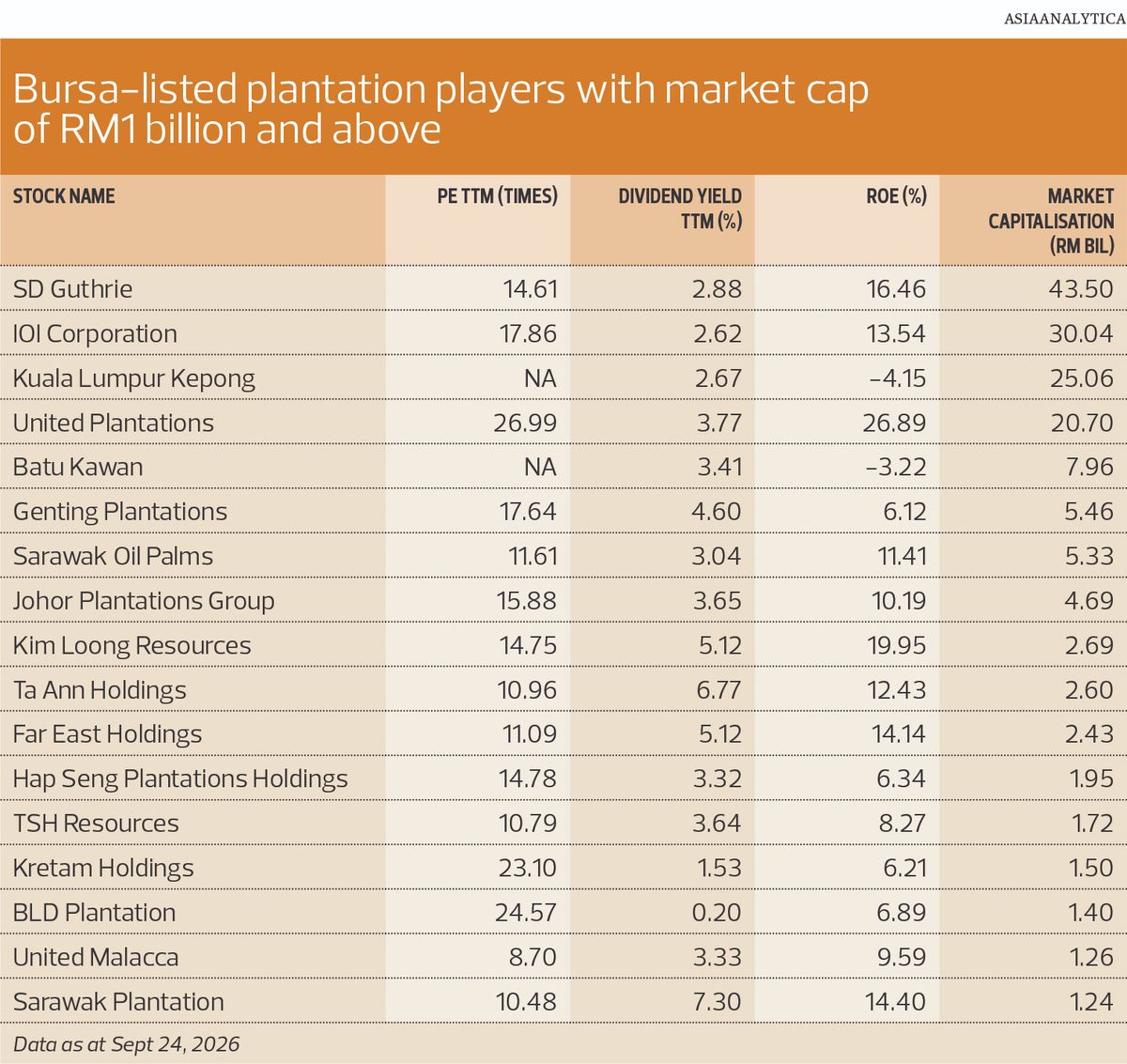
On those measures, he favours planters in Sabah and Sarawak, including Sarawak Oil Palms Bhd (KL:SOP), Ta Ann Holdings Bhd (KL:TAANN), Hap Seng Plantations Holdings Bhd (KL:HSPLANT) and Sarawak Plantation Bhd (KL:SWKPLNT), citing prevailing rainfall patterns and management guidance for FFB growth.
The picture is murkier for integrated groups. “Among integrated groups, companies where upstream growth is strong enough to outweigh pressure on downstream margins, or where downstream businesses have sufficient pricing power to pass through higher feedstock costs, will be the stronger beneficiaries,” Neoh says.
That makes stock selection increasingly important if CPO prices simply hold rather than continue to climb.
Neoh also does not believe valuations have run away from fundamentals. “I do not see sector valuations as excessive, although there is meaningful dispersion.”
He notes that most Malaysian plantation names continue to generate healthy cash flow while trading at forward price-earnings ratios in the teens.
Neoh flags a name with a catalyst that doesn’t depend on CPO at all. SD Guthrie Bhd’s (KL:SDG) 1.2 billion sq ft land bank on Carey Island, Selangor — under 2% of its total land bank — could, by his estimate, be worth more than the company’s entire market capitalisation if rezoned from agricultural to industrial use, assuming a RM15 psf conversion premium and an industrial land price of RM60 to RM80 psf.
But that is a theoretical gross valuation, not cash that SD Guthrie can realise immediately. Rezoning, development and monetisation would take time, and not all of the land may ultimately be converted or sold at those assumed prices; furthermore, proceeds would likely be realised in stages.
For investors, upstream exposure may be the cleanest way to benefit from elevated CPO prices. But if the commodity stops climbing, the stronger case shifts to companies that can still grow through better volumes, yields, costs or catalysts outside palm oil itself.
Save by subscribing to us for your print and/or digital copy.
P/S: The Edge is also available on Apple's App Store and Android's Google Play.