

_20261002225816_theedgemalaysia.jpg&w=1920&q=75)
This article first appeared in The Edge Malaysia Weekly on September 28, 2026 - October 4, 2026
DUOPHARMA Biotech Bhd (KL:DPHARMA), the country’s largest generic drug manufacturer by market share, is stepping up exports and expanding its biologics portfolio as it looks to offset a decline in domestic market share for human insulin.
Group CEO Wan Amir-Jeffery Wan Abdul Majid says the group is targeting growth across Asean, China, India, the Middle East and Africa as it seeks to build its next growth engine.
The strategy follows changes in government procurement that have seen rival Pharmaniaga Bhd (KL:PHARMA) take a larger share of the human insulin market. Duopharma had briefly become the sole supplier of human insulin to government hospitals and clinics nationwide following Danish pharmaceutical giant Novo Nordisk A/S’ exit from Malaysia’s human insulin market in the first half of 2024.
The group capitalised on the opportunity, posting record earnings in the financial year ended Dec 31, 2025 (FY2025). Net profit for FY2025 rose 39.6% to RM87.46 million from RM62.65 million in the previous year, while revenue increased 14.5% to RM931.69 million from RM813.7 million.
But the government subsequently awarded Pharmaniaga a contract to supply human insulin to public hospitals, adopting a dual-supplier model to reduce dependence on a single provider.
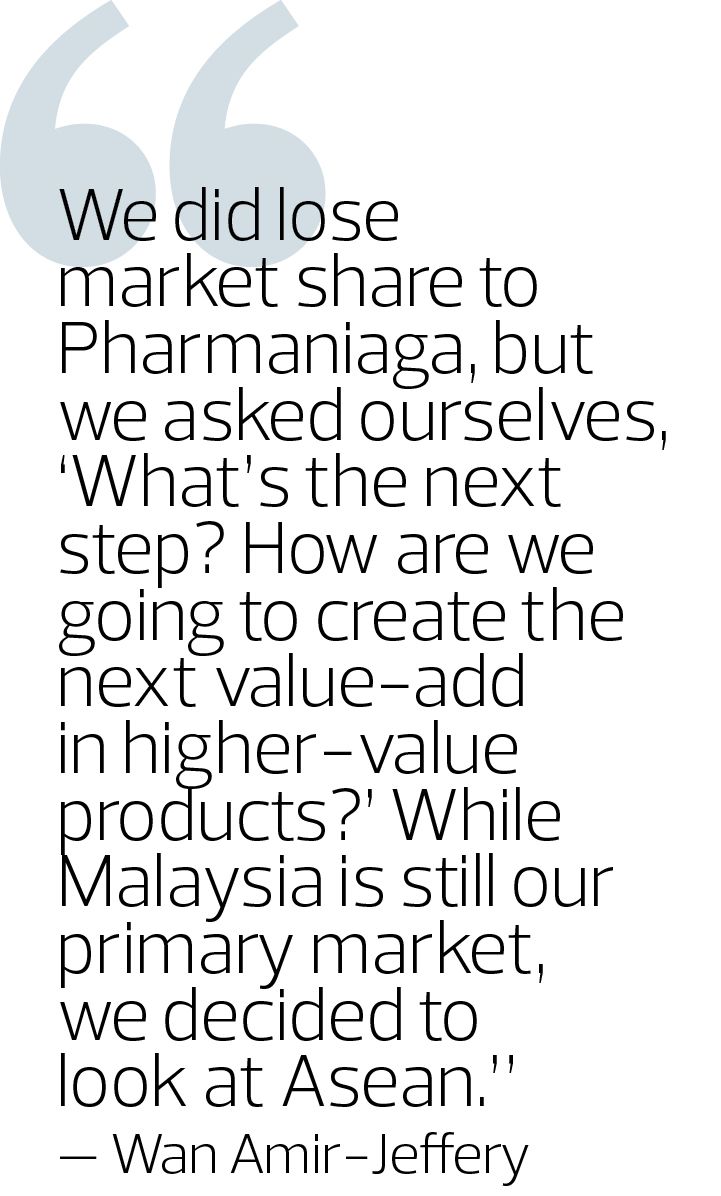
“We did lose market share [to Pharmaniaga], but we asked ourselves, ‘What’s the next step? How are we going to create the next value-add in higher-value products?’ While Malaysia is still our primary market, we decided to look at Asean. There are other markets outside as well that we are already in. There are other markets that we are not in yet, and we want to go into [them] as well,” Wan Amir-Jeffery tells The Edge in an interview.
Duopharma’s international business grew about 22% last year, with the Middle East remaining a key market despite geopolitical tensions.
Wan Amir-Jeffery says the group is also assessing opportunities in Africa, although it intends to be selective. “We have to pick those markets accordingly because we want to make sure that we get the biggest bang for the buck and our resources are actually expanded in the right markets.”
Rather than establishing wholly-owned operations from the outset, Duopharma plans to work with established distributors that already understand local markets.
Exports currently constitute a relatively small part of its business, accounting for 7.5% of revenue in 1HFY2026. The Philippines was the largest contributor, at 37.7% of export revenue, followed by Singapore (29.3%) and the Middle East (16.6%).
Biologics at the heart of expansion
Wan Amir-Jeffery remains firmly focused on biologics — complex medicines derived from living organisms — as the group’s main avenue for higher-value growth.
“I still stand by the focus and strategy on biologics. I think that’s the way to go because, globally, that’s proven to be the case. There are a lot more new biological entities being produced compared with chemical drugs. So, in that regard, I think you can’t go wrong if you pivot towards biologics, and that’s our key focus,” he says.
However, the group has yet to set a specific target for biologics export revenue or its contribution to earnings.
Instead, Duopharma plans to establish a presence in new markets through partnerships and trading arrangements before considering technology transfer or local manufacturing once sufficient scale and economics justify the investment.
Its biologics portfolio currently includes products secured through partnerships with global biopharmaceutical companies such as India-based Biocon Ltd and South Korea-based PanGen Biotech Inc. The partnerships cover products for diabetes, oncology, ophthalmology and renal care, including human insulin and insulin analogues, biosimilars and erythropoietin, a biologic used to treat anaemia, particularly in patients with chronic kidney disease.
Government contracts are expected to remain an important route into emerging markets, with such contracts typically secured for two to three years before being put out to tender again.
Duopharma also wants to tap the private sector by partnering with distributors that have established commercial networks.
Building the pipeline before K5
Those partnerships could eventually feed into Duopharma’s plans to establish high-value manufacturing capabilities in Malaysia, including at its specialised biotechnology manufacturing facility in Klang, Selangor, known as K5. The facility has not been launched yet as the group works to build a sufficiently large product pipeline and secure long-term partners to make the investment economically viable.
“We’ve been talking about K5. Now, there’s a reason why we haven’t actually launched K5. It’s because we need to pipeline more products into K5. That’s about making sure we have a viable portfolio of products that will give us the returns we need from that investment,” says Wan Amir-Jeffery.
The group is looking for partners willing to work with it over the longer term, he says, noting that Chinese and Indian companies that are established but not too large and need a local partner like Duopharma could provide a useful starting point.
Duopharma recently signed a memorandum of understanding with China-based Chongqing Zhifei Biological Products Co Ltd to explore the trading of its biological products and vaccines in Malaysia and across Asean.
For now, trading provides a bridge between importing products from partners and eventually manufacturing them locally once sufficient scale is achieved.
Duopharma does not intend to have manufacturing replace trading entirely. Instead, it plans to continuously replenish its trading pipeline so that individual products can move into local manufacturing without creating a corresponding drop in revenue.
“The trading part is a stopgap measure. You start out by trading, and then the products that you’re trading now, you will then manufacture if there is scale,” says Wan Amir-Jeffery.
“But you continuously pipeline trading products, not just from one party. So that’s how you maintain a more steady growth approach rather than experiencing a dip.”
The next insulin play
Duopharma’s net profit for 1HFY2026 rose 32.2% to RM60.59 million from RM45.84 million a year earlier, supported by a more favourable product mix, a stronger ringgit that lowered input costs for most active pharmaceutical ingredients and continued operational efficiencies. Revenue, however, slipped 0.5% to RM482.24 million from RM484.52 million, mainly because public sector insulin sales normalised after a one-off surge in 1HFY2025.
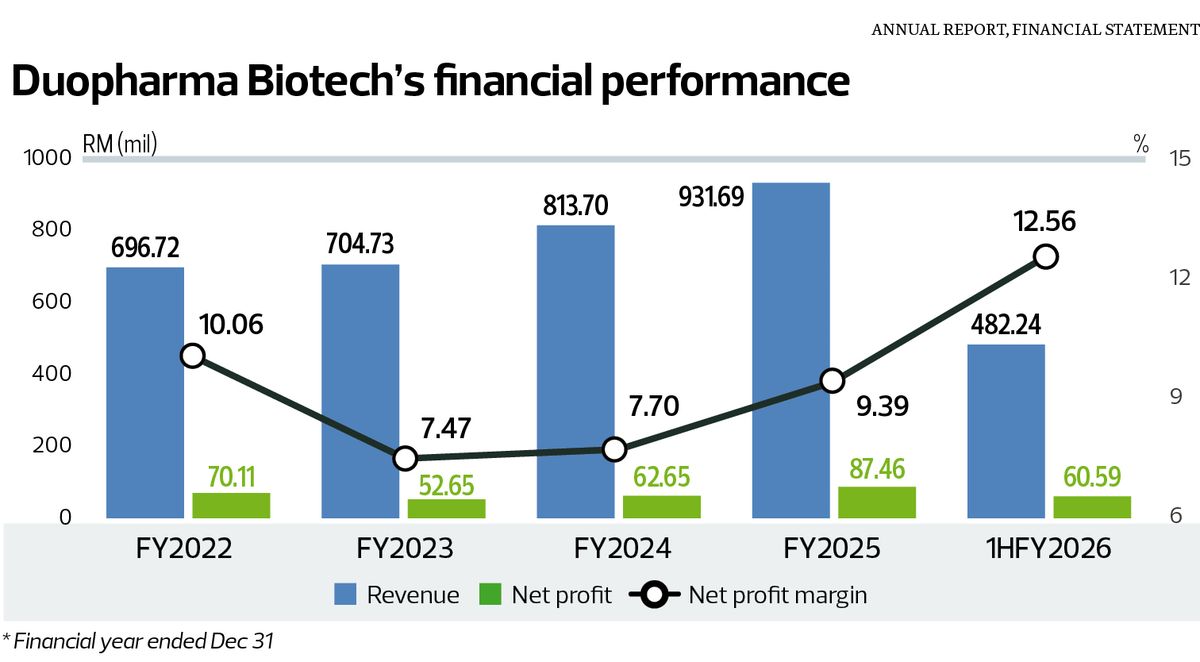
Bloomberg data shows analysts expect Duopharma to post a net profit of RM106.33 million in FY2026 and RM110 million in FY2027.
Despite losing domestic market share, the group still sees room to expand its insulin business as demand rises alongside the growing prevalence of diabetes.
The International Diabetes Federation estimates that 589 million adults aged 20 to 79, or one in nine globally, are living with diabetes, and that number is projected to reach 853 million by 2050.
In Malaysia, human insulin remains more widely used than clinical insulin analogues, largely because of the lower cost. The Ministry of Health (MOH) accounts for about 90% to 92% of the country’s insulin purchases by volume, with the balance coming from the private sector.
Duopharma was previously the dominant supplier of human insulin to the government, supplying about 80% of its requirements as the primary distributor for Biocon Biologics Ltd, a subsidiary of Biocon, which manufactures insulin for the local market in Johor.
However, production issues at Biocon in 2024, coinciding with Novo Nordisk’s withdrawal from Malaysia’s human insulin market, contributed to an acute shortage of human insulin in the country. MoH subsequently adopted a dual-supplier model to reduce reliance on a single source.
Under the latest arrangement, Pharmaniaga has about 70% of the government market, leaving Duopharma with about 30%, compared with 80% previously. Duopharma is now looking at higher-value insulin analogues, including long-acting insulin glargine and rapid-acting insulin aspart.
Wan Amir-Jeffery says the uptake of analogues in Malaysia remains relatively low because of their higher cost, but greater adoption could create a larger opportunity for the group.
“We are still using human insulin, but we’re converting a little bit into analogues, but not very much. Because it’s a cost factor. If we were to convert, utilising more analogues than human insulin, then what we’re doing is actually increasing the volumes that we’re using,” he adds.
Wan Amir-Jeffery says Biocon’s manufacturing facility in Johor could potentially help bring down the cost of analogues and make them more accessible to patients. The opportunity would become more significant if MoH were to increase its use of insulin analogues.
While human insulin remains in high demand in Malaysia, other markets have shifted towards more analogues, which are higher-value products and can offer improved treatment adherence. “We would want to naturally move to the higher-value insulins,” he says.
Playing the long game in Indonesia
Duopharma is taking a longer-term view of Indonesia, giving its operations there another two years to reach break-even.
The group initially served Indonesia by exporting products from Malaysia through local distributors. In 2023, it established PT Duopharma Healthcare Indonesia (PT DHI) to build a local presence and expand its consumer healthcare business with brands such as Flavettes, Proviton and Champs.
“Indonesia is still an attractive market. Population is one [reason]. It is also very dispersed, so logistics is a bit of a tough one. But it has the capabilities. It has local distributors who can do the job,” says Wan Amir-Jeffery.
He acknowledges that the market remains challenging, citing the weakening rupiah and other factors that have weighed on investor sentiment. Still, Duopharma intends to stay the course.
“Overall, Indonesia is still a large market. We just need to be resilient. You must have stamina in a market like this and decide that you want to stay, then bring in certain products, use certain partners, use certain distributors and extract as much value from it as you can. I think I would give it two more years,” says Wan Amir-Jeffery.
The group’s experience in the Philippines illustrates why it is prepared to take a long-term approach. Duopharma entered the Philippines in 2009 but only began making money in 2018 or 2019. The business was hit by the Covid-19 pandemic in 2020, recovered in 2021 and returned to profitability in 2022. The Philippines has since become the group’s largest export market by revenue, overtaking Singapore.
Rejects talk of merger with Pharmaniaga
Speculation about a potential merger between Duopharma and Pharmaniaga continues to resurface, but no firm proposal has reached Duopharma’s management, says Wan Amir-Jeffery.
The group is open to considering a proposal, but any transaction would have to make strategic and financial sense and create value for shareholders.
“There are parties who want to see that happen. We are open to hearing it, but so far nothing has come to my table. But yeah, I’ve heard the same rumour,” he says.
“If we did go down that route of considering it, then we will have, again, like I said, what makes sense to us from a business standpoint and how it contributes to shareholder value creation. That’s the most important.”
Both pharmaceutical groups have ties with government-linked organisations, with Permodalan Nasional Bhd (PNB) holding a 43.1% stake in Duopharma and Lembaga Tabung Angkatan Tentera (LTAT) having a controlling 54.9% stake in Pharmaniaga.
Duopharma is actively scouting for acquisition targets, although none has progressed to a serious level, says Wan Amir-Jeffery.
“It has to be a company that is not in trouble. It has to be value-accretive, have revenue, profitability. It is a good company, has differentiated technologies, differentiated portfolio of products, preferably in Malaysia, if not Asean,” he adds.
As at June 30, 2026, Duopharma’s cash and cash equivalents stood at RM255.99 million against total borrowings of RM471.6 million.
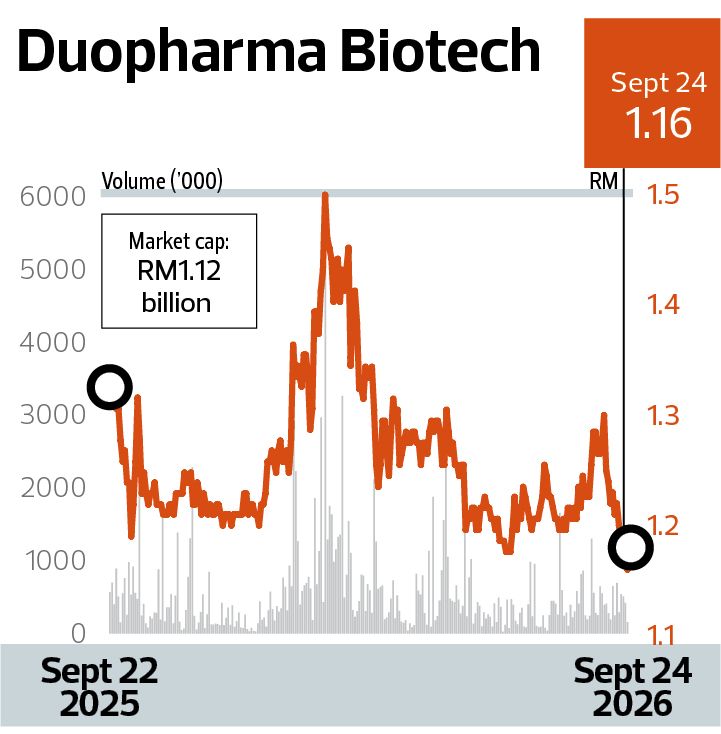
Its share price peaked at RM1.50 on Feb 19 this year before falling 22.7% to close at RM1.16 last Thursday, giving the group a market capitalisation of RM1.12 billion.
At RM1.16 each, Duopharma’s shares were trading at a forward price-earnings ratio (PER) of 10.91 times, below Kotra Industries Bhd’s (KL:KOTRA) 14.06 times and Nova Wellness Group Bhd’s (KL:NOVA) 11.70 times. Pharmaniaga had the highest forward PER at 18.93 times, according to Bloomberg.
For Duopharma, the strategy is in place. The next test is converting its growing product pipeline and market into sustained earnings growth.
Save by subscribing to us for your print and/or digital copy.
P/S: The Edge is also available on Apple's App Store and Android's Google Play.