


This article first appeared in The Edge Malaysia Weekly on September 28, 2026 - October 4, 2026
FOR years, Oppstar Bhd (KL:OPPSTAR) was mainly confined to designing chips for others.
Now, the Penang-based integrated circuit (IC) design house wants to broaden its business scope, becoming a turnkey service provider in the IC chip industry. On top of that, Oppstar intends to tape out its own chips.
Under this model, a customer provides the product specification while Oppstar handles more of the development process, from chip design and tape-out through foundry engagement and board enablement.
Management calls this transformation Oppstar 2.0 — keeping its established chip-design services business while adding product development and intellectual property (IP) capabilities to capture more value from its technology.
Its co-founder and co-CEO Ng Meng Thai says this provides an avenue to grow recurring revenue. Oppstar can also incorporate its own IP into products and potentially earn royalties as those products are sold.
The shift is significant because much of Oppstar’s traditional business is project-based. There will be no recurring revenue once the project is completed.
The strategy is being accelerated by Oppstar’s access to Arm Holdings plc’s Compute Subsystem (CSS), specifically the N2 system, which gives an extra push for Oppstar to climb the value chain. Access to Arm’s CSS provides a foundation for Oppstar to develop specialised CPUs on an advanced process node.
In August, Oppstar was given access to one of the seven CSS tokens secured under the Malaysian government’s 10-year, US$250 million (RM1.1 billion) agreement with Arm. So far, four of the seven tokens have been allocated (see sidebar “Arm CSS gives Oppstar a head start, not a shortcut to earnings”).
Co-founder and chief operating officer Tan Chun Chia believes Arm’s token is a great stepping stone for Oppstar to cement a foothold in the global semiconductor industry and to serve bigger clients.
“Companies like Alchip [Technologies Ltd] of Taiwan and Socionext [Inc] of Japan are also design service companies — Google and many other major companies go to them to design chips. If we are able to execute this successfully, it will bring us to that kind of level, where the world knows us,” Tan says.
Nonetheless, Oppstar is realistic, too, knowing that access to Arm’s CSS is unlikely to generate income anytime soon. It cannot rely solely on this project and will need other work to sustain its operations.
The company signed an agreement with Samsung Foundry in 2024 as part of efforts to strengthen its foundry capabilities and expand beyond pure design services.
Management stresses that the push for Oppstar 2.0 is built on capabilities the company has accumulated over the years, rather than being a sudden attempt to ride the current AI boom.
Co-founder and co-CEO Cheah Hun Wah says Oppstar had already been working on AI-related chip technology before the pandemic. More importantly, the objective is to gradually move from being a service provider towards product and IP actualisation.
“Before the pandemic, we were already taping out a chip through TSMC (Taiwan Semiconductor Manufacturing Co Ltd) using 40nm process technology. We were already working on AI,” Cheah tells The Edge at its Penang headquarters. “That is our key strength. With that in mind, we can propel ourselves.”
Founded in 2014 by Ng, Tan and Cheah, Oppstar is the first chip designer to list on Bursa Malaysia. The trio, former colleagues and chip-design engineers at Intel Malaysia, collectively owns 54.65% of the company.
Capturing the edge-AI opportunity
Edge AI — putting computing and AI capabilities directly into cars, industrial equipment, surveillance systems, home appliances, robots and other devices — is an area that Oppstar will focus on moving forward.
Rather than competing head-on with Nvidia Corp and Advanced Micro Devices Inc (AMD) in the data-centre market, Oppstar believes its opportunity lies in the next stage of AI adoption: bringing intelligence out of the data centre and into everyday devices.
“AI is going to move from the data centre to all the devices,” Ng says.
A vehicle, for example, cannot depend entirely on an internet connection to send every camera image to a remote data centre before making a decision. Critical AI functions need to be processed locally, creating demand for specialised combinations of central processing units (CPUs) and neural processing units (NPUs). This is where Oppstar believes its chip-design expertise will come in handy.
The home-grown chip designer has already begun positioning itself for the market segment. Tan says Oppstar has made an initial investment in an NPU start-up in Taiwan, which it sees as complementary to its CPU capabilities.
The applications being explored are wide-ranging, implying the exponential potential to be taped.
A camera mounted near a railway track, for example, could identify loose components or safety hazards and send an alert to a control centre. Similar technology could be deployed in ports, factories, airports and other infrastructure where large volumes of visual information need to be processed quickly.
In Japan, for instance, Oppstar is working with an AI software company whose technology is used in areas such as smart-city systems, factory robot control and railway-track inspection. The Japanese company has the AI expertise but lacks an in-house hardware team, creating a potential fit with Oppstar’s chip-design capabilities.
Cheah is also eyeing the seaports. He explains that container and vehicle movements are high in volume and still largely handled manually.
Oppstar is exploring how its chip technology could eventually support autonomous trucks, automated cargo clearance and other AI-enabled systems at ports, Cheah says.
The vision is not necessarily for Oppstar to build an entire autonomous system itself, but to provide the underlying silicon and hardware capability that enables these systems.
Growing an international footprint
Oppstar now has a presence in Shanghai, Yokohama and Taiwan. Japan is a market in which the company sees opportunities in industrial AI, railway systems and automation. Its Taiwan office, opened in January 2026, places it close to some of the world’s leading chip-making facilities and gives the company closer access to advanced manufacturing technology. China remains a market of interest, given its size.
The longer-term ambition extends beyond Asia. Cheah says Oppstar could eventually establish a presence in the US because technological capability alone is insufficient if the company lacks proximity to major customers.
For now, however, management wants to establish itself among tier-two international players before attempting to penetrate the biggest markets.
Supporting this expansion, Oppstar has grown its workforce to roughly 350, from 180 five years ago, and expects its headcount to continue to grow over the next one to two years.
Cheah also points to the organisation’s technical depth, citing chief technology officer (CTO) Lim Han Wooi, a former senior principal engineer at Intel Malaysia specialising in advanced process nodes, full-chip and system-on-chip (SoC) design. Cheah describes Lim, a close friend, as one of the country’s most experienced engineers in his field.
The company believes this technical leadership can help it build a deeper in-house talent base rather than simply compete for experienced engineers in an increasingly tight market.
“Today, with our CTO office and talented technologists, we have already propelled ourselves,” says Cheah.
Oppstar also plans to work with Malaysian public and private universities and other institutions to develop semiconductor talent.
A recovery, but not a straight line
The three co-founders are optimistic that the stars may have aligned and expect better days ahead, although Oppstar’s earnings could swing from quarter to quarter because revenue recognition depends on project milestones.
Oppstar’s unbilled order book stood at roughly RM50 million at end-March, with about 40% related to AI-focused projects. Management, however, remains cautious about forecasting a smooth progression.
Ng says the company is only halfway through its financial year, leaving room for new customers and projects to emerge, while acknowledging that some external factors remain beyond its control.
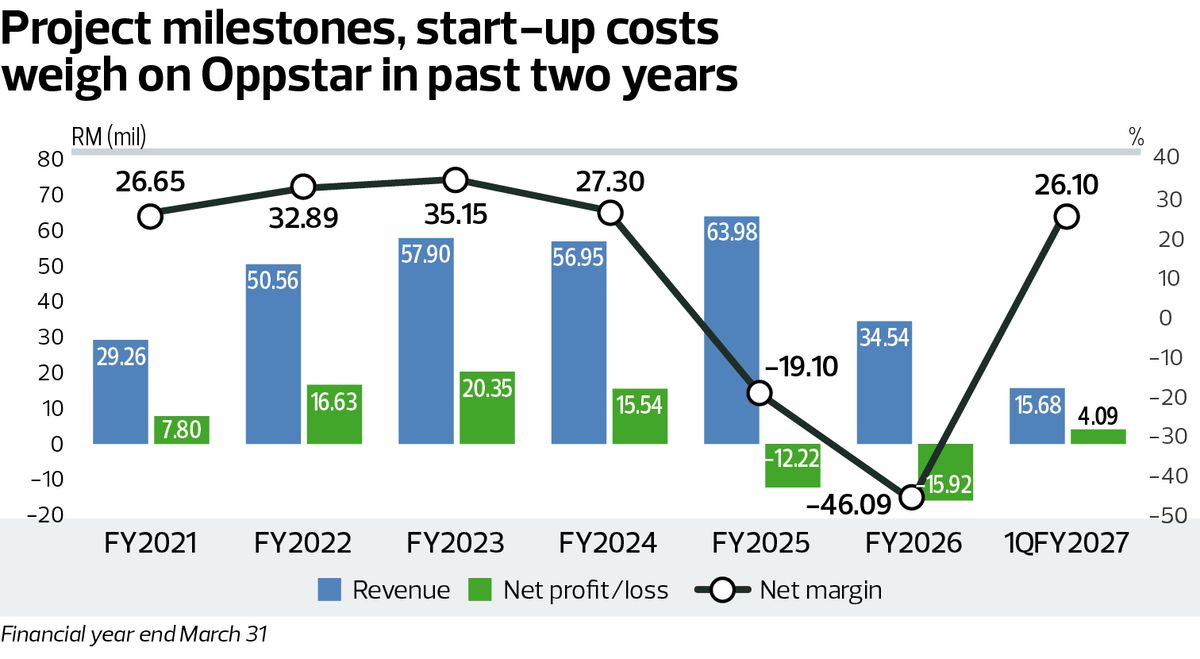
It wasn’t a good year for Oppstar in the financial year ended March 31, 2026 (FY2026), in terms of earnings. Revenue fell 46% to RM34.54 million from RM63.98 million a year earlier, owing mainly to the absence of revenue from the semiconductor wafers and components segment, which contributed about RM26.8 million in FY2025.
The chip designer’s net loss widened to RM16.03 million in FY2026, from RM12.2 million a year earlier.
The latest financial picture, however, has improved sharply. In 1QFY2027, Oppstar returned to profitability after seven consecutive quarters of losses, posting a quarterly net profit of RM4.09 million on revenue of RM15.86 million.
The turnaround was driven by higher revenue recognition, particularly from turnkey design services, alongside improved utilisation of its engineering resources.
Following the better results, Kenanga Research upgraded the stock to “market perform” from “underperform” and raised its target price to 75 sen from 43 sen. The research house said it believed the turnaround was sustainable, although quarterly earnings could remain lumpy because revenue is recognised upon the achievement of project milestones.
On its balance sheet, Oppstar has total liquidity of about RM109.74 million, comprising RM9.54 million in cash, RM64.29 million in money market funds and about RM35.91 million in quoted financial instruments.
Oppstar raised RM104.25 million when it listed on the ACE Market in March 2023. As at end-March, RM39.84 million remained unutilised, while part of the proceeds has been used to expand the workforce, fund R&D expenditure and establish its Japan and new Kuala Lumpur offices.
Investors take notice
On May 11, Oppstar’s share price surged 79% in a single day after it secured a government offer to access Arm’s Flexible Access (AFA) token. The stock continued climbing in the following days, reaching a 52-week high of RM1.06 on May 19. In less than a month, the share price had more than tripled from around the 30 sen level.
The rally also coincided with bullish sentiment in the semiconductor sector, including the blockbuster listing of Skyechip Bhd (KL:SKYECHIP), which opened at RM3.50 on May 20, nearly three times its IPO price of 88 sen, before closing at RM2.21, or 151% above its IPO price, on its first trading day.
Oppstar’s share price also made a big leap on its debut, soaring 286% above its offer price of 63 sen.
The shares had been on a downward trend for more than three years, however, hitting a low of 17.5 sen in March 2026 amid lacklustre financial performance.
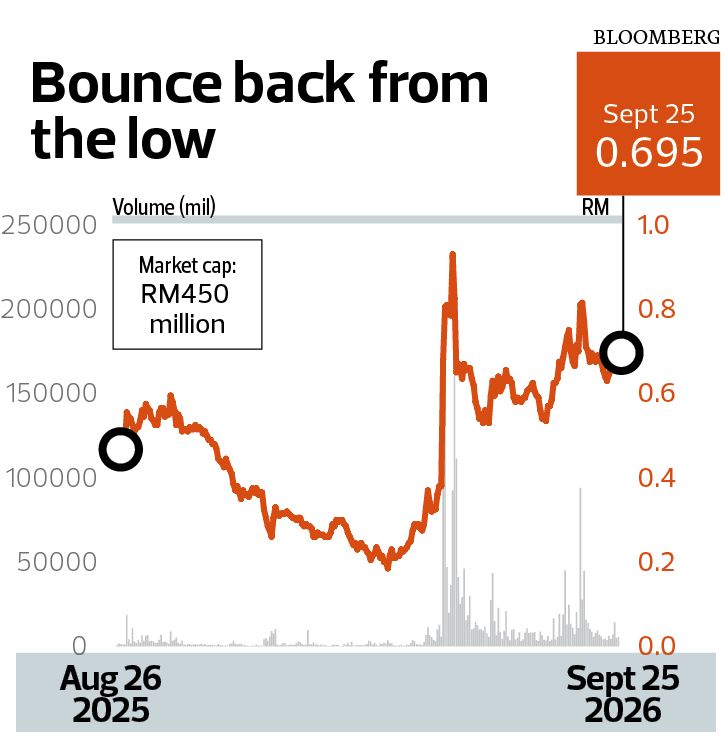
This year, the stock has been riding the global AI boom. It has gained 105% since the start of 2026. At last Friday’s closing price of 69.5 sen, it was only slightly above its IPO price of 63 sen in March 2023. The group’s market capitalisation stood at RM450 million.
Based on analysts’ forecasts, the stock was trading at a forward price-earnings ratio (PER) of 33.1 times. For comparison, Taiwan’s Alchip trades at a forward PER of 20.1 times, and Japan’s Socionext trades at 27.8 times.
The two brokers that currently cover the stock have a “hold” rating. Kenanga Research has a target price of 75 sen, and UOB Kay Hian’s stands at 51 sen.
Demand for chips is expected to remain strong. Oppstar now needs to execute well to capture its share of that growth.
Save by subscribing to us for your print and/or digital copy.
P/S: The Edge is also available on Apple's App Store and Android's Google Play.