

This article first appeared in The Edge Malaysia Weekly on September 28, 2026 - October 4, 2026
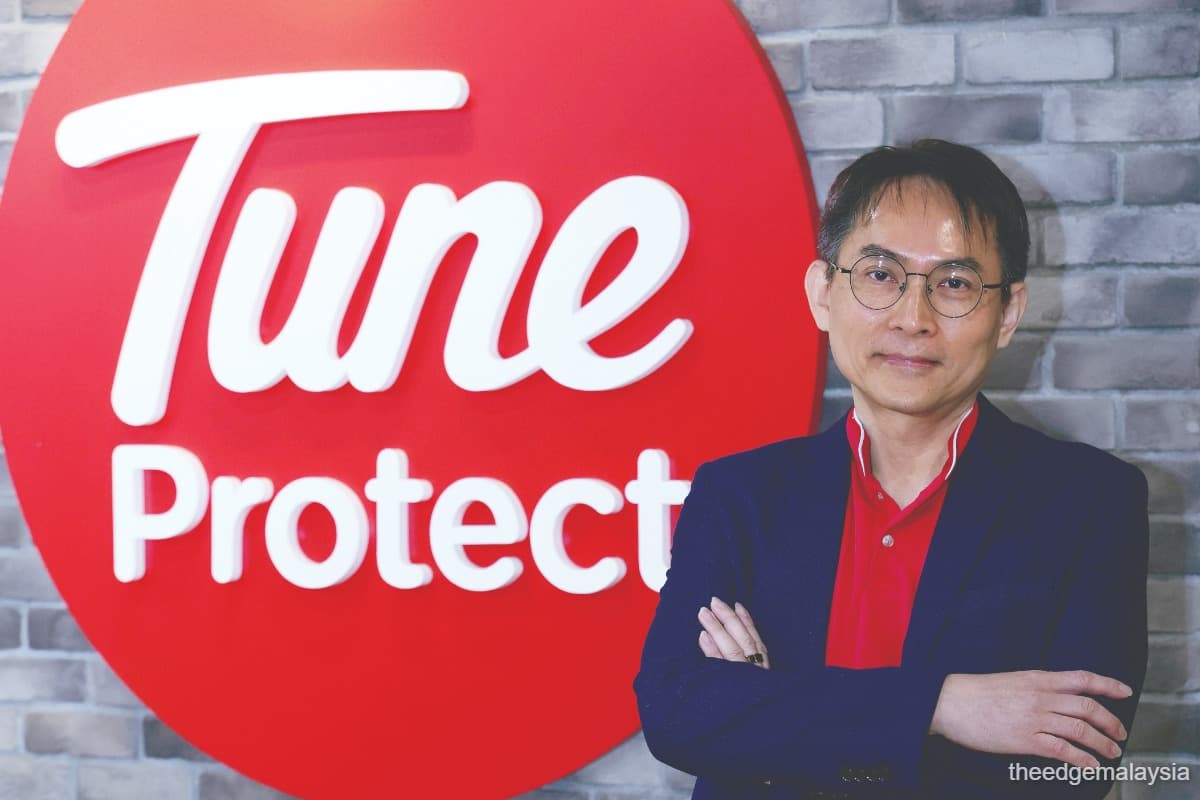
TWO years into his tenure as group CEO, How Kim Lian has helped steer Tune Protect Group Bhd (KL:TUNEPRO) out of three consecutive years of losses. The challenge now is to turn that recovery into sustainable growth as weaker travel demand, market volatility and geopolitical tensions weigh on its outlook.
Tune Protect’s net profit jumped 46-fold to RM26.45 million in the financial year ended Dec 31, 2025 (FY2025) from RM572,000 in FY2024. It had recorded a net loss of RM947,000 in FY2023.
The improvement was supported by a 3.9% gain from cost optimisation in FY2025, as well as a shift in focus towards prioritising yields and margins over pursuing volume growth.
But that recovery has lost momentum in 2026.
For 1HFY2026, net profit fell 39% to RM8.79 million from RM14.4 million a year earlier, while revenue declined 6.9% to RM162.89 million from RM175.04 million. Lower investment income, foreign exchange movements and weaker travel business, amid the ongoing Middle East conflict and reduced airline capacity, weighed on results.
“I was actually a lot more bullish at the beginning of the year before the Middle East conflict. We didn’t see any reason why we could not beat the previous year’s performance in FY2026,” How tells The Edge in an interview.
That confidence has since been tempered by events beyond the company’s control.
“Now we are watching how long this volatility will hit us. In 2QFY2026, we still saw net profit improve 66.7% to RM5.5 million from the preceding quarter despite the Middle East conflict,” he says.
Tune Protect is also monitoring the impact of airline capacity cuts. AirAsia Group Bhd (KL:AAGB) recently announced plans to reduce seat capacity by 20% to 25% year on year (y-o-y) in the third quarter of 2026, citing higher fuel costs. The cuts could weigh on Tune Protect, whose travel insurance business is distributed through airline partnerships.
“We are closely watching how big that impact may be,” says How.
Tune Protect provides travel insurance to passengers flying with AirAsia Group, Air Arabia in the United Arab Emirates, SalamAir in Oman, Vietjet Air in Vietnam and Thai Vietjet Air.
Despite the weaker first-half performance, How expects Tune Protect to remain profitable in FY2026.
“The Middle East conflict will definitely impact us in the short term. But in the long term, I am bullish. Actually the biggest impact to us now is the uncertainty because the market does not know what to do. It is the most painful,” he says.
The company is looking at ways to offset near-term headwinds, including adjusting product pricing across markets.
“Travellers in different markets do not necessarily have the same needs or willingness to pay. Australia pricing, for example, cannot be the same as Bangkok pricing. Japan’s pricing should not be the same as Indonesia’s,” he notes.
Firm prioritises yield and margin protection
How, 52, joined Tune Protect in 2000 and served as group chief financial officer before becoming group CEO in July 2024, replacing Rohit Chandrasekharan Nambiar, who had led the company for nearly four years.
Under How, Tune Protect has shifted its focus from top-line growth towards improving the quality and profitability of its insurance portfolio.
“Back then, we were very aggressive in pursuing our top-line growth and that maybe actually attracted some of the less favourable business. Insurance is very different compared to other industries. It’s not about the more you grow, the more profit you make. Insurance is very much about what kind of risk that you’re taking,” he says.
The company responded with a portfolio optimisation exercise, particularly in motor insurance, to identify segments with better claims performance.
How says motor policies with lower sums insured tend to have higher claims ratios, while Sabah and Sarawak have historically recorded healthier claims experience than Peninsular Malaysia. Motorcycle insurance, meanwhile, has generally been more profitable than private car insurance.
Tune Protect began studying motor insurance sub-segments in 2024 before changing its portfolio mix in the first quarter of 2025. The exercise found that about 35% of its motor business accounted for 60% of claims and losses, while the remaining 65% performed better.
The strategy came at the expense of premium growth. Gross written premium declined 3.7% y-o-y in FY2025.
Underwriting performance, however, improved, with the combined ratio falling to 90.5% in FY2025 from 99.2% in FY2024 and 102.4% in FY2023.
For How, the next challenge is to turn those gains into sustainable earnings.
Tune Protect has since organised its business around three pillars: general insurance, international or global business and “beyond insurance”.
The first pillar is its conventional general insurance business. Tune Protect holds general insurance licences in Malaysia and Thailand.
“General insurance needs to be very disciplined in underwriting. This means that you do not underwrite all kinds of risk. It’s just underwriting discipline to make sure that everything that we underwrite, we see the profitability,” he stresses.
“Our vision for Pillar 1 is not to be the largest player, but to be a niche player that generates combined ratio and margins above the industry.”
Scaling the international business
The second pillar is its international business where Tune Protect sees greater growth potential. The business operates in the insurance technology (insurtech) space alongside platforms and providers such as GoBear, Bjak, Cover Genius, bolttech and Igloo.
Travel insurance is currently the largest component, but the model extends to other sectors. Concert organisers, for example, may require protection against unexpected changes affecting events across several countries, while consumer electronics companies such as Samsung and Xiaomi can use device insurance coverage as they expand into different markets, says How.
Rather than obtaining an insurance licence in every market, Tune Protect works with local insurers that already hold the necessary licences, while providing the technology and integration. The company operates across 33 countries and territories and works with 56 insurance partners.
“What we do is we will bring the business to them in those countries. But the technology and integration are all from Tune Protect,” says How.
Tune Protect generates monthly reports for its insurance partners, which use the figures for billing. About 80% of the business is then reinsured back to Tune Protect through its reinsurance licence, while partners retain 20% of the business generated.
For Tune Protect, the appeal is scalability. Because the international business is largely digital, How says its overhead costs are relatively fixed. “Every incremental growth that I can get, it will immediately translate into the company’s bottom line.”
The contrast between the two pillars is reflected in their use of resources. General insurance accounts for about 80% of Tune Protect’s 450-odd employees, while the international business operates with about 20 people.
The contribution to earnings is more evenly split. How says Pillar 1 and Pillar 2 typically account for between 40% and 60% each of the company’s bottom line, although the mix can shift.
Since last year, Tune Protect has stepped up efforts to promote its international business. The challenge is no longer simply building the network, but ensuring potential customers and business partners are aware of its capabilities and reach.
The company already works with e-commerce platforms such as Shopee to offer protection services, although its name is not always visible to end customers.
It also provides a digital portal for travel agents to purchase travel insurance. Almost 2,000 travel agents worldwide use the platform, including about 1,500 active in the Middle East and about 400 in Malaysia, says How.
He points out that the network is one of Tune Protect’s main advantages, but brand recognition remains a challenge.
Building recognition will take time, but it is central to the company’s international ambitions.
“For Pillar 2, we need to create awareness for people to understand that we are not a Malaysia insurance company, but an insurtech firm with coverage in 33 countries,” says How.
Valuation challenge
That positioning creates another question: How should a company with both a conventional general insurance business and an insurtech platform be valued?
How believes the market has yet to fully recognise the second part of the business.
“We are in an awkward situation because, under Pillar 2, we have developed a network of insurance partners and country coverage that is even wider than some insurtech companies. However, our valuation is still based on a very traditional insurance Pillar 1 role,” he says, noting that insurtech companies typically command higher valuations.
In the longer term, Tune Protect aims to become Southeast Asia’s largest insurtech player by premium size within five years.
Tune Protect’s plans are evolving as market conditions change. The company had initially intended to concentrate on travel this year, but the Middle East conflict has prompted it to accelerate diversification into areas such as telecommunications and organised events.
The general insurance business is also being expanded selectively, with Tune Protect planning to enter the small and medium enterprise (SME) fire insurance market in the second half of the year.
For now, the company has no plans to rush into obtaining general insurance licences in every market where it operates. Doing so would require additional capital and could reduce shareholder returns, says How.
“If I go that way, it will work against returns to shareholders because that is capital intensive,” he says.
The third pillar, “beyond insurance”, comprises about 30 products, predominantly linked to travel. These include access to more than 1,000 airport lounges during flight delays, complimentary eSIM services and airport connectivity.
Pillar 3 is aimed at extending the company’s relationship with customers beyond the insurance policy itself. “What matters to the customer is the customer’s experience,” says How.
Tune Protect is also beginning to apply the model to motor insurance in Malaysia. Customers with sums insured of RM70,000 or more, for example, could receive complimentary valet parking at eight shopping malls.
The aim is to make insurance less of a transaction and more of a service attached to everyday life, while giving Tune Protect another way to differentiate its offerings.
As at April 8, 2026, Tune Group Sdn Bhd was Tune Protect’s largest shareholder with a 15.73% stake, followed by Move Digital Sdn Bhd, a wholly-owned subsidiary of Capital A Bhd (KL:CAPITALA), with 13.62%, and CIMB SI II Sdn Bhd with 9.38%.
On Sept 18, Capital A said it planned for an orderly distribution of Move Digital’s 13.6% stake in Tune Protect as part of its capital structure optimisation exercise, with the proceeds to be distributed to Capital A.
Tune Protect shares have fallen 16% year to date to close at 26 sen last Thursday, giving the company a market capitalisation of about RM192 million. At that price, the stock trades at 9.8 times one-year forward earnings. That compares with 13.9 times for LPI Capital Bhd (KL:LPI), while Allianz Malaysia Bhd (KL:ALLIANZ), Syarikat Takaful Malaysia Keluarga Bhd (KL:TAKAFUL) and MNRB Holdings Bhd (KL:MNRB) trade at 7.73 times, 6.71 times and 3.82 times respectively.
Save by subscribing to us for your print and/or digital copy.
P/S: The Edge is also available on Apple's App Store and Android's Google Play.