


This article first appeared in The Edge Malaysia Weekly on September 28, 2026 - October 4, 2026
TALKS of a potential corporate exercise at property developer MK Land Holdings Bhd (KL:MKLAND) have resurfaced, with a source familiar with the matter saying an adviser has been appointed to explore possible options.
The source spoke on condition of anonymity because the discussions are private.
However, another source close to the family of the late Tan Sri Mustapha Kamal Abu Bakar, co-founder of MK Land, disputed the claim, saying no adviser had been appointed as at Sept 25.
The conflicting accounts warrant a closer look at MK Land, whose shares trade at a steep discount to book value and whose concentrated yet divided shareholder base could complicate any potential corporate exercise.
Deep discount to book
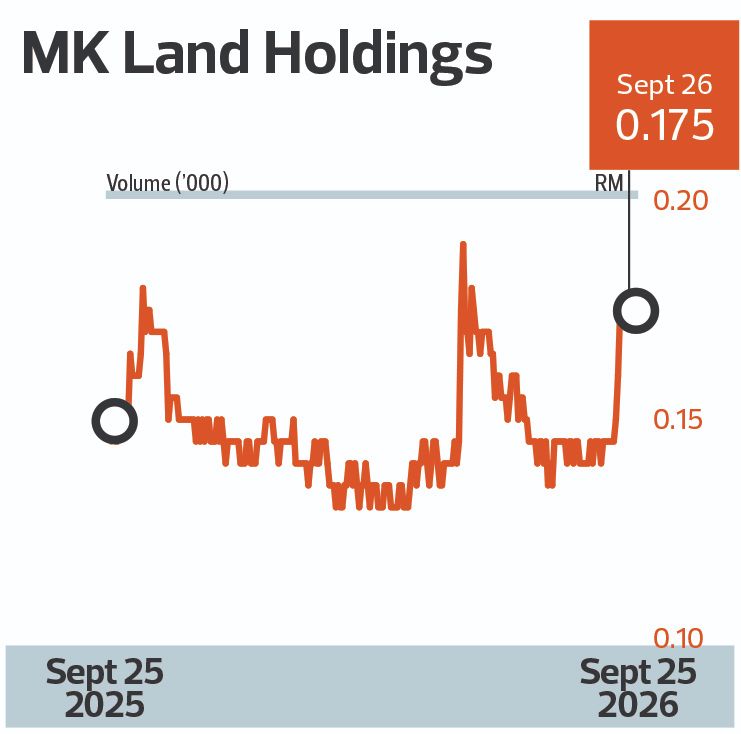
Rising expectations of a corporate exercise may have triggered this week’s buying spree, which sent the counter 20.7% higher since Sept 22 to close at 17.5 sen, last friday giving the company a market capitalisation of RM210.8 million. MK Land trades at an 83% discount to book value, with net assets per share standing at RM1.06 as at June 30, 2026.
The discount is steep even by property sector standards. Bloomberg data shows MK Land trading at an implied price-to-book ratio of 0.156 times for the financial year ended June 30, 2026 (FY2026). By comparison, MBSB Research said in July that Bursa Malaysia’s KL Property Index was trading at 0.68 times book value, slightly above its long-term average of 0.66 times.
There are reasons for that discount. MK Land’s earnings have struggled to match the size of its asset base.
Net profit rose 7.3% to RM10.21 million in FY2026 from RM9.51 million in the previous year, mainly due to higher other operating income from the property segment. Revenue, however, fell 25% to RM175.7 million from RM234.7 million, primarily due to lower construction progress on ongoing projects.
The group also has a sizeable land bank that may contain value not fully reflected in its carrying amounts.
As at June 30, 2026, MK Land reported RM763.23 million in land held for property development on its balance sheet. Such land is generally carried at cost unless its estimated net realisable value falls below carrying value, meaning the book value does not necessarily reflect subsequent appreciation in market value.
The latest valuation dates disclosed for some of the group’s larger development properties also go back decades.
Its 160-acre Sungai Buloh land in Selangor, carried at RM255.3 million, includes a valuation dated June 1997. A 1,317-acre mixed-use development and resort parcel in Kerian, Perak, carried at RM123.3 million, has a June 2003 valuation date. Another 1,888-acre Kerian development parcel, carried at RM97.3 million, was also valued in 2003.
For several other development parcels, MK Land’s annual report discloses acquisition dates but no valuation dates.
That leaves open the possibility of latent value in parts of the group’s land bank that is not reflected in carrying values. The extent of any such value cannot be determined without fresh valuations.
The same consideration does not apply to MK Land’s investment properties, which are accounted for separately at fair value.
While the steep discount to book may help explain interest in a corporate exercise, the company’s shareholder structure presents another hurdle.
Divided shareholder base
The largest identifiable shareholder block is linked to the family of Mustapha Kamal.
According to the company’s 2025 annual report, MKN Holdings Sdn Bhd was the largest shareholder, with a 39.77% stake as at Sept 30, 2025. PB Trustee Services Bhd held another 7.6% under the EMKAY Trust for the benefit of Puan Sri Wan Nong Wan Ibrahim, the widow of Mustapha Kamal. Together, the disclosed holdings put the family-linked stake at about 47.4%.
Datuk Kasi K L Palaniappan, MK Land’s other co-founder, is the company’s second largest shareholder, with a 15.71% stake. His holding could prove significant depending on the structure of any potential corporate exercise.
If an exercise were structured as a conventional takeover offer, Bursa Malaysia’s Main Market Listing Requirements allow a listed issuer to withdraw its listing once at least 90% of its listed shares, excluding treasury shares, are held by a shareholder individually or jointly with its associates, provided the offeror has announced that it does not intend to maintain the listing.
On a simple aggregation of the disclosed family-linked interests, even acquiring every remaining listed share other than Kasi’s would take that block to only 84.3%.
Other forms of corporate exercise would be subject to different rules, thresholds and structures.
Kasi’s stake is particularly relevant, given the history between MK Land’s two co-founders. Kasi ceased to be a director in December 2017 after failing to be re-elected at MK Land’s 38th annual general meeting. At the time, he held about 16% of the company, while Mustapha Kamal controlled about 47%. The Edge reported then that Kasi had been Mustapha Kamal’s business partner but that the two had subsequently split.
That history makes the positions of MK Land’s two largest shareholder camps an important consideration in any potential corporate exercise.
For now, the status of any potential exercise remains disputed. No structure, price or formal proposal has been publicly disclosed, while the reported appointment of an adviser is itself contested.
Until those elements are independently established, it remains unclear whether the latest market talk reflects a concrete corporate proposal or is still at an exploratory stage.
Save by subscribing to us for your print and/or digital copy.
P/S: The Edge is also available on Apple's App Store and Android's Google Play.