

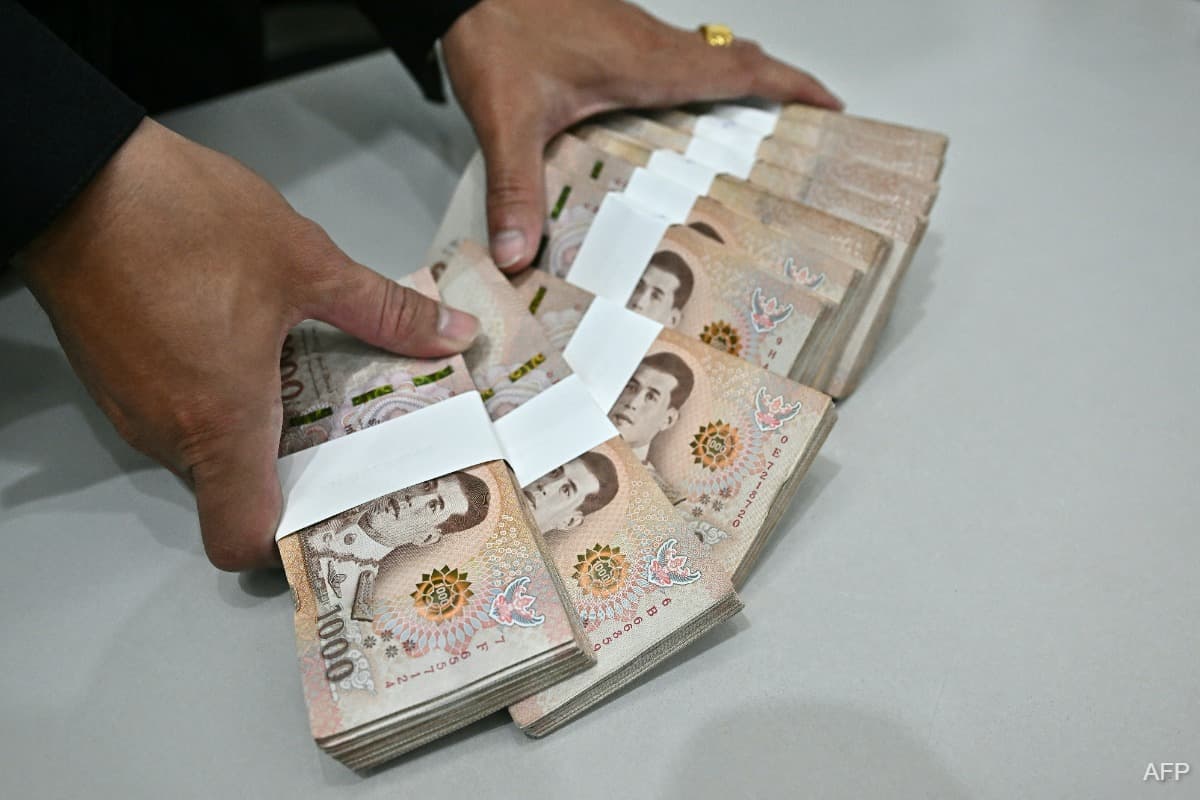
BENGALURU (Sept 28): Most Asian currencies weakened on Monday, with Thailand's baht leading losses, as surging oil prices and elevated US Treasury yields stoked concerns over sticky inflation and narrowed the region's rate advantage.
Investors shunned riskier assets after the US rejected Iran's peace proposal over the weekend, spurring another leg higher in oil prices, keeping an October Federal Reserve (Fed) hike in play with the 10-year US Treasury yields holding above 5.1%.
Persistently high energy prices risk stoking inflation across Asia's net energy-importing economies and widening fiscal deficits, while rising US yields threaten to draw capital toward dollar assets.
The baht weakened as much as 0.8% to 33.64 against the dollar, its lowest level since late July.
With US yields rising faster than local bond yields, the deterioration in relative rate support has been particularly pronounced in Thailand and Indonesia, Lloyd Chan, a foreign exchange strategist at MUFG, said.
The Indonesian rupiah weakened 0.6% to 17,985 points per dollar, bringing the currency's year-to-date losses to over 7%.
Bank Indonesia's governor said on Monday the central bank has reduced its foreign exchange interventions in the spot market to 30% of the total because it was too costly.
The remarks underscore growing strain on the rupiah, which risks undoing the recovery seen since its record low in June, as external price pressures add to existing concerns about the Indonesian government's limited fiscal room against its 3.0% fiscal deficit cap.
Elsewhere, the Philippine peso ticked lower, and the Indian rupee depreciated as much as 0.2%.
The ringgit was down 0.3%, while the South Korean won weakened 0.5%.
The Taiwan dollar slipped 0.1%, on limited volumes, while Taiwan's equities were not trading on the day due to a holiday.
Speaking about the risks to Asian foreign exchange from a further rise in bond yields, Glenn Yin, a research director at brokerage ACCM, said a rise in the US 10-year Treasury yield to 6% would be a warning sign rather than a breaking point.
"A gradual rise alongside resilient growth is manageable; a rapid rise driven by oil, inflation fears and a stronger dollar could force foreign investors to cut Asian bond and equity exposure at the same time."
Asian equities were broadly lower, with South Korea's chipmaker-heavy stock benchmark dropping 2.7% in catch-up trading following a holiday break.
Stocks in Thailand the and Philippines slipped 0.4% and 0.6% respectively.
Equities in Jakarta fell as much as 1% to their lowest since July 30.
Separately, the Indonesia Stock Exchange said on Monday that it has changed the rules for its watchlist board, which flags firms meeting certain risk criteria, to focus more on company fundamentals rather than share prices or the number of freely trading shares.
In West Asia, Turkish authorities lifted asset-freeze orders imposed on 46 companies as part of an investigation into investment funds and market manipulation, broadcaster NTV and other media reported on Monday.
Highlights:
- Thousands huddled in Bangkok shelters as Thai flood damages seen at US$320 million (RM1.31 billion)
- Thailand's court to rule on a challenge to 2026 election legality
- The Bank of Japan debated need for faster rate hikes, its July minutes showed
Uploaded by Tham Yek Lee