

_0.jpg&w=1920&q=75)
(Sept 26): President Donald Trump’s lavish welcome of leader Xi Jinping this week marked a high point for stability in a US-China relationship that’s seen a lot of lows. Now, the Chinese president is pushing to lock in more favourable terms on Taiwan and trade while he still can.
Xi intensified pressure on Trump to limit support for Taipei on Thursday, while hinting at a broader detente on trade. Those potential advances for Beijing emerged as both men swapped warm words over two days of bonhomie that even saw China’s top leader board the US presidential helicopter. Trump declared they’d “never gotten along better”, while Xi hailed their “unprecedented” timetable of meetings this year.
Their next get-together will take place in November, Trump announced, right after the US midterm elections.
The Republican Party is in danger of losing control of Congress in that contest, with polls showing Trump’s approval at record lows. Any shift in the balance of power risks undercutting Trump and strengthening calls for tougher action on Taiwan as well as tighter export controls and restrictions on Chinese companies. Greater political division, however, also breeds gridlock, which might limit Washington’s ability to pressure Beijing.
“Xi wants to get the reassurance from President Trump that he will continue to handle the Taiwan issue with great caution,” said Wu Xinbo, a director at Fudan University’s Center for American Studies in Shanghai. “The problem for China is, of course, whether he can continue that policy down the road, especially after the US midterm election.”
So far, Trump hasn’t publicly responded to Xi’s request that Washington adopt “the correct position of opposing Taiwan independence”. US Ambassador to China David Perdue told Fox News on Friday that Trump hadn’t changed his position. “We don’t support independence,” he added. “But we really don’t support coercion either.”
China also hasn’t yet confirmed an extension to the trade truce announced by Treasury Secretary Scott Bessent, while US Trade Representative Jamieson Greer said on CNBC that more details on trade may be released as soon as Monday.
Any deals unveiled in the coming days will show whether Xi came away with more than the bald eagle statue Trump gifted him.
“We might be at the moment of maximum détente,” said Rana Mitter, a US-China scholar at the Harvard Kennedy School. But while leader ties are strong, “in terms of a policy substantive shift, no, we are not there”.
Dinner diplomacy
The Communist Party’s flagship newspaper splashed images of Xi’s airport greeting and Oval Office huddle with Trump on its Friday cover, devoting three pages to the summit where Xi was shown unusual deference by an American counterpart.
Trump, 80, praised the health of Xi, 73, calling him “strong, vibrant and fit”. He allowed his guest to invoke China-US cooperation against Japan in World War II while glossing over more contentious moments and invited state dinner guests to be among the world’s first to glimpse his White House ballroom renovation. Human rights, a routine discussion topic during past US-China summits, was not raised publicly by Trump.
Before the summit concluded on Friday, Trump gifted Xi a photo album of the trip.
Underneath the grand gestures, however, there were signs of the limits to the relationship.
US export controls were spotlighted by the banquet seating chart. Xi sat with Nvidia Corp’s Jensen Huang, whose top-end AI semiconductors China is banned from buying. The complete absence of any Chinese executives at the candlelit banquet of some 130 guests also symbolised deep resistance to Chinese corporate investment in America.
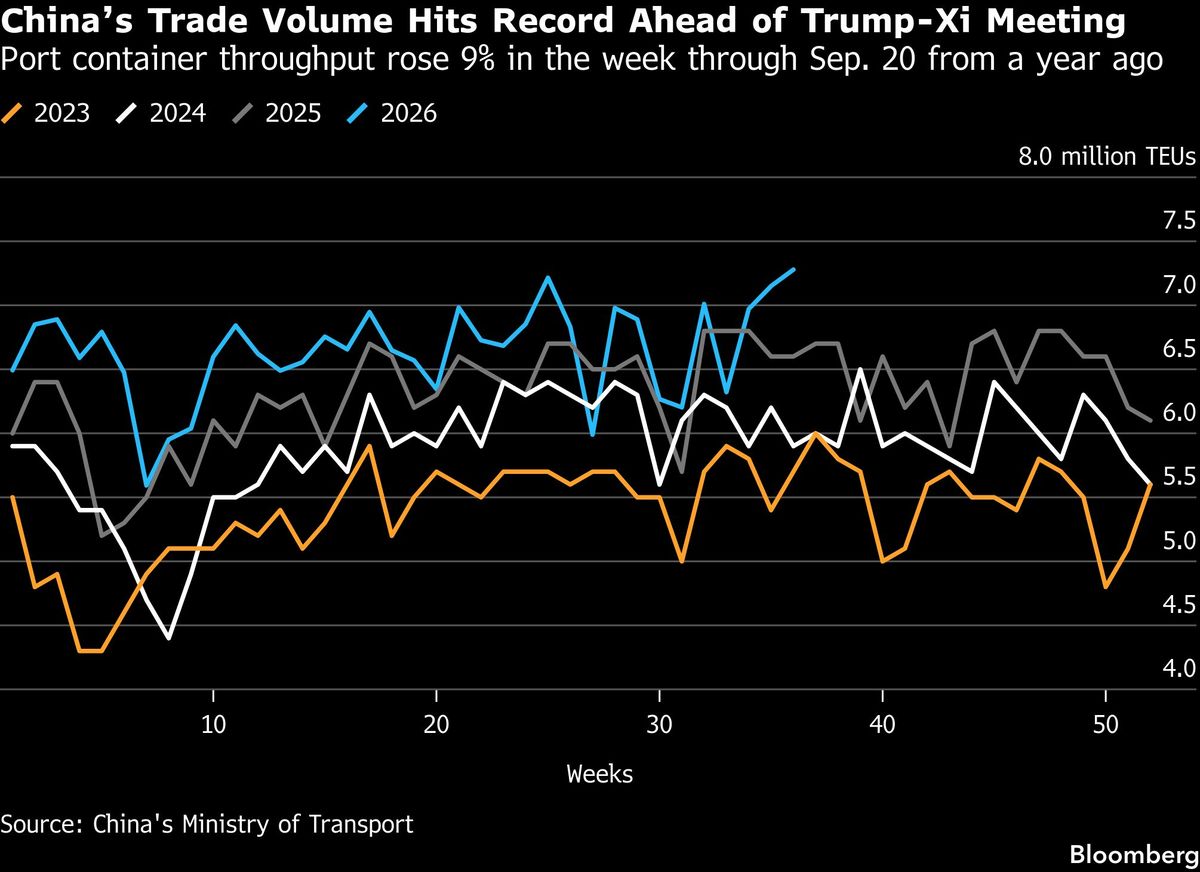
Furthermore, the two-month truce extension fell short of the six months previously floated. China still faces the highest effective US tariff rate imposed on major trading partners at roughly 23%, compared with about 7% for the rest of the world, according to Barclays. With Chinese ports clocking their busiest week in history ahead of the summit, Xi has likely learned to live with those levels.
Taiwan offers the most politically sensitive test of whether China’s most powerful leader since Mao Zedong can coax policy changes out of a US president who described arms sales to Taiwan as a “negotiating chip”.
China wants Washington to say it “opposes” Taiwanese independence, replacing the long-standing US formulation that it “does not support” it. Following through on that move would likely trigger bipartisan blowback from members of Congress who strongly support military backing for Taipei.
Trump is unlikely to change US policy, said Jeremy Chan, a senior analyst at Eurasia Group. “Both sides are reasonably happy with maintaining the status quo,” he added. Prospects for Trump releasing a planned US$14 billion (RM57 billion) arms package for Taiwan before the Group of 20 summit in December remain low, Chan said. Xi is also slated to attend that event in Miami.
For China, success does not necessarily require Trump to announce a new Taiwan policy. Continued delays to weapons sales and reduced high-level contact with Taipei could gradually raise the political cost of reversing course, giving Beijing greater scope to retaliate against a future administration.
Xi already signalled he’s thinking about what comes after Trump.
Invoking a slogan China uses to describe the current detente, he said that “constructive strategic stability” shouldn’t be a “temporary expedient or something accomplished overnight”.
China’s best bet for maintaining stability is to leverage its stranglehold over rare earths — tiny metals essential for manufacturing a wide range of products, including missiles and mobile phones.
Data suggest the US — and most of the world — will remain reliant on China for those magnets through 2030 and beyond, said Bloomberg Economics’ Adam Farrar.
“That’s driven this reality,” he added, “that there are limited choices for the US when it comes to escalation.”
Uploaded by Tham Yek Lee