


This article first appeared in The Edge Malaysia Weekly on September 28, 2026 - October 4, 2026

The political economy of incentives and power
Most debates about democracy ask whether democracy is superior to the alternatives. Supporters point to freedom, representation and legitimacy. Critics point to voter ignorance, populism, short-termism and political dysfunction. Others look at countries governed by technocrats or strong states and ask whether expertise and competence might sometimes produce better outcomes than electoral politics.
But perhaps we are asking the wrong question. Instead of asking who should govern, perhaps the more important question is what governs those who govern?
Voters respond to incentives. Politicians respond to incentives. Bureaucrats, experts, political parties and journalists do too.
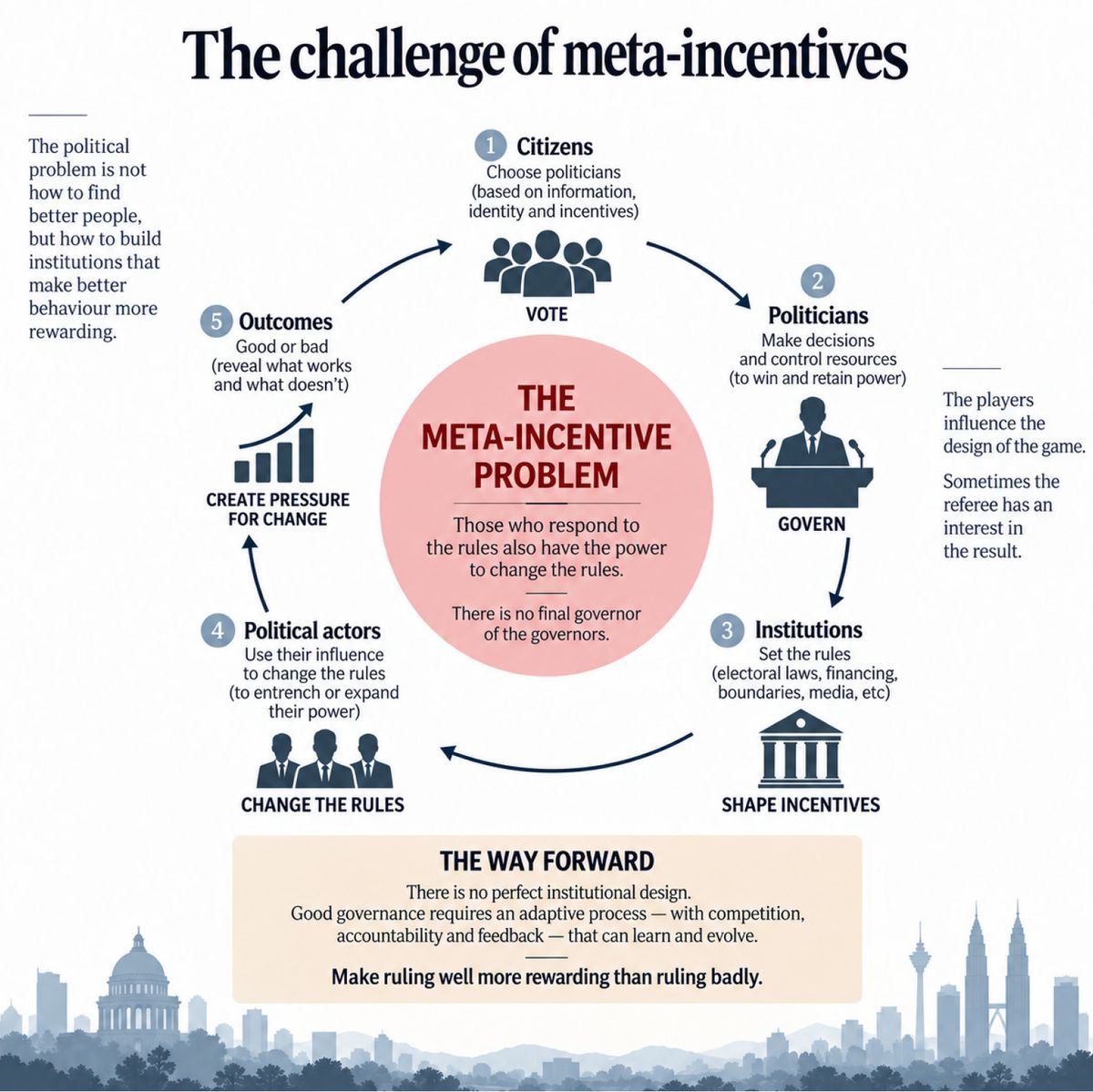
The political problem is therefore not primarily how to find better people. It is how to build institutions that make better behaviour more rewarding.
Imperfect voters, imperfect politicians
Three influential books illuminate the different weaknesses of democracy.
In The Myth of the Rational Voter, Bryan Caplan argues that voters can be “rationally irrational”. Because the probability of a single vote determining an election is negligible, the individual cost of holding mistaken political beliefs is also negligible. Voters may therefore support policies whose immediate benefits are visible while their longer-term costs are dispersed or hidden.
Jason Brennan goes further in Against Democracy. If competence matters in medicine, engineering and aviation, why should it not matter in politics? We do not determine surgical procedures by popular vote. Yet, citizens with little knowledge of economics, taxation, healthcare or national security participate equally in deciding who will govern these areas.
Steven Levitsky and Daniel Ziblatt, in How Democracies Die, identify another danger: democratic institutions can be weakened gradually from within, not necessarily through coups but through the erosion of norms, restraints and institutional checks.
These are important criticisms — but they leave a deeper question unanswered.
Suppose voters were better informed. Suppose politicians were more competent. Suppose experts replaced some political decisions. Would governance improve? Not necessarily. Because knowledge and competence do not eliminate incentives.
Buchanan’s more fundamental question
James Buchanan, together with Gordon Tullock, changed the way economists thought about politics through Public Choice Theory.
Its central insight is simple. Political actors are not fundamentally different from economic actors. A business seeks profits. A politician seeks votes and political survival. A bureaucrat may seek larger budgets and influence. An interest group seeks favourable rules. Voters seek outcomes they value.
None of this requires bad intentions. It simply requires human beings to respond rationally to the incentives they face.
Buchanan therefore shifted attention away from personalities towards institutions. The important question is not whether good people occupy positions of power. It is whether institutions channel ordinary human motivations towards socially beneficial outcomes.
The question is not who governs. The question is what incentives govern those who govern. That distinction explains much that otherwise appears puzzling about politics.
If subsidies win votes, politicians promise subsidies. If identity wins votes, politicians mobilise identity. If outrage attracts attention, political actors manufacture outrage. If painful reforms impose costs today while their benefits arrive after the next election, politicians have powerful reasons to postpone them.
What looks irrational from the perspective of the nation may be entirely rational from the perspective of the politician.
It also explains a familiar political paradox. Opposition politicians often demand transparency, condemn waste, champion accountability and call for institutional reform. Then they enter government. Suddenly, compromises appear, reforms are delayed and political calculations become more visible.
Sometimes, this is hypocrisy. But, sometimes, the politicians have changed less than we imagine. Instead, the incentives have changed. In opposition, the objective is to gain power. In government, the objective is to retain it. Different incentives produce different behaviour.
When politics becomes a market for privilege
Tullock extended Public Choice through the concept of rent-seeking.
In competitive markets, businesses generally succeed by producing something consumers value. Politics creates another avenue to economic gain: influence the rules themselves. Businesses lobby for protection. Industries seek subsidies. Interest groups demand privileges. Political coalitions compete over transfers and government resources.
Mancur Olson explained why this can become persistent.
A small group receiving a large, concentrated benefit has a powerful incentive to organise and lobby for it. The much larger public bearing the cost may have little incentive to resist because the cost to each individual is small. The result is an asymmetry.
Concentrated interests organise. Dispersed interests often do not.
Over time, privileges accumulate. Protected sectors multiply. Reform becomes harder. National interests can gradually lose out to organised interests. Again, no conspiracy is required. The incentives are sufficient.
But incentives are not everything
There is another constraint on governance: knowledge.
Steven Sloman and Philip Fernbach, in The Knowledge Illusion, observe that human beings routinely believe they understand far more than they actually do. This becomes especially important in modern society. Taxation, healthcare, trade, energy, education, technology, monetary policy and national security are extraordinarily complex systems.
No voter understands all of them. Neither does any politician or any single expert.
Knowledge is distributed throughout society.
This was one of Friedrich Hayek’s great insights. Consumers know things governments do not. Entrepreneurs know things planners do not. Workers possess knowledge unavailable to bureaucrats. Markets coordinate much of this dispersed information through process and competition.
Buchanan therefore identifies one constraint on government: incentives.
Hayek identifies another: Knowledge.
Even a perfectly motivated government cannot possess all the dispersed information required to govern a complex society. And even a perfectly informed government may act badly if its incentives are wrong.
Good political institutions must therefore solve both problems: align incentives while enabling discovery, feedback and correction.
This is why simply replacing voters with experts does not solve the governance problem. Experts know more about particular subjects. But they do not know everything. And experts have incentives too.
The technocratic temptation
If voters are often poorly informed and politicians are constrained by electoral cycles, technocracy has obvious appeal.
Let experts decide. They possess specialised knowledge. Professional bureaucracies can accumulate institutional competence. Governments can potentially plan beyond the next election.
Singapore illustrates much of what technocratic competence can achieve. Its extraordinary development is associated with professional administration, long-term planning and unusually capable government.
But Singapore demonstrates something else as well. Competence does not exist independently of incentives. Civil servants are expected to perform. Corruption is strongly punished. Political legitimacy has historically been closely associated with economic and administrative performance. The system creates incentives for competence. Singapore therefore does not invalidate the incentives argument. It reinforces it.
China demonstrates the other side of the problem. Its extraordinary economic transformation shows that competitive elections are not the only mechanism capable of producing economic growth, state capacity or long-term planning.
But concentrated authority creates its own risks. The same concentration of power that permits rapid decisions can magnify mistakes. When criticism and feedback weaken, incorrect policies may persist longer.
The strength of technocracy is competence. Its weakness can be accountability and information. Democracy has the opposite strengths and weaknesses.
Neither institutional form solves the problem automatically.
Coalitions and the Malaysian reality
The same reasoning applies to coalition governments. Coalitions are often portrayed as inherently weak. But majority governments can also concentrate power and weaken checks. Coalitions may slow decisions, but negotiation can aggregate different perspectives and require compromises. The institutional form alone tells us little.
The more important question is, what behaviour does it reward?
This is especially relevant to Malaysia. Political competition here is shaped not only by economics but by race, religion, language, geography and history. An increasingly fragmented political landscape has produced governments assembled through coalitions, sometimes after elections.
That need not in itself represent democratic dysfunction. A fragmented society may naturally produce fragmented political outcomes.
The question is what political behaviour those arrangements reward. If race wins votes, politicians have incentives to emphasise race. If religion wins votes, politicians have incentives to emphasise religion. If patronage preserves political coalitions, patronage becomes politically rational.
But the reverse is equally important. If economic competence wins votes, politicians have incentives to become economically competent.
Electoral rules, constituency boundaries, political financing, candidate selection, party structures, media institutions and the allocation of government resources matter because they help determine the political marketplace in which politicians compete.
Change the rewards and costs, and the behaviour can change with them.
But surely leaders matter?
There is an obvious objection. History tells us that individuals sometimes matter enormously.
Would Singapore have followed the same trajectory without Lee Kuan Yew? Would democratic South Africa have emerged in the same way without Nelson Mandela? Would China’s economic transformation have occurred without Deng Xiaoping?
Institutions do not create themselves. Someone builds, reforms and defends them.
Leadership therefore matters, particularly during periods of transition, crisis or institutional founding. But this does not contradict the institutional argument; it clarifies it.
A capable ruler may govern well through personal authority. A great nation-builder does something harder. They create institutions capable of governing well after they are gone.
That may ultimately be the greatest achievement of exceptional leadership: making exceptional leadership less necessary.
Who designs the incentives?
And here we reach the deepest problem.
If incentives shape political behaviour, who shapes the incentives?
Politicians influence electoral laws. Political parties determine candidate selection. Legislatures amend constitutions. Governments influence campaign financing, constituency boundaries and media regulation.
The people responding to the rules therefore possess some ability to change the rules. The players can influence the design of the game. Or the referee may have an interest in the result.
This is the meta-incentive problem.
Buchanan distinguished between ordinary politics — the daily arguments over taxes, budgets, spending and policies — and constitutional politics: the rules governing how those decisions are made. That distinction is fundamental.
Once the rules establish incentives, behaviour tends to follow.
Constitutional design is, in an important sense, incentive engineering. Yet there is no final constitutional designer standing outside politics. Institutions constrain political actors. Political actors reshape institutions. Citizens choose politicians while responding to information generated by the same political and media environment.
So who governs the governors? Ultimately, nobody does. There is no final governor of the governors. There are only layers of constraint, accountability, competition and feedback.
Governance as an evolutionary process
There is no final governor of the governors because there can be no final institutional design. Circumstances change. Technology changes. Economic structures change. Political coalitions change. So do the sources of information and power. Institutions that once worked well may cease to do so.
Good governance therefore cannot be a finished institutional destination. It must be an adaptive process.
Institutions constrain politicians; politicians reshape institutions; outcomes reveal weaknesses; competition, accountability and feedback create opportunities for correction. The process never ends.
The ultimate political question is therefore not simply who should rule. It is how do we make ruling well more rewarding than ruling badly — and preserve the ability to change the rules when they no longer do so?
That is why societies cannot depend on perfect leaders, perfectly informed voters or perfectly disinterested experts. They need institutions capable not only of aligning imperfect human incentives, but of learning and adapting when circumstances change.
The challenge is not to design politics for saints. It is to design incentives for human beings. And ultimately, to make serving the next generation more rewarding than merely surviving the next election.
Note: This article is a companion to The Economic Evolution, a forthcoming book. It is the political counterpart to the book’s economic argument.
Portfolio commentary
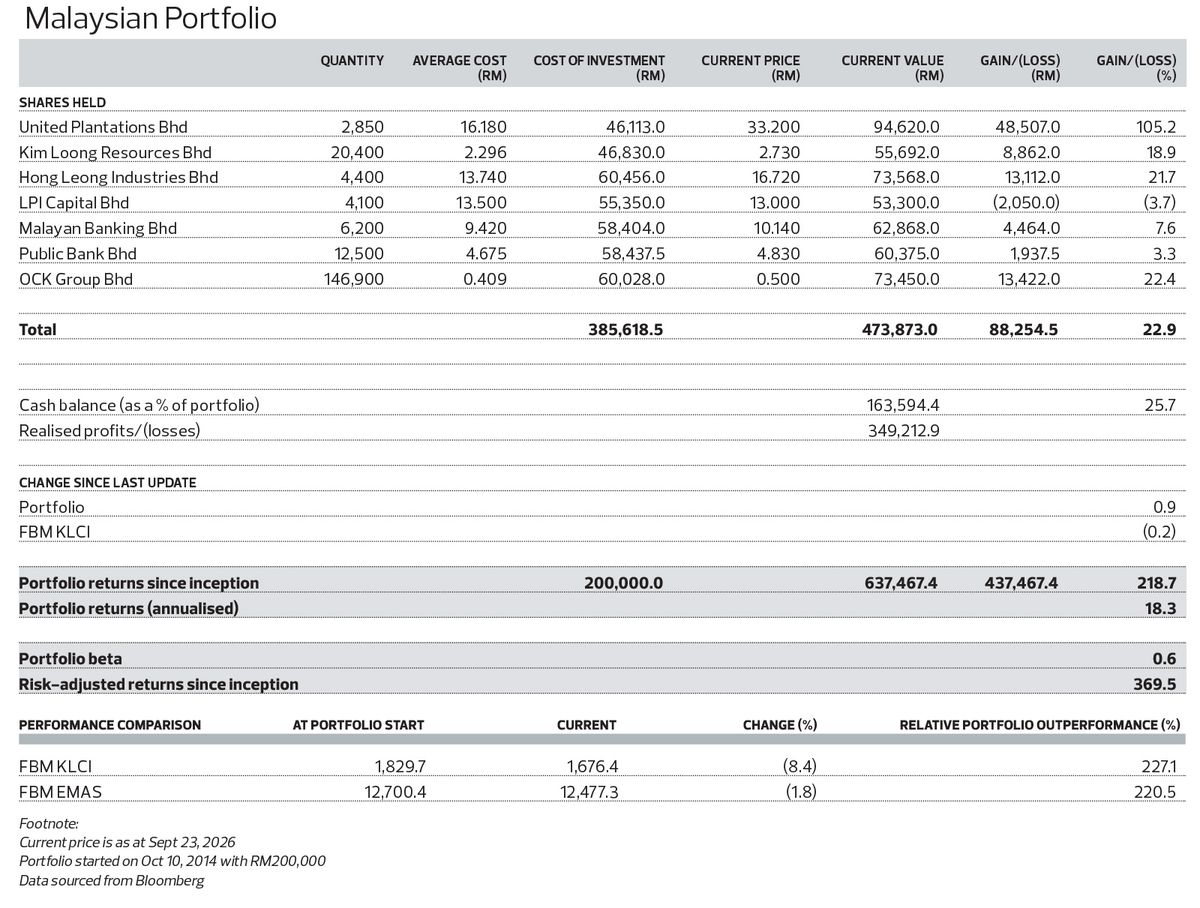
The Malaysian Portfolio gained 0.9% for the week ended Sept 23, faring better than the benchmark FBM KLCI, which fell 0.2%. Much the gains can be attributed to OCK Group, whose share price was up 14.9%. Other gainers were Public Bank (+0.6%) and Maybank (+0.3%). The biggest losers include Kim Loong Resources (-2.2%), Hong Leong Industries (-2.0%) and United Plantations (-1.2%). Total portfolio returns now stand at 218.7% since inception. This portfolio is outperforming the benchmark index, which is down 8.4% over the same period, by a long, long way.
The Absolute Returns Portfolio also closed higher, up 2.0%. Last week’s gains lifted total portfolio returns to 32.5% since inception. The top gainers were Nvidia Corp (+5.4%), Talen Energy Corp (+4.4%) and Schneider Electric (+4.2%) while the three losing stocks were Berkshire Hathaway (-2.4%), Alphabet Inc - CL C (-1.3%) and Sun Hung Kai Properties (-0.5%).
The AI Portfolio, meanwhile, surged 7.0% over the same period. Total portfolio returns rose to 29.1% since inception. All stocks in the portfolio closed higher. The biggest gainers were Marvell Technology Inc (+13.6%), Akamai Technologies Inc (+13.4%) and Roundhill Memory ETF (+11.9%).
Disclaimer: This is a personal portfolio for information purposes only and does not constitute a recommendation or solicitation or expression of views to influence readers to buy/sell stocks. Our shareholders, directors and employees may have positions in or may be materially interested in any of the stocks. We may also have or have had dealings with or may provide or have provided content services to the companies mentioned in the reports.
Save by subscribing to us for your print and/or digital copy.
P/S: The Edge is also available on Apple's App Store and Android's Google Play.