

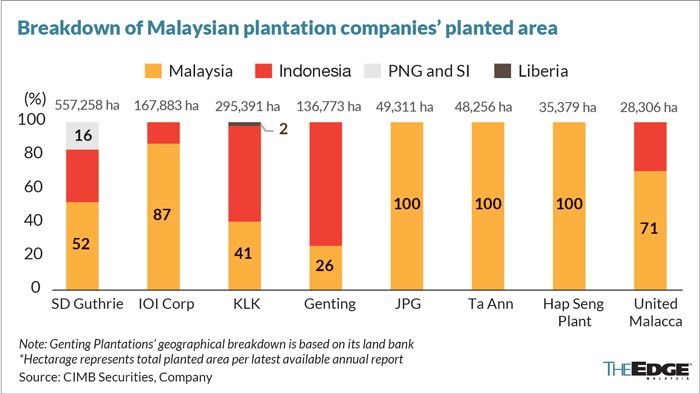
KUALA LUMPUR (Sept 25): Malaysian plantation companies with sizeable operations in Indonesia face greater regulatory uncertainty following the country’s new agrarian reform law, with SD Guthrie Bhd (KL:SDG), Genting Plantations Bhd (KL:GENP) and Kuala Lumpur Kepong Bhd (KL:KLK) among those with the largest exposure, according to CIMB Securities.
The potential impact, however, remains unclear as key details — including maximum landholding limits for companies and affiliated entities, and how a provision requiring at least 20% of certain land to be made available for agrarian reform and redistribution — have yet to be finalised through implementing regulations.
As such, CIMB has not made any adjustments to its earnings forecasts or the land banks of plantation companies under its coverage, saying it sees higher regulatory uncertainty rather than an immediate loss of land or earnings.
“We do not expect an across-the-board 20% cut in existing land,” the research house said in a note on Friday.
Indonesia’s parliament approved the Agrarian Reform Law on Tuesday, creating a broader framework to address land ownership concentration, redistribution and longstanding agrarian conflicts. The law also provides for a dedicated body under the president to oversee implementation, supervision and conflict resolution.
However, the Indonesian government still needs to draw up implementing rules that will, among other matters, determine minimum and maximum landholding limits. Agrarian Affairs and Spatial Planning Minister Nusron Wahid said such details would be provided through subsequent regulations.
The development was reported earlier this week, including by Bloomberg, which highlighted broader risks to Indonesia’s plantation and property sectors. CIMB’s latest assessment focuses on the potential implications for Malaysian-listed plantation companies.
Among CIMB’s Malaysian plantation coverage, SD Guthrie, Genting Plantations and KLK have the largest absolute plantation exposure to Indonesia. IOI Corp Bhd (KL:IOICORP) has a smaller relative exposure, while Johor Plantations Group Bhd (KL:JPG), Ta Ann Holdings Bhd (KL:TAANN) and Hap Seng Plantations Holdings Bhd (KL:HSPLANT) have plantation operations entirely in Malaysia.
CIMB said the impact will depend on the final land limits, whether the 20% rule applies to existing plantations and how it will be implemented.
Bloomberg consensus as at Friday showed analysts remaining broadly positive on SD Guthrie and Genting Plantations, while views on KLK were more mixed.
For SD Guthrie, 17 analysts had "buy" calls and three had "hold" calls, with a 12-month target price of RM7.68. Genting Plantations had 10 "buy" calls and two "hold" calls, with a target price of RM6.81. KLK had nine "buy" calls, 10 "hold" calls, and one "sell", with a target price of RM24.57.
Separately, India’s decision to lower import duties on major edible oils could provide some support for crude palm oil (CPO) demand, although CIMB expects the benefit to Malaysian planters to be modest.
India cut the basic customs duty on crude palm oil and crude soybean oil to 5% from 10%, while eliminating the 10% duty on crude sunflower oil, effective Thursday. The Indian government said the move was aimed at reducing import costs and easing domestic edible oil prices.
CIMB said the lower CPO duty should reduce landed costs and support Indian palm oil imports, although the larger tariff reduction for sunflower oil could make it more competitive against palm oil and limit the increase in demand.
India accounted for about 17% of Malaysia’s palm oil export volume in 2025. CIMB said the main benefit for Malaysian planters would likely come through firmer CPO prices rather than a significant direct increase in export volumes.
CIMB maintained its CPO price forecasts at RM4,450 per tonne for 2026 and RM4,550 per tonne for 2027.