

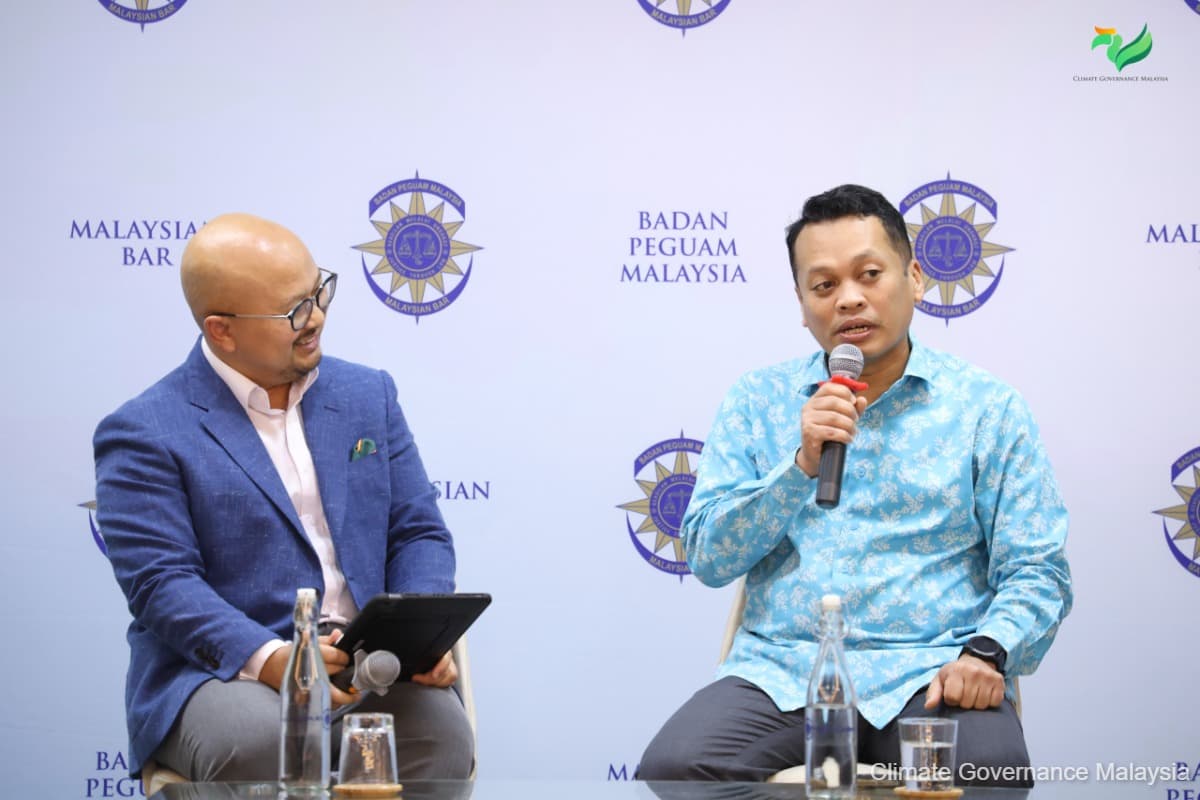
KUALA LUMPUR (Sept 24): The Malaysian Constitution, shaped by the realities of 1957 and 1963, needs to be revisited if the government is to take greater responsibility for climate action today, said former natural resources and environmental sustainability minister Nik Nazmi Nik Ahmad.
Addressing the delay to the National Climate Change Bill (RUUPIN), Nik Nazmi said the bill could improve how Malaysia addresses climate change, but would not resolve the underlying issue unless the Federal Constitution was also reviewed.
“If you were to look at responsibility and all that, then I think we must relook at our Constitution as well. Our Constitution is a picture of 1957 and 1963. You must remember, the first environmental ministers in the world came out with Rachel Carson's book in the 70s.
“If you compare with other countries, South Africa has a very forward-looking Constitution, but it has a modern Constitution shaped by their experience, so I think we need to relook at that,” he said during the Climate and Law Conference held at the Malaysian Bar Council on Wednesday (Sept 23).
The delay to RUUPIN has also affected the rollout of the carbon tax, as the system needs the framework provided by the bill, Nik Nazmi said. Before resigning on May 28 last year, Nik Nazmi had pushed for the RUUPIN which was reported to be in the final stages drafting for submission to the Cabinet and Parliament.
He said one proposal was for RUUPIN to require a portion of carbon tax revenue to be spent on climate-related measures, with the tax overseen by a designated regulator.
Nik Nazmi also said a climate fund could return some of the revenue to the states and help the country prepare for climate-related disasters, including floods and haze.
“The proceeds of carbon tax or even any other future revenue that can come out from the climate change bill, that must be shared. And I think this is one of the things that the federal government needs to realise because, again, the political reality is that politics in Malaysia in 2026 is much more dynamic than 1974,” he said.
The absence of climate legislation and a carbon tax has also weakened Malaysia’s incentive to strengthen its commitments under the Paris Agreement, Nik Nazmi said.
He described the RON95 fuel subsidy as regressive, arguing that the money could instead be spent on infrastructure that improves accessibility and walkability.
Nik Nazmi said Malaysia should recognise its status as an upper-middle-income country and build on its strengths. He noted that the country only gained control of its fossil fuel industry in the 1970s, after years of colonial exploitation, but said it must continue to progress.
“We have to try and play up our strengths, [like in] biodiversity and all that… I really think we should find our own solutions and showcase what we can do as a country, rather than hoping for something, and I think, with the current political mood, it seems to be very, very difficult.”
Beyond climate legislation, Nik Nazmi called for a review of how revenue is shared between the federal and state governments. He cited ecological fiscal transfers (EFT) as an example, describing them as a “drop in the ocean” because they remain an administrative policy rather than a legislated system.
He also pointed to UK Prime Minister Andy Burnham’s approach to allocating funds to towns, cities and regions in England as a possible model for Malaysia. Under the proposal, mayors of English city regions would receive a share of income tax raised in their areas, while regional authorities would be allowed to retain some revenue from local business rates. The UK government has yet to decide how much they would receive.
“For a lot of states, we’re only relying on revenues from forests, from land, from mining. Even for a state like Selangor, it's just developing land, and that gives off money, but they don't have any other source of revenue. If we tweak that system, then maybe there won't be so much pressure upon the states to develop the land.”