


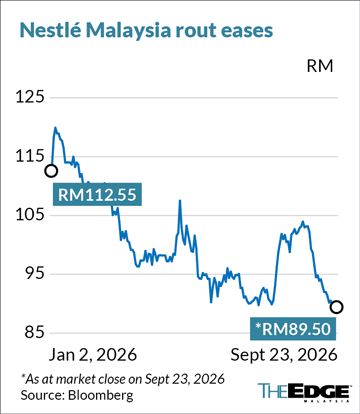
KUALA LUMPUR (Sept 24): Nestlé (Malaysia) Bhd paused its downward slide on Wednesday, following a 22% year-to-date drop that market observers said has run ahead of the company's underlying fundamentals.
The sell-off has erased about RM5.39 billion from Nestlé Malaysia’s market capitalisation since the start of the year. Based on its RM89.50 closing price on Wednesday (Sept 23), the group's market value stands at RM20.99 billion.
The stock’s recent weakness has been driven primarily by negative sentiment rather than any material deterioration in business fundamentals, said Hong Leong Investment Bank (HLIB) analyst Jonathan Ooi, who maintained his “buy” call on the stock.
“Its current share price has more than priced in [the downside risks], given that it is trading at a 35-times price-to-earnings ratio,” Ooi told The Edge, adding that he sees little room for the stock to fall further.
He noted that institutional investors have become more selective amid broader market volatility, with funds favouring thematic plays such as artificial intelligence and data centres.
A steady pipeline of initial public offerings on Bursa Malaysia has also drawn liquidity away towards cheaper alternatives.
In September alone, Nestlé Malaysia retreated close to 10%. The stock settled at RM89.50 on Wednesday, up 34 sen or 0.38% from a day earlier — a slight rebound after skidding to its year-to-date low of RM89.16 on Tuesday.
The stock remains well below Bloomberg’s consensus 12-month target price of RM112.47, with targets ranging between RM92 and RM135.
Most analysts remained optimistic on the stock, with eight of the 13 analysts tracking the stock keeping it on “buy”, as opposed to four recommending a “hold” and one advising “sell”.
The group reported a 31.7% jump in net profit to RM360.13 million for the first half ended June 30, 2026 (1HFY2026) from 1HFY2025, as revenue rose 7.5% to RM3.69 billion and gross profit margin widened to 32.3% from 30.4%.
Input costs and waning cash aid key risks
Berjaya Research's head of research Kenneth Leong struck a more cautious tone, as he flagged a possible moderation in earnings in the second half of the year as the boost from government cash aid wanes, which could soften consumer purchasing power.
Higher raw-material and shipping costs could also cap near-term share-price recovery, Leong added.
“The strong 1H2026 performance may be difficult to replicate if consumer spending moderates and the boost from Sara (Sumbangan Asas Rahmah) gradually wanes. Hence, maintaining a stable volume growth without relying heavily on price increases will be the key focus to sustain earnings growth into 2H2026,” he said.
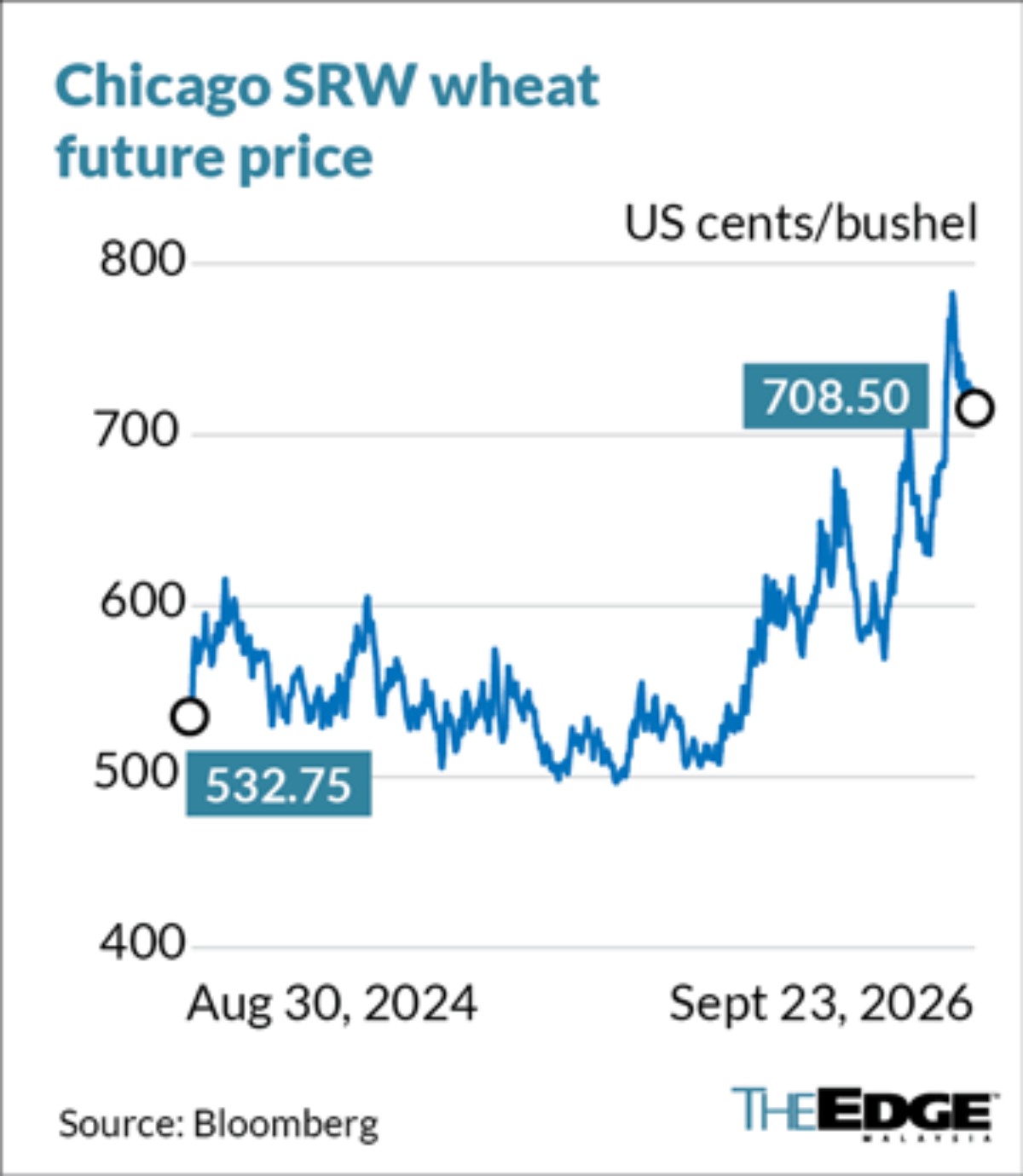
Commodity price movements present a mixed picture for Nestlé Malaysia. While coffee and cocoa have retreated from earlier highs this year, wheat prices have risen sharply.
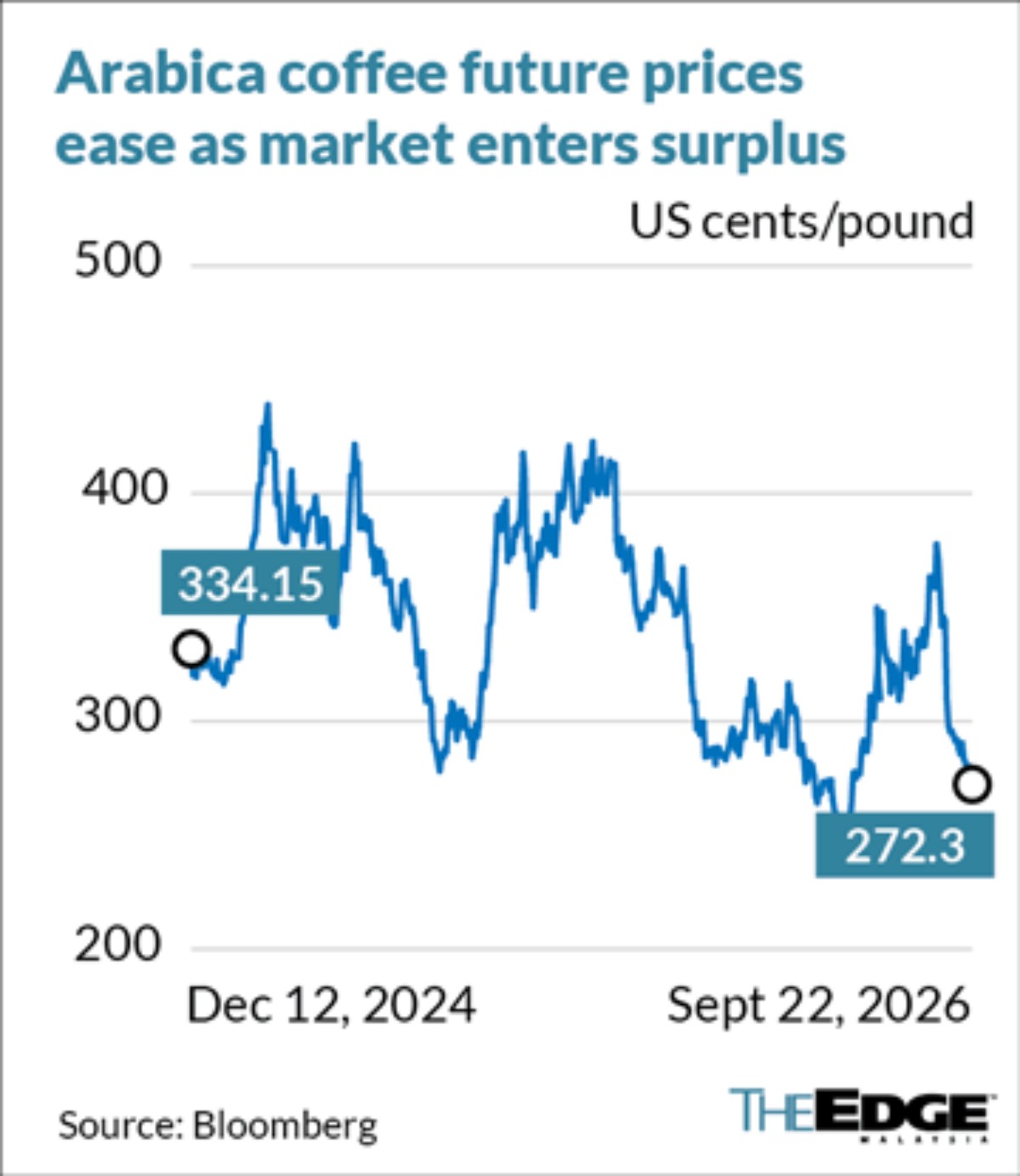
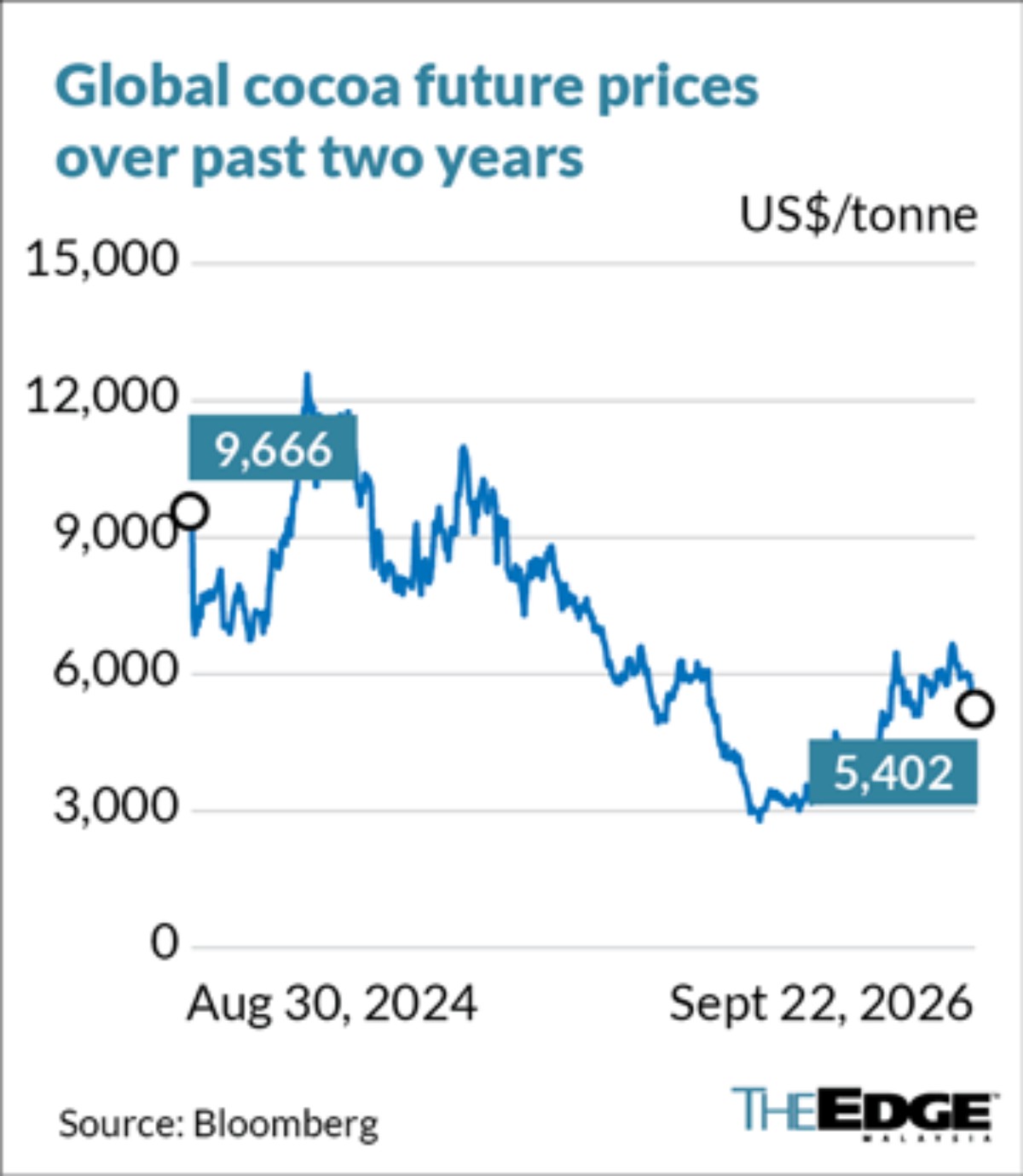
Arabica coffee futures have dropped roughly 24% year to date, as it fell to 272.30 US cents per pound as of Tuesday (Sept 22), while cocoa futures have fallen about 8% over the same period to US$5,402 per tonne — nearly halving from US$10,000 per tonne in June last year.
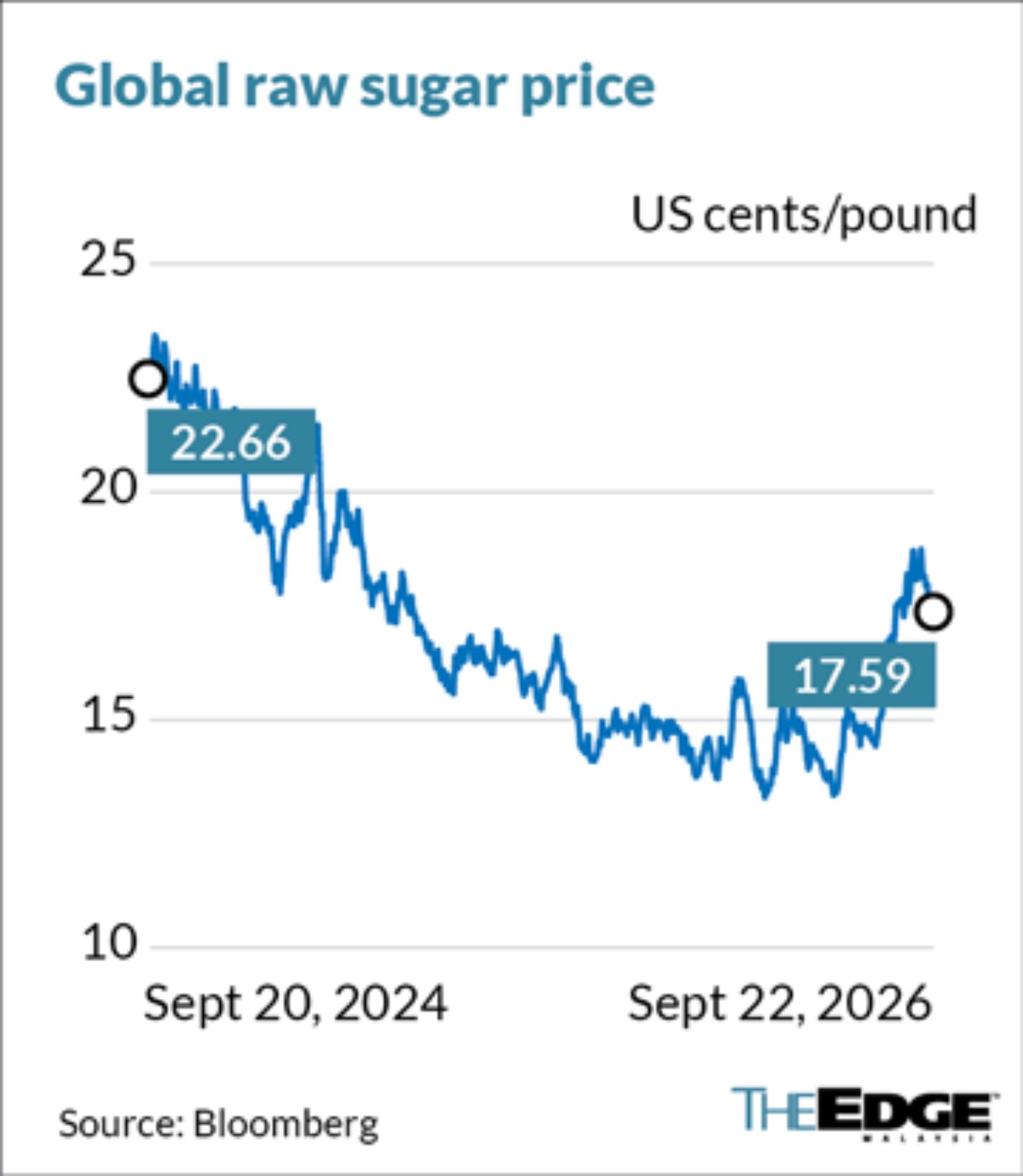
In the same period, Chicago soft red winter wheat futures have risen over 40% to 717.25 US cents per bushel, while raw sugar prices shot up 20.5% to 17.59 US cents per pound.
HLIB's Ooi, however, said Nestlé Malaysia’s outlook remains positive, citing steady domestic consumption demand for essential food products.
The group's margins also remained well shielded at least until end-2026, he said, as the group has built an inventory buffer of at least six months following the eruption of the US-Iran war in February.
Nestlé Malaysia also has room to protect margins through price increases if necessary, he added.
Compressed valuation amid sector-wide correction
Nestlé Malaysia’s valuation has compressed sharply from historical levels. Leong noted that the stock is now trading at about 35 times earnings — well below its one-year historical average of 47.9 times — representing a significant erosion of its usual valuation premium.
Sustained earnings growth and margin resilience would be needed for the stock to command a higher valuation again, Leong said.
“A sustained moderation in cocoa and coffee prices would provide further support to gross margin, while ringgit could lower the costs of imported raw materials and further bolster bottom-line. These factors could help restore investor confidence in Nestlé Malaysia's defensive earnings profile and pave the way for a valuation re-rating,” Leong said.
Nestlé Malaysia's downturn mirrors a sector-wide correction across consumer staples on Bursa Malaysia.
As of Wednesday’s close, beverage manufacturer and distributor Fraser & Neave Holdings Bhd (KL:F&N) was down nearly 35% year to date to RM23, while brewers Heineken Malaysia Bhd (KL:HEIM) and Carlsberg Brewery Malaysia Bhd were down 40% and 26.6%, respectively.
Dutch Lady Milk Industries Bhd (KL:DLAY) was a notable outlier, having eased just 2.44% over the same period.
Leong said the broader de-rating reflects a combination of cautious consumer spending amid higher living costs and stagnant wage growth, expectation that stimulus effects are fading, as well as margin pressures from higher material, logistics, energy and labour costs.
Dutch Lady’s relative resilience, he said, is partly due to its defensive product mix, which leans towards essential dairy and nutritional products rather than discretionary spending.