

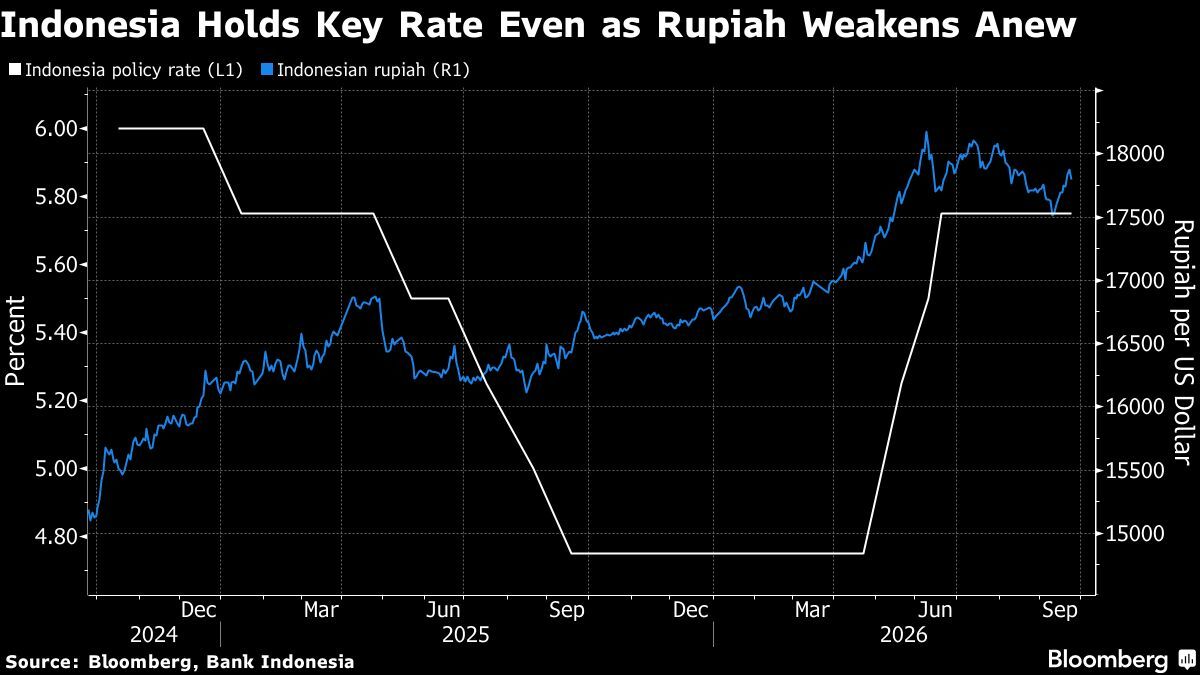
(Sept 23): Indonesia’s central bank kept its interest rate unchanged for a third straight meeting, choosing to rely on continued intervention and increased hedging incentives to support the rupiah in the face of higher oil prices and US yields.
The new governor Destry Damayanti and her board held the BI-Rate at 5.75% on Wednesday as expected by 33 of 36 economists surveyed by Bloomberg. The rest had pencilled in a quarter-point hike.
Bank Indonesia also further cut the premiums for conventional hedging swaps on portfolio investments by up to 25% and for domestic non-deliverable forwards by up to 30%. These perks are applicable for portfolio investments, foreign loans and foreign direct investments.
“BI will continue to strengthen incentive policies to attract foreign capital inflows, stabilise the rupiah, and accelerate the deepening of the money and foreign exchange markets,” Destry said in a briefing. “These incentive policies also follow a ‘higher for longer’ approach; the longer investors keep their funds here, the higher the premium discount.”
The Indonesian rupiah and bonds held earlier gains after the decision, with the currency strengthening 0.4% to 17,800 per dollar to outperform regional peers on Wednesday. Stocks rallied further to 1.5%, the biggest rise in almost a month.
The hold suggests policymakers are confident that intervention and other non-interest rate tools can act as the first line of currency defence, even as the external backdrop becomes more challenging.
The domestic economy is still growing but “needs a boost”, Destry said. “Therefore, we are exploring policies beyond interest rates to address global uncertainty.”
Stronger response
Destry noted an increase in global volatility, with oil prices above US$100 a barrel, global inflation higher than expected and the US Federal Reserve likely to raise rates anew. Such developments demand stronger policy responses and closer fiscal-monetary policy synergy to bolster resilience, she said.
Indeed, the worsening Middle East conflict and weather disruptions from El Niño are fanning energy and food prices across Asia. Inflation stood at 3.2% in August, nearer the top end of BI’s 1.5%-3.5% target range.
The rupiah, meanwhile, weakened back toward 17,900 per dollar earlier this week amid the Fed rate hike, higher US Treasury yields and costlier crude.
“We still think a final rate hike of 25 basis points is needed in mid-December for the stability of the rupiah as uncertainties persist in the energy market and the US Fed is expected to carry out another hike of its own in the month,” said Homin Lee, a senior macro strategist at Lombard Odier Singapore Ltd.
“If we are right in our prognosis of a ‘one more and done’ scenario for both the Fed and BI, we think a range-bound trajectory for the rupiah is a reasonable possibility.”
PT Bank Permata economist Faisal Rachman in Jakarta also sees another quarter-point rate hike in the fourth quarter.
“If geopolitical tensions persist longer than anticipated or broaden further, keeping global oil prices above US$100 per barrel, the likelihood of additional rate hikes by both the Fed and BI would increase,” he said in a text message.
Policy mix
Still, Destry said the current level of Indonesia’s key rate is “adequate to maintain stability”, after the central bank raised it preemptively by 100 basis points earlier this year.
“We are now using more targeted incentive policies which is to encourage capital inflows,” the governor said.
BI has also stepped up intervention in recent days, pledging to act “consistently and continuously” offshore and onshore, including buying government debt in the secondary market. Higher foreign-exchange reserves give the central bank more room to support the currency without immediately raising rates.
The decision, which is Destry’s first since permanently taking on the governor post earlier this month, also comes shortly after Suahasil Nazara took over as finance minister. The reshuffle puts greater focus on fiscal-monetary coordination as higher energy costs threaten both the rupiah and the state budget at a time when President Prabowo Subianto is pushing for faster economic growth.
Bank Indonesia’s “policy mix” — keeping the rate on hold, while ramping up its other tools — can “create room for the economy to continue moving forward”, Destry said.
Bank lending grew 13.65% in August compared to a year earlier, more than the 8%-12% expected growth for this year.
Uploaded by Chng Shear Lane