

This article first appeared in Capital, The Edge Malaysia Weekly on September 21, 2026 - September 27, 2026
IT has been a volatile year for investors on Bursa Malaysia as the benchmark index made little headway, with swings in sentiment both ways. The FBM KLCI closed at 1,679.21 points last Tuesday, almost unchanged from 2025’s end of 1,680.11.
“When capital gains are harder to come by, dividends naturally do more of the heavy lifting. That is particularly so for companies outside the market’s favoured themes, many of which continue to trade at low price-earnings multiples (PERs),” M&A Equity Holdings Bhd managing director Datuk Bill Tan tells The Edge.
“Some companies are paying higher dividends this year and I’m not even talking about first-liners like semiconductor companies and data centre stocks, which have been doing well. Generally, the rest of the market has been lagging and trading at very low PER, which means if they declare dividends, the yield could be very high and that will attract investors to buy their share.”
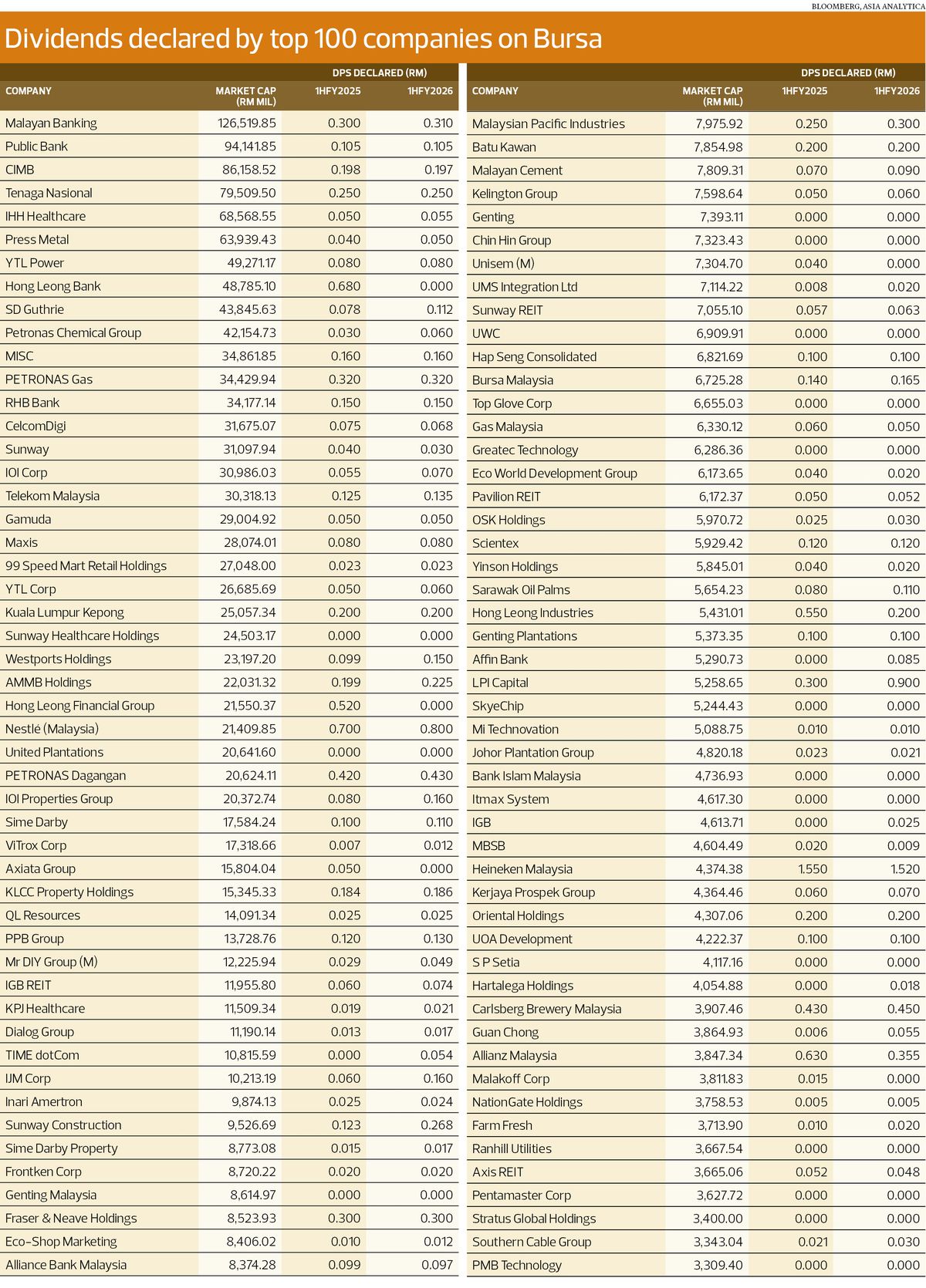
Bloomberg data on the 100 largest Bursa-listed companies by market capitalisation shows 79 companies declared dividends in 1H2026 compared with 80 in 1H2025.
Forty-four companies recorded a higher dividend per share (DPS). Among the 75 companies that paid dividends in both periods, 40 raised their DPS, 21 kept it unchanged and 14 paid less (see table).
Aggregate estimated payouts in 1H2026 rose 2.3% to RM29.08 billion, from RM28.43 billion in 1H2025.
The data excludes, however, certain dividend announcements for the quarter ended June 30, 2026, including Axiata Group Bhd’s (KL:AXIATA) 5.5 sen first interim dividend for the period, announced on Aug 28, as well as Hong Leong Bank Bhd’s (KL:HLBANK) 80 sen final dividend and Hong Leong Financial Group Bhd’s (KL:HLFG) 57 sen final dividend announced on Aug 27. Axiata’s latest dividend was 10% higher year on year (y-o-y), while HLB’s FY2026 total dividend rose to RM1.10 a share from 96 sen and HLFG’s to 79 sen from 72 sen.
CIMB Group head of Malaysia research and regional head of agribusiness Ivy Ng tells The Edge: “We have only dividends declared in the first half. A full year’s dividend is needed to tell the full story because many companies, even if they have allocated the full year’s dividend, may still be holding back what they paid out in the first half, with the intention of paying more in the second half, given the economic uncertainties this year.”
Financial services, plantation, industrial products firms remain top dividend payers
The financial services sector remains the largest dividend contributor, led by Malayan Banking Bhd (KL:MAYBANK), Public Bank Bhd (KL:PBBANK) and CIMB Group Holdings Bhd (KL:CIMB), with dividend payouts of 31 sen, 10.5 sen and 19.65 sen for the first six months ended June 30, 2026 (1H2026) respectively, similar to payouts last year in the same period.
There were about RM10.32 billion in estimated payouts from the sector in 1H2026 compared with some RM11.78 billion in 1H2025, taking into consideration Hong Leong and HLFG’s declarations this year amounting to RM625.98 million and RM525.45 million respectively.
Meanwhile, the plantation sector rose 25.8% y-o-y to RM1.76 billion in estimated payouts during the period under review, from RM1.4 billion, supported by resilient crude palm oil prices, healthy cash flows and stronger balance sheets that have given producers greater flexibility to raise shareholder distributions. SD Guthrie Bhd (KL:SDG) raised its DPS to 11.18 sen from 7.75 sen, IOI Corp Bhd (KL:IOICORP) to seven sen from 5.5 sen and Sarawak Oil Palms Bhd (KL:SOP) to 11 sen from eight sen.
Industrial products and services recorded a 23.9% increase to RM1.77 billion. Petronas Chemicals Group Bhd (KL:PCHEM) doubled its comparable DPS to six sen from three sen, Press Metal Aluminium Holdings Bhd (KL:PMETAL) increased its payout to five sen from four sen, and Malayan Cement Bhd (KL:MCEMENT) raised it to nine sen from seven sen.
Consumer sector payouts rose 11.3% to RM3.44 billion. Among the notable increases, Mr DIY Group (M) Bhd (KL:MRDIY) lifted its DPS to 4.9 sen from 2.9 sen, Nestlé (Malaysia) Bhd (KL:NESTLE) to 80 sen from 70 sen, and Farm Fresh Bhd (KL:FFB) to two sen from one sen.
Even payouts by real estate investment trusts (REITs) rose 13.8% to RM1.17 billion, with IGB REIT (KL:IGBREIT) raising its distribution to 7.44 sen from 6.01 sen, Sunway REIT (KL:SUNREIT) to 6.28 sen from 5.68 sen, and Pavilion REIT (KL:PAVREIT) to 5.17 sen from 4.97 sen.
Construction and property recorded even bigger headline increases, but special dividends contributed to the jump.
Construction payouts rose 79% to RM1.32 billion, helped by Sunway Construction Group Bhd’s (KL:SUNCON) 26.8 sen, which included 15.2 sen of special dividends in the first quarter ended March 31, 2026, and IJM Corp Bhd’s (KL:IJM) 16 sen, including 11 sen of special dividends across two declarations in the first two quarters of the year.
Property payouts climbed 46.7% to RM1.47 billion, led by IOI Properties Group Bhd’s (KL:IOIPG) 16 sen payout, including an eight sen special dividend, after full-year net profit more than doubled and revenue hit a record RM4.44 billion.
Tradeview Capital CEO Ng Zhu Hann says commodity-related companies, property and plantations have benefited from land monetisation, the data-centre investment cycle and strong commodity prices, while banks and utilities traditionally generate recurring cash flows that support dividends.
“There are many reasons that dividend payout has increased even if marginally. The rising yield market globally makes equities less attractive unless they can provide justification in terms of returns. Higher dividend yield is one of the ways to do so. However, the companies must have cash reserve to do so sustainably,” says Zhu Hann, whose dividend picks are HLFG, Mega First Corp Bhd (KL:MFCB), Malayan Flour Mills Bhd (KL:MFLOUR), Duopharma Biotech Bhd (KL:DPHARMA), Syarikat Takaful Malaysia Keluarga Bhd (KL:TAKAFUL), Tenaga Nasional Bhd (KL:TENAGA) and Uchi Technologies Bhd (KL:UCHITEC).
Likewise, BIMB Securities Sdn Bhd director of research Mohd Redza Abdul Rahman points to resilient earnings and relatively healthy balance sheets among large companies.
There have also been signs of dividends returning amid a recovery in earnings. Hartalega Holdings Bhd (KL:HARTA) declared 1.8 sen in May after having no comparable payout last year.
After suspending payouts in FY2023 and FY2024 amid a downturn in the glove industry caused by oversupply and weaker selling prices, Top Glove Corp Bhd (KL:TOPGLOV) paid a dividend of 0.48 sen per share amounting to RM38.5 million and representing a payout ratio of 37% for the financial year ended Aug 31, 2025 (FY2025).
The glove maker said the board will consider an interim dividend when it announces its 4QFY2026 results, as “improved earnings should allow it to move closer to our 50% payout policy”.
Similarly, Hartalega, which did not announce a dividend in 1HFY2025, declared a first single-tier interim dividend of 1.8 sen per share for the financial year ending March 31, 2027, on May 5, 2026.
While some of the market experts whom The Edge spoke to are cautious about the sustainability of current dividend payout levels in 2027, Redza is positive, given the “expectation of strong earnings growth for this year and next year, giving clout to dividend payouts remaining sustainable into 2027, although the pace of growth may moderate”.
The experts expect dividend growth to become more selective if global growth, exports or commodity prices weaken, or if companies need more cash for capital expenditure and acquisitions.
Bonds not the same play as dividend stocks
It is worth noting that the benchmark 10-year Malaysian Government Securities (MGS) yield stood at 3.476% on Sept 17, meaning investors can obtain considerably more income from government bonds than they could a year ago.
Tradeview Capital’s Zhu Hann says the narrowing yield differential raises the return that investors should demand from equities.
“Naturally, the yield competition is narrowing. That is why REITs and dividend-based stocks are seeing selloffs recently.”
BIMB’s Redza and M&A’s Tan note, however, that bond yields and dividend stocks are not directly comparable, as bonds are long-term investments with no capital gains, unlike equities.
“A stock offering a 3% to 4% dividend yield may still be highly attractive if investors expect earnings growth to drive share price appreciation of 8% to 10% annually. Conversely, a stock yielding 7% to 8% may be less compelling if earnings are stagnant and share prices have limited upside,” says Redza.
For income investors, BIMB sees yields of 4% to 6% as attractive for mature businesses such as banks, utilities, REITs and telcos. Total-return investors may accept 3% to 4% if earnings and dividends are growing.
To this end, he believes there may also be a gradual change in what boards do with surplus cash.
Redza says investors are increasingly asking whether retained funds can earn returns above a company’s cost of capital. If attractive reinvestment opportunities are limited, paying dividends or buying back shares becomes a more credible alternative to accumulating cash.
The push towards more disciplined capital allocation could gain further momentum from the MY Value Up programme introduced by the Securities Commission Malaysia and Bursa Malaysia in April this year. The initiative encourages large listed companies to spell out their growth strategies and capital allocation priorities, including how surplus capital can best be deployed to create shareholder value. While it does not specifically require higher dividends, returning excess cash to shareholders could be an option.
Zhu Hann notes that MY Value Up is relevant because it puts pressure on companies, particularly larger ones, to justify what they do with excess cash.
“Potentially only bigger companies in the My Value Up programme may start to look at this seriously as part of their adherence to the policy. If the companies want the support from GLICs (government-linked investment companies), funds and investors, dividend is an important part of managing investors relations,” he says.
Kenanga Investment Bank Bhd head of research Peter Kong says elevated MGS yields have raised the hurdle rate, driving demand for players offering yields well above 5%.
“We like Alliance Bank Malaysia Bhd (KL:ABMB) for its more disciplined loan growth, which gives it greater payout headroom that we appreciate ahead of the market,” says Kong.
“We also like Bermaz Auto Bhd (KL:BAUTO), as good reception for its models is a positive surprise, translating into sector leading DPS growth potential. Meanwhile, Velesto Energy Bhd (KL:VELESTO) should see a stronger second half, and their commitments to paying out from cash flow rather than profits is reassuring to investors.”
Dividend stock picks
BIMB’s core dividend picks are Tenaga, Telekom Malaysia Bhd (KL:TM), SD Guthrie, Sime Darby Bhd (KL:SIME) and PETRONAS Gas Bhd (KL:PETGAS).
Redza likes Tenaga for its defensive cash flows and longer-term electricity-demand growth, including from data centres.
“TM’s recurring broadband and enterprise revenue provides earnings visibility, while SD Guthrie’s plantation cash flows and balance sheet underpin its distributions,” he says. “[Meanwhile], Sime Darby offers diversified industrial and healthcare earnings, while PETRONAS Gas’ regulated infrastructure business provides highly visible cash flows and dependable dividends.”
Among REITs, BIMB prefers Axis REIT (KL:AXREIT) for its industrial and logistics exposure; KLCCP Stapled Group (KL:KLCC) for its premium office and retail assets; and Al-’Aqar Healthcare REIT (KL:ALAQAR) for its defensive healthcare rental income.
Redza, who also highlights “dividend growth stocks”, says: “Time dotCom Bhd (KL:TIMECOM), Gamuda Bhd (KL:GAMUDA), Sunway Bhd (KL:SUNWAY) and IJM may not offer the highest yields today, but their appeal lies in the possibility that earnings growth ultimately translates into higher dividends and share-price appreciation.”
With bond yields higher and the economic outlook still uncertain, investors will have to discern between companies with the highest dividend yields and those whose earnings and cash flows can sustain those payouts.
Save by subscribing to us for your print and/or digital copy.
P/S: The Edge is also available on Apple's App Store and Android's Google Play.