

This article first appeared in Capital, The Edge Malaysia Weekly on September 21, 2026 - September 27, 2026
THE country’s major private healthcare operators are heading into the second half of 2026 with a stronger earnings outlook, as rising patient volumes, higher bed utilisation and ongoing hospital expansions provide fresh support for growth.
Analysts expect KPJ Healthcare Bhd (KL:KPJ), IHH Healthcare Bhd (KL:IHH) and Sunway Healthcare Holdings Bhd (KL:SUNMED) to benefit from the continued growth in demand for private healthcare, underpinned by an ageing population and the rising prevalence of chronic and non-communicable diseases.
But after a strong run in the first half of the year, investors face a more immediate question: how much of that growth is already reflected in share prices?
BIMB Securities analyst Maliana Shaharudin remains “overweight” on the sector, forecasting that earnings in 2H2026 will rise an average of 33% from the first half, and 28% from 2H2025.
She says the expected improvement should come from higher utilisation at existing hospitals, continued medical tourism, additional capacity from brownfield and greenfield projects, a richer case mix as hospitals take on more complex procedures and increasing operating leverage as newer facilities mature.
Philip Capital analyst Shahira Abdul Rahim also expects earnings to strengthen in 2H2026, driven by higher patient throughput and additional bed capacity. This combination should allow operators to spread fixed costs across a larger volume of patients, supporting margins.
MBSB Research is also positive on the sector.
It expects earnings for KPJ to strengthen as its newer hospitals mature and make a larger contribution, while cost optimisation, capacity expansion and digital transformation should provide further support.
Medical tourism remains another important driver. MBSB Research expects demand across KPJ’s hospital network to remain resilient despite geopolitical uncertainties.
For IHH, it expects the company to maintain an earnings before interest, taxes, depreciation and amortisation (Ebitda) margin of between 22% and 24% in 2H2026, helped by higher inpatient volumes even as medical-cost inflation remains elevated.
“The trend reversal in the Singapore division provides earnings tailwinds for the remainder of its financial year ending Dec 31, 2026 (FY2026),” MBSB Research says in an email response to The Edge. As volumes increase against a backdrop of largely fixed overheads, Singapore is expected to return to positive earnings growth margins, it adds.
The group’s planned efficiency measures, including a groupwide enterprise resource planning system and process harmonisation, should also generate operating savings and help offset higher labour and administrative costs.
IHH’s geographic diversification in Malaysia, India and Türkiye provides an additional buffer against regional disruptions and currency movements, MBSB Research says.
Healthcare reform could change equation
The earnings outlook, however, comes with a longer-term policy question.
Healthcare reform could create both opportunities and risks for private hospital operators, BIMB Securities’ Maliana says. Among the measures being introduced are MediAsas, a voluntary medical insurance and takaful plan that is scheduled to be rolled out nationwide next January, as well as the gradual introduction of diagnosis-related groups (DRG).
“In the near term, these measures could create uncertainty over pricing and reimbursement, but over the longer term, a more affordable insurance product could potentially expand the pool of insured patients able to access private healthcare,” she notes.
A bigger concern for operators is whether their ability to raise prices would be constrained by greater payer scrutiny under DRG.
“Therefore, going forward, we would place more value on operators capable of generating growth through volume, utilisation, case complexity and cost efficiency, rather than simply higher pricing,” Maliana says.
“That distinction is important. The easy phase of healthcare inflation translating directly into revenue growth may gradually become harder.”
Mixed 1H results
The three listed healthcare operators reported mixed results for the six months ended June 30.
KPJ and IHH came in below BIMB Securities’ full-year expectations, while SunMed was broadly in line. KPJ’s 1H results represented 37% of BIMB Securities’ full-year forecast and 43% of consensus estimates. IHH’s accounted for 40% of the local research firm’s full-year forecast.
SunMed’s results, meanwhile, were broadly in line with expectations, with 1H results representing 41% of BIMB Securities’ full-year forecast and 40% of consensus estimates.
Maliana says investors should look beyond the headline figures because underlying operating trends remain encouraging.
RHB Investment Bank Research (RHB Research) described SunMed’s results as broadly in line with expectations, while noting that IHH’s performance was ahead of its forecasts.
In a Sept 7 note, RHB Research upgraded IHH to “buy” from “neutral” and raised its target price to RM9.54 from RM9.30 after the group reported 1H core earnings of RM1 billion, up 22% from a year earlier. That represented 52% of RHB Research’s full-year forecast and 50% of consensus estimates.
In an Aug 21 note, PublicInvest Research also said SunMed’s results were broadly in line with expectations. Its 1H performance represented 40% of the research outfit’s full-year forecast.
KPJ’s net profit rose 24.7% to RM173.57 million in 1HFY2026 from RM139.12 million a year earlier. Revenue increased 13.1% to RM2.25 billion from RM1.99 billion, driven by higher patient visits and surgical volumes.
IHH’s net profit rose 14.9% to RM1.1 billion from RM957 million, while revenue increased 8% to RM13.6 billion from RM12.59 billion. The expansion was supported by sustained demand, a richer patient case mix and price adjustments to offset inflation.
Of the three, SunMed posted the fastest year-on-year growth. Net profit rose 39.1% to RM111.5 million in 1HFY2026 from RM80.14 million a year earlier, while revenue increased 26.9% to RM1.26 billion from RM992.62 million, reflecting higher patient volumes.
Asia OneHealthcare IPO could provide another catalyst
While the sector’s long-term growth story remains intact, its valuations have become harder to ignore after the strong gains in 1H2026.
One analyst, who declined to be named, says private hospital operators could see another valuation rerating later this year if TPG Inc-backed Asia OneHealthcare Sdn Bhd proceeds with a planned listing.
The potential initial public offering (IPO) could provide a fresh catalyst for the sector, much as investor interest intensified ahead of SunMed’s listing in March.
Reuters, citing sources, reported earlier this month that Asia OneHealthcare had filed for an IPO with the Securities Commission Malaysia that could raise as much as RM10 billion. If completed at that size, it would be Malaysia’s largest IPO since FGV Holdings Bhd’s RM10.4 billion listing in 2012.
“It’s more of an upside risk towards the later part of this year, similar to what we saw early this year before SunMed’s IPO. The cheaper ones like IHH and KPJ may see some rerating,” the analyst tells The Edge.
The analyst says a major downside risk could emerge if the government moved ahead with a nationwide DRG scheme, which the analyst said had been postponed to 2028.
SunMed’s strong valuation and successful listing helped lift sentiment across the private healthcare sector. KPJ and IHH both subsequently reached record highs.
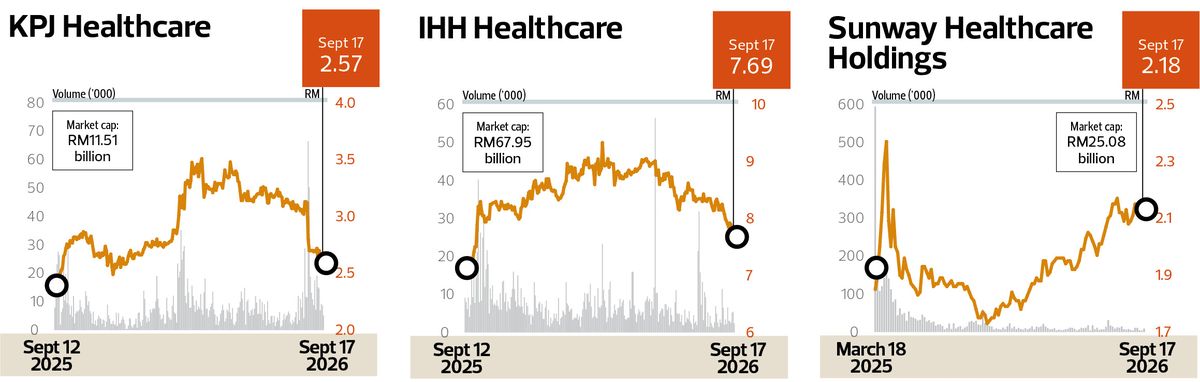
KPJ shares rose to RM3.51 on April 2, while that of IHH reached RM9.33 on March 18, the day SunMed made its debut on the Main Market. Both have since pulled back.
Shares of KPJ came under additional pressure following the resignation of president and managing director Chin Keat Chyuan on Sept 1, leaving the group in search of a successor.
IHH faces a separate source of uncertainty in India. On Aug 31, the Delhi High Court ordered a forensic audit into the dissipation of shares previously held by the former promoters of Fortis Healthcare Ltd, the Singh brothers. The audit will also examine IHH’s 2018 acquisition of a controlling stake in the Indian hospital operator.
The audit is not expected to have a material impact on IHH’s earnings, but the process could add uncertainty and potentially delay the group’s plans to increase its stake in Fortis to 51%. IHH currently owns 31.17% of Fortis after completing a mandatory tender offer last December.
As at last Thursday, IHH was down 17.6% from its March 18 peak of RM9.33, settling at RM7.69. KPJ shares had fallen 26.8% from its April 2 peak of RM3.51 to close at RM2.57 last Thursday.
SunMed has moved in the opposite direction, gaining 17.9% since its listing to close at RM2.18 last Thursday.
SunMed’s valuation raises the bar
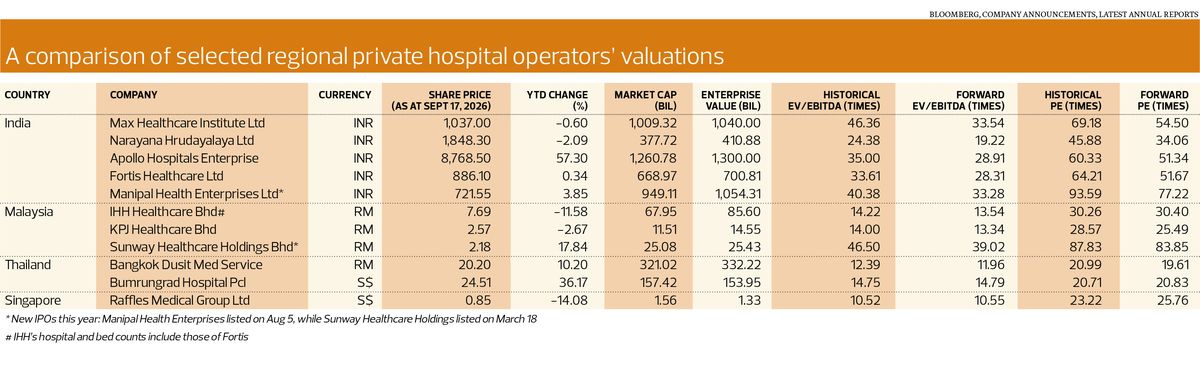
That divergence is reflected in valuations. According to Bloomberg data, SunMed trades at 83.85 times forward price-to-earnings (PE), compared with 30.40 times for IHH and 25.49 times for KPJ.
On an enterprise-value-to-Ebitda basis, SunMed trades at 39.02 times, versus 13.54 times for IHH and 13.34 times for KPJ. The premium has made analysts more cautious about SunMed, even as they remain positive on its earnings prospects.
The head of a local research house says the valuation could partly reflect the wider Sunway Group ecosystem and potential synergy with other businesses within the group.
“It may be a case of not looking solely at SunMed per se, but at businesses in Sunway, such as Sunway Property and others. It may be too expensive, but it may not go down as much for the time being,” he says.
As for KPJ, he says its leadership change could continue to weigh on sentiment in the near term. But after the recent sell-off, its valuation has become more attractive.
The research head also highlights the possibility of a recovery in KPJ and IHH as the broader economic environment improves.
Analysts favour IHH and KPJ on valuation
Bloomberg data shows that analysts remain broadly positive on KPJ, with 16 “buy” recommendations and two “hold” calls. The consensus 12-month target price of RM3.51 is about 37% above last Thursday’s closing price.
IHH has 24 “buy” recommendations and two “hold” calls. Its consensus 12-month target price of RM10.21 is about 33% above last Thursday’s closing price of RM7.69.
Analysts are more divided on SunMed, with 12 “hold”, three “buy” and two “sell” calls. Its consensus 12-month target price of RM2 is about 8.3% below last Thursday’s closing price of RM2.18.
A healthcare analyst says SunMed’s valuation makes it difficult to recommend the company to clients despite its earnings growth.
“At the moment, if they can’t deliver earnings, I think the share price will drop a lot.”
He prefers IHH, citing its stable management and improving performance in Singapore.
For investors in Malaysian private healthcare, the second half of 2026 is therefore likely to be less about whether earnings can grow than how much growth is needed to support current valuations.
The sector has several structural supports in the form of an ageing population, rising healthcare demand, medical tourism, capacity expansion and operating leverage. However, the next phase of growth may increasingly depend on hospitals treating more patients, performing more complex procedures and operating more efficiently rather than simply charging more.
Save by subscribing to us for your print and/or digital copy.
P/S: The Edge is also available on Apple's App Store and Android's Google Play.