

This article first appeared in The Edge Malaysia Weekly on September 21, 2026 - September 27, 2026
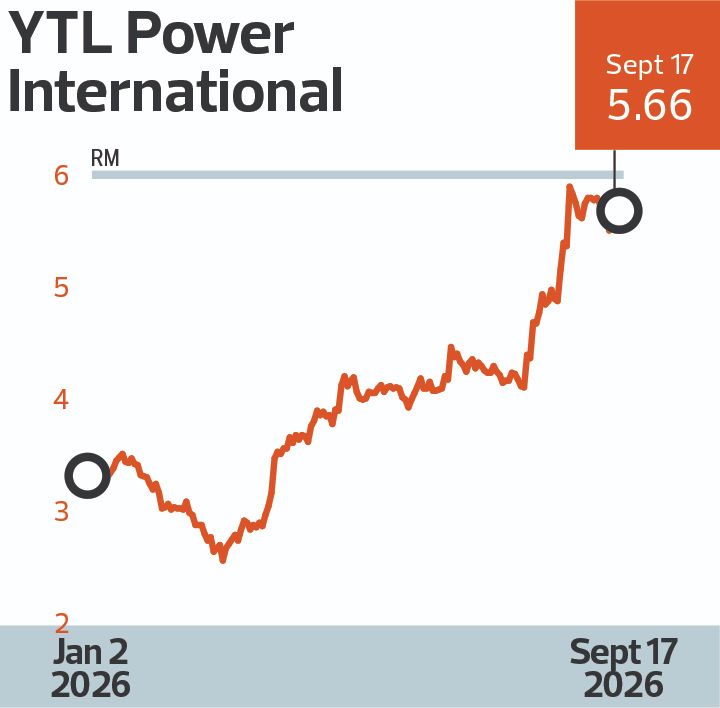
YTL Power International Bhd’s (KL:YTLPOWR) share price has risen by 72.7% year to date. The gains come as its data centre (DC) segment has begun reporting standalone earnings, while its water and sewerage segment has strengthened and power generation has shown signs of stabilisation. In addition, speculation about a potential spin-off or listing of its DC segment has likely added to the group’s re-rating.
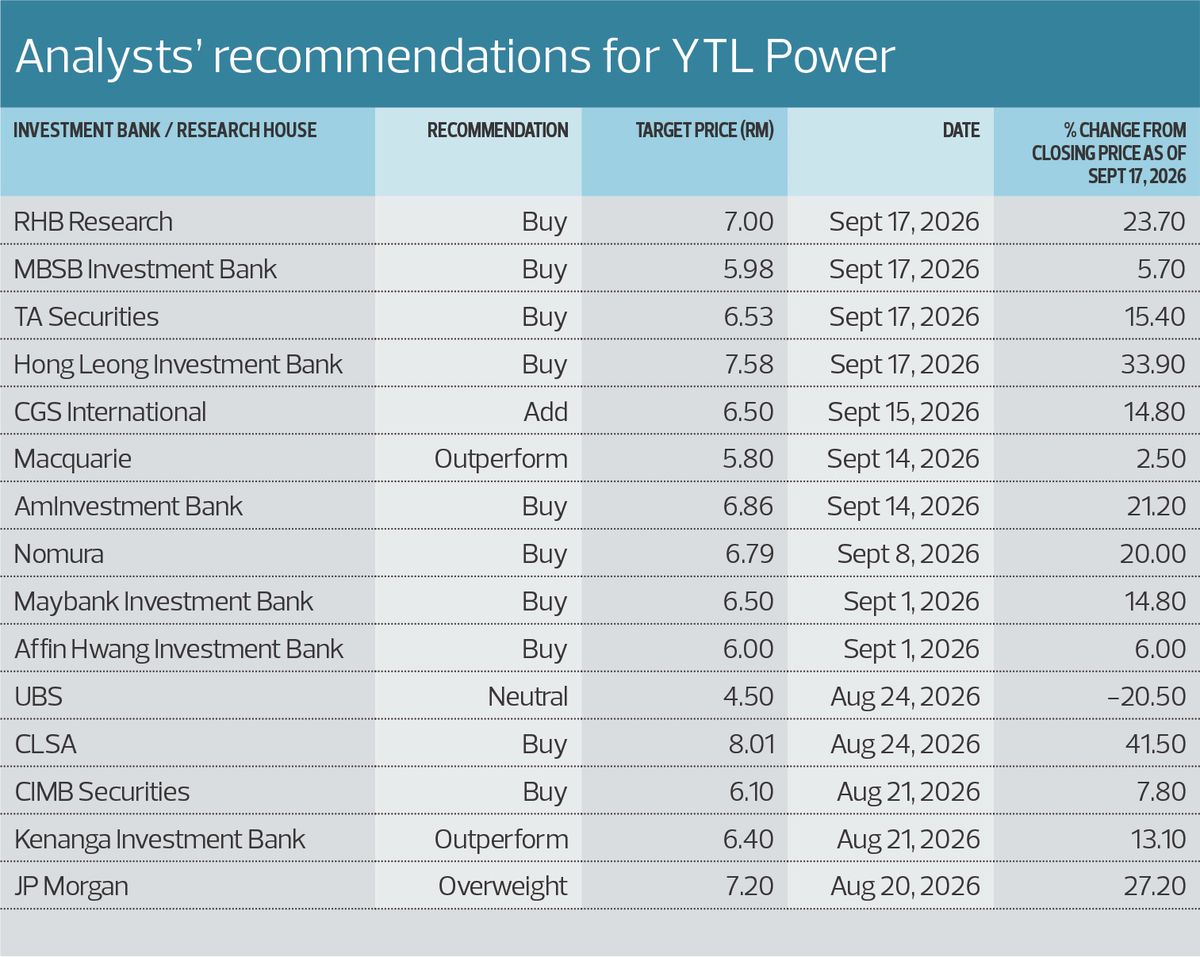
The only question now is whether there is a ceiling for YTL Power’s share price gains. Analysts think the stock has more room to run. Bloomberg data shows that of the 15 research houses with recent 2026 calls on the stock, 14 have positive recommendations, one is neutral and none covering the counter have a “sell” call.
Target prices range from RM4.50 to RM8.01, with an average TP of RM6.52, currently 15.1% above YTL Power’s closing price of RM5.66 as at last Thursday (Sept 17).
The broadly bullish expectations come amid a re-rating of several of the group’s businesses. The DC segment has been the clearest beneficiary, while analysts are also increasingly positive on Wessex Water and the outlook for PowerSeraya.
But the range of valuations assigned to the DC business shows just how much of YTL Power’s future value remains dependent on assumptions over capacity, utilisation and earnings. DC business valuations range from RM1.40 to RM5.13 per YTL Power share, with the variation reflecting how much future capacity research houses are pricing in today.
Mixed FY2026 earnings
Despite the share price strength, earnings for YTL Power’s financial year ended June 30, 2026 (FY2026), were more mixed. Revenue edged 1% higher year on year (y-o-y) to RM22.02 billion, while net profit attributable to owners fell 33.7% to RM1.69 billion.
The largest drag came from the group’s power generation operations, which include PowerSeraya in Singapore. Segment revenue fell 11.6% to RM10.77 billion, while profit before tax (PBT) nearly halved to RM1.46 billion. YTL Power attributed the weaker profit to “lower retail, vesting and pool margins”, while revenue was dragged down by lower retail prices and generation units sold, compounded by the stronger ringgit against the Singapore dollar.
The pricing environment has since strengthened. Singapore’s regulated household electricity tariff rose 17% quarter on quarter (q-o-q) for the July to September period, following a sharp rise in natural gas costs. The Energy Market Authority (EMA) sets tariffs quarterly, using gas prices during the first 2½ months of the preceding quarter, meaning movements in fuel prices feed through with a lag. The EMA has noted, though, that an easing of Middle East tensions could lower fuel costs and therefore tariffs in the fourth quarter this year.
The group’s water and sewerage business moved in the opposite direction. Segmental PBT more than doubled to RM870 million, aided by higher tariffs at both Wessex Water in the UK and Ranhill Utilities Bhd’s (KL:RANHILL) domestic operations in Johor.
YTL Power controls Ranhill Utilities through a 53.19% collective stake, representing an effective interest of 42.9%.
Wessex operates under a regulated model overseen by the Water Services Regulation Authority (Ofwat), the economic regulator for the water and sewerage sector in England and Wales. Ofwat’s latest five-year regulatory settlement allows water companies to raise bills to fund a large investment programme through 2030. Across England and Wales, the average household water bill is rising by 5.4% for the 2026/27 period. JP Morgan noted that Wessex itself benefited from an average 3% tariff increase from April 2026 and expects earnings to continue growing as its regulated asset base expands alongside annual inflation-linked adjustments that feed into allowed revenue.
The standout, however, is the DC segment, which has been disclosed as a separate business segment starting in 3QFY2026. For 4QFY2026, PBT surged more than 300% q-o-q to RM244.3 million as the full 150mw of operational capacity contributed for the quarter.
But the headline number may be overstating the underlying run rate. MBSB Research estimates that a catch-up adjustment relating to contractual annual escalation clauses accounted for about 30% of DC revenue and 50% of PBT during the quarter. Excluding this, the research house estimates underlying revenue of about RM320 million and PBT of RM122 million, implying a PBT margin of about 38%.
Don’t count power out
YTL Power and Ganda Power have reserved seven Siemens Energy SGT-9000HL gas turbines capable of supporting more than 5.25gw of combined generation capacity. Ganda Power is a privately held Malaysian investment holding company incorporated in 2022. The seven turbines are not power plants themselves, but equipment reserved for potential future power generation projects. The four latest units add to three secured earlier.
Hong Leong Investment Bank (HLIB) expects the first three turbines, representing 2.25gw, to be delivered before 2030, with another four units totalling 3gw thereafter. HLIB described the move as “YTLP’s re-entry into Malaysia’s power generation industry following the expiry of Paka Power in 2020”.
The timing could prove important. TA Securities separately cited global gas turbine lead times of more than five years, meaning access to the equipment itself could become an advantage as utilities race to add generation capacity.
The 5.25gw potential generation capacity is also sizeable, relative to YTL Power’s existing footprint. TA puts PowerSeraya’s licensed generation capacity in Singapore at 3.1gw.
But reservations are not the same as projects. YTL Power will still need to convert those turbine slots into power plants, secure the necessary approvals, and obtain commercially viable power purchase agreements.
TA adds that the earnings implications could be substantial if the full pipeline is eventually deployed. Assuming an effective IRR of about 9%, it estimates that the 5.25GW could add RM450 million to RM500 million in annual profit after tax (PAT).
Elsewhere, PowerSeraya is building a 600mw hydrogen-ready combined-cycle gas turbine plant, scheduled for completion by end-2027. JP Morgan believes PowerSeraya’s 4QFY2026 results mark a floor after maintenance works were completed, although a force majeure affecting part of its gas supply remains. The research house forecasts PBT growth of 4% in FY2027 and 18% in FY2028, with the new plant contributing from FY2028.
Room for more with DCs
The DC pipeline remains in expansion mode.
YTL Power says in its most recent earnings report that 298mw of capacity had been contracted, even as only 150mw was operational and generating revenue at the end of FY2026.
MBSB Research expects operational capacity to remain at 150mw in 1QFY2027, before another 40mw comes online by the year’s end, with total live capacity reaching 258mw by the end of FY2027.
JPMorgan, meanwhile, forecasts DC PBT to climb to RM630 million in FY2027 and sees live capacity scaling to 898mw by FY2030.
The group’s longer-term ambitions are substantially larger. YTL Power has raised the planned capacity of its Kulai, Johor, data centre campus to 1.2gw, while the newly acquired 145-acre site at Sedenak Tech Park West could accommodate another 1.2gw, taking management’s current headline ambition to about 2.4gw.
MBSB Research believes that there could be substantially more capacity beyond that. Management told the research house that the initial 145-acre Sedenak parcel alone could support 1.2gw. Extrapolating the same development density across the potential 545-acre footprint — the 145 acres already secured plus the 400-acre option — would imply a theoretical 4.5gw at Sedenak alone.
The research house has separately estimated that YTL Power’s eventual DC portfolio could reach about 3gw to 4gw, although no timeline has been provided.
Several research houses have pointed to a listing of the DC segment or other capital market events as an added catalyst.
MBSB Research says management is in the process of obtaining a credit rating and establishing a sukuk programme for the DC business while considering a corporate listing rather than a real estate investment trust structure.
HLIB has similarly pointed to a RM10 billion sukuk programme, which it expects to be completed by end-2026, as potentially paving the way for an initial public offering of the DC operations.
A standalone listing could establish a clearer market valuation for a business that currently sits inside a group spanning power generation, water, telecommunications and other investments.
YTL Power, as at its latest report, has yet to announce a proposed listing of the DC business.
Execution a potential risk
Despite the bullish sentiment, risks remain. Execution becomes increasingly more important as future capacity is reflected in valuations. YTL Power needs to translate land and planned capacity into power supply, completed facilities and contracted customers.
The expansion is also capital-intensive. At the group level, YTL Power spent RM7.91 billion on property, plant and equipment in FY2026, while cash and bank balances fell to RM8.65 billion from RM12.22 billion a year earlier. Total borrowings stood at RM39.88 billion as at end-June, although subsidiary borrowings are non-recourse to the parent company, except for RM914.9 million for which YTL Power has provided corporate guarantees.
JP Morgan additionally flagged a potential colocation oversupply in Johor and a lack of clarity surrounding the longer-term DC road map. Regulatory changes, plant outages and foreign-exchange movements are additional broader risks to the group.
How much further YTL Power can re-rate will therefore depend on whether its increasingly ambitious capacity pipeline can be converted into contracted earnings.
Save by subscribing to us for your print and/or digital copy.
P/S: The Edge is also available on Apple's App Store and Android's Google Play.