

This article first appeared in The Edge Malaysia Weekly on September 21, 2026 - September 27, 2026
GXBank has been scaling up its lending business and now, three years since launching operations, is pursuing early graduation from its foundational phase as a digital bank as it looks to enter its next phase of growth.
The country’s first digital bank, which began operations on Sept 1, 2023, is currently working closely with Bank Negara Malaysia on its application for early graduation — a move that would enable it to grow its assets much faster.
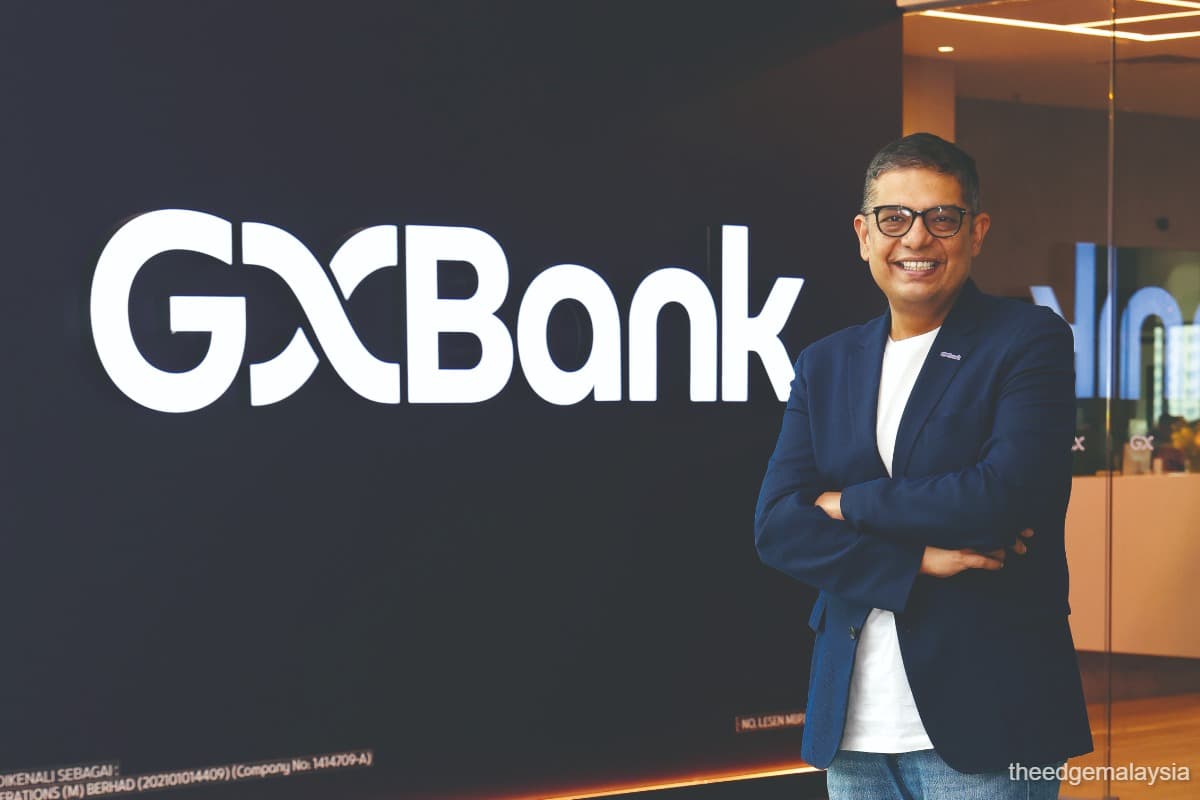
“The central bank is currently evaluating us, and we are working closely with them as part of the process,” CEO Kaushik Chowdhury, better known as KC in the industry, tells The Edge in an interview.
Digital banks in Malaysia are subject to a RM3 billion asset cap during their foundational phase, covering their first three to five years. Under Bank Negara’s licensing framework, the banks can apply after three years of operations to exit the foundational phase and have the RM3 billion asset cap lifted, but this is subject to the central bank’s approval.
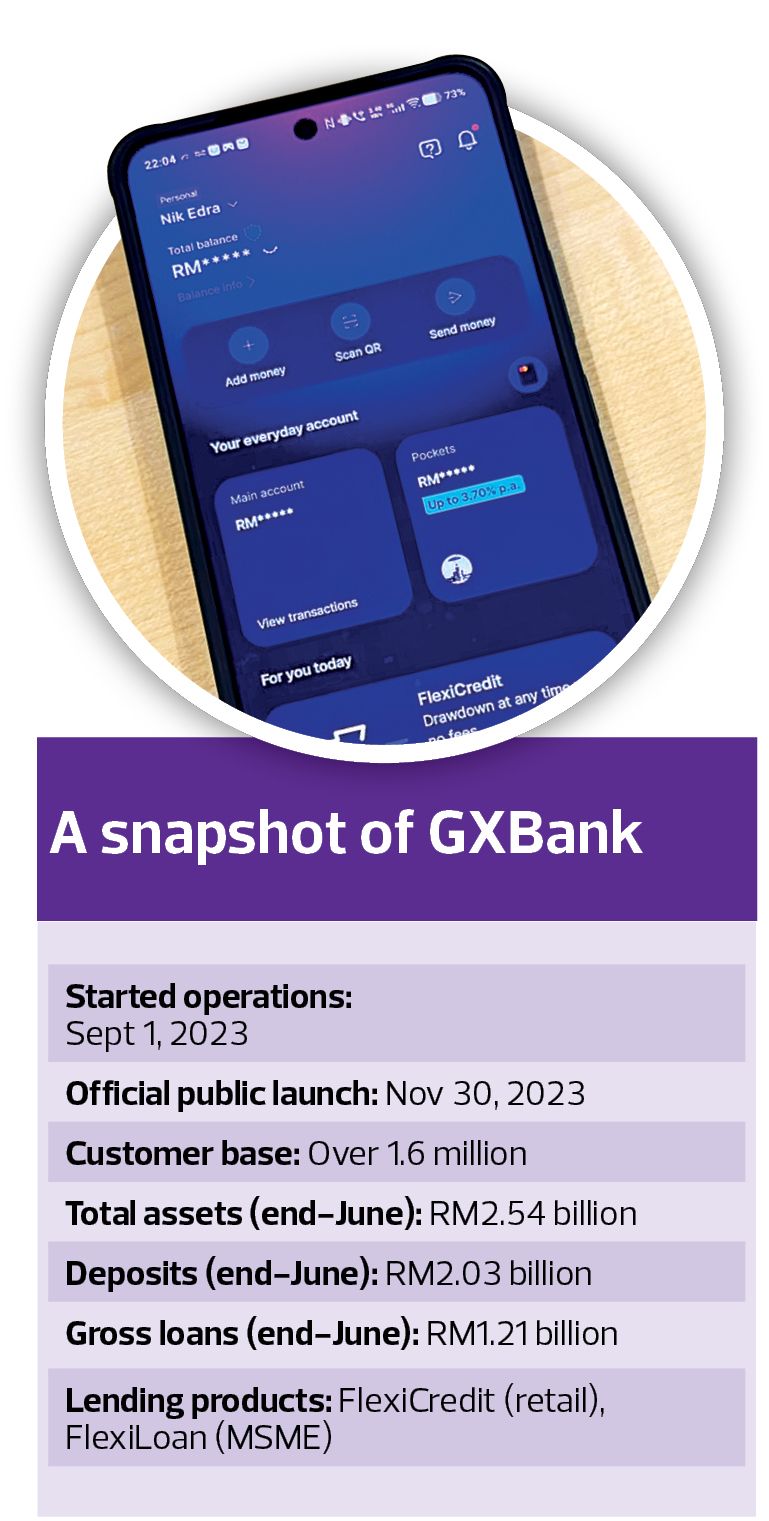
As at end-June, GX Bank — operated by GX Bank Bhd — had total assets of RM2.54 billion and a lending book size of RM1.21 billion. Deposits were at RM2.03 billion. KC says the bank has deliberately calibrated deposit growth alongside lending, rather than pursuing deposits simply for the sake of growing its balance sheet. He says the bank currently serves “over 1.6 million” customers.
The attempt to graduate early comes as GXBank’s lending business gains traction. It had, since its second year of operations, focused on ramping up lending.
“I am happy to report that we have really been able to scale our lending book,” KC says.
He shares that the bank’s flagship retail product, FlexiCredit, has attracted more than 100,000 customers, with the retail lending book at around RM1 billion. The product allows borrowers to draw down and repay credit flexibly, without prepayment penalties, and is aimed primarily at smaller-ticket borrowing.
The bank has also extended the FlexiCredit proposition beyond its own app. In August, it began offering the product through the TNG eWallet app, allowing users to apply for and draw down funds without leaving the platform.
KC says the partnership with the app owner, TNG Digital Sdn Bhd, was part of GXBank’s strategy of being present where its customers are, with other large digital platforms potentially offering further distribution opportunities.
“The initial traction has been really strong,” KC says, of the FlexiCredit take-up on the TNG eWallet app. “From a GXBank perspective, we are very clear — we want to be where our users are.”
On the business banking side, the bank’s FlexiLoan, aimed at sole proprietors — a segment underserved by the banking system — is still at an earlier stage.
“We started scaling it only this year,” KC notes. Be that as it may, the bank has onboarded about 15,000 operating accounts and recorded around 5,000 loan drawdowns already. Customers include Grab merchants.
The bank’s micro, small, and medium enterprise (MSME) lending book is about RM53 million, he says.
KC acknowledges that lending to MSMEs presents different challenges from retail lending, particularly because borrowers may have less predictable income and limited financial data. To manage that risk and expand lending, GXBank has been working with development institutions to build a “covered” or guaranteed book.
One such arrangement is with Credit Guarantee Corporation Malaysia Bhd (CGC). Since March, GXBank has approved RM27 million CGC-guaranteed facilities, and the positive trajectory has also resulted in the bank’s recent decision to increase the maximum credit limits from RM150,000 to RM350,000 for expanding businesses.
MSME opportunity with IFC
Last week, GXBank also inked a risk-sharing agreement with International Finance Corporation (IFC), a World Bank Group member focused on private sector development.
Under the arrangement, the multilateral lender will provide coverage for up to US$110 million (RM449 million) of GXBank’s eligible MSME loan portfolio. KC says the guarantee, which covers the first 5% of losses on the covered portfolio, would reduce the risk-weighted assets associated with the lending and make the bank more capital-efficient, enabling it to take on additional MSME exposure.
He says the arrangement followed a stringent assessment of GXBank’s credit and risk management framework, including its anti-money laundering controls, underwriting standards, onboarding processes and governance.
GXBank sees the deal as both a means of supporting its MSME expansion and external validation of its risk management capabilities.
“Essentially, it unlocks the MSME opportunity for us, and the size of it is also not bad at all — they will be covering our books up to US$110 million, which is roughly almost half a billion ringgit.
“It feels good that we are the first digital bank in the region to get a first-loss guarantee. It is something that the IFC rarely does,” KC shares. “It’s also an external validation of our robust risk management policies and framework.”
Asset quality, meanwhile, remains closely watched as GXBank’s relatively young loan book matures. Its gross impaired loan ratio rose to 1.88% as at end-June compared with 1.03% as at end-2025, a level KC says the bank remains comfortable with.
The bank put in place a pre-emptive provision overlay in the first quarter of this year as a response to geopolitical uncertainty and the potential economic fallout from the conflict in the Middle East.
“We did an assessment, and being pragmatic lenders, we did take some overlays in terms of risk provision,” he says, but declines to reveal the amount.
However, KC says there have so far been no signs of stress in either the retail or MSME portfolios, with forward flows remaining “well behaved”.
“We didn’t pick up anything [worrying] in our forward flows,” he says. The bank continues to maintain the overlay and could release it later if economic and portfolio conditions remain benign.
On track for 2028 profitability
Despite the cost of building up the bank, GXBank remains on track for its profitability targets. KC says the bank continues to target its first full-year profit in 2028, but it has set nearer-term operating milestones.
On a pre-provision operating profit, or PPOP, basis, GXBank expects to cover its operating costs by the end of the first quarter of next year. It is also targeting Ebitda (earnings before interest, taxes, depreciation and amortisation) break-even in September next year.
“We’re still eyeing full-year profitability in 2028. We are confident of achieving this and it’s not too far away,” he remarks.
The bank is a subsidiary of GXS Bank Pte Ltd — the 60:40 joint venture between Grab Holdings Ltd and Singapore Telecommunications Ltd — and is also owned by a consortium of other Malaysian investors, including Kuok Group.
A listing is not on the immediate agenda, he says. Although its regional ownership gives it flexibility in terms of capital and potential listing options, the bank is focused for now on reaching break-even, building a sustainable and profitable bank and serving underserved customers.
“Yes, it will be in the horizon, but not in the next couple of years,” he says.
One focus area for the group going forward is to improve the app experience for customers. As for new products, he says: “Rather than fancy, exotic complex products, we’ll do plain vanilla term deposits … things like that.”
Three years into its journey, however, KC says his biggest frustration is not competition but the pace at which the wider financial ecosystem is becoming more open. He pointed to the slow development of public digital infrastructure as an area where faster progress could make financial services more accessible.
“For a digital native, much faster,” he says, arguing that the pace of technological change — particularly with artificial intelligence — requires the financial system to move more quickly. The goal, he says, should be to make finance “accessible and open”, with the wider economic benefits extending beyond GXBank itself.
In the financial year ended Dec 31, 2025 (FY2025), GX Bank reported a slightly deeper loss after tax of RM238.3 million compared with RM234.6 million the year earlier. Total operating income shot up to RM54 million compared with just RM2.4 million before, helped by higher net interest income.
Its operating expenses grew slightly to RM237.2 million from RM235.9 million before.
In 1HFY2026, loss after tax stood at RM122.1 million compared with RM119.9 million in the year-ago period, even as operating income grew to RM61.4 million from RM17.4 million. Allowance for credit and other losses came in at RM61.9 million compared with RM18.6 million previously.
Save by subscribing to us for your print and/or digital copy.
P/S: The Edge is also available on Apple's App Store and Android's Google Play.