

This article first appeared in The Edge Malaysia Weekly on September 21, 2026 - September 27, 2026
Cutting carbon is particularly difficult for a chemical company because many of its products rely on fossil-based raw materials while lower-carbon alternatives often cost far more than buyers are prepared to pay.
That leaves companies with a few broad options, such as investing in activities that avoid emissions elsewhere and count a share of those savings against their own footprint or replace the fossil raw materials entering their plants with renewable alternatives made from waste.
Ancom Nylex Bhd (KL:ANCOMNY), one of the country’s larger industrial chemicals groups, has taken the first route. The group completed a RM22 million subscription for a 16.92% stake in Green Lagoon Technology Sdn Bhd, a homegrown environmental solutions company that designs, builds, operates and manages biogas plants.
For Ancom Nylex managing director and group CEO Datuk Lee Cheun Wei, the investment combines a measurable environmental benefit with a commercial return.
An accountant by training, Lee says he applies the same test to sustainability investments as he does to the group’s other businesses. “If you can find a good, profitable business that is involved in sustainability, that’s the best of all,” he says.
Green Lagoon captures methane released by palm oil mill effluent and other biomass and converts it into electricity. Without intervention, the methane would escape into the atmosphere, where it traps considerably more heat than carbon dioxide.
Ancom Nylex initially considered acquiring a single biogas operation supported by a long-term power purchase agreement and feed-in tariff. After examining Green Lagoon’s wider operations and technical capabilities, it decided to invest in the company itself.
Ancom Nylex’s own operations produce roughly 34,000 tonnes of carbon dioxide equivalent annually from its manufacturing plants, a fleet of about 80 ISO tank containers and a chemical tanker. Lee says the figure covers its Scope 1 and Scope 2 emissions while the group is not yet ready to account fully for Scope 3 emissions across its value chain.
Green Lagoon’s projects avoid about half a million tonnes annually, Lee says. The amount attributable to Ancom Nylex’s 16.92% interest exceeds its operational Scope 1 and Scope 2 footprint.
The investment follows Ancom Nylex’s decision to begin tracking its emissions in 2022. Its exports to 50 countries also expose the group to multinational customers with more developed environmental, social and governance requirements.
Since it began tracking those figures, the group has switched some plants from light fuel oil to natural gas, moved its haulage operations to Euro 5 trucks, fitted variable-speed air-conditioning systems and replaced conventional lighting with LEDs.
“As the business grows, absolute emissions may rise. What matters is whether carbon dioxide emissions per unit of revenue are declining. That is a sign that you are doing more for the environment,” Lee says.
There is, however, a limit to what such measures can achieve. “You cannot reduce emissions from 30,000 tonnes all the way to zero unless you have no business activities,” he says.
Replacing fossil fuels
Where emissions cannot be eliminated, companies can also invest in avoiding them elsewhere, as Ancom Nylex has done, or attempt to replace the fossil-based feedstock itself.
EcoCeres, a renewable fuels producer, represents this second route. The company has built its business around converting waste oils and animal fats into fuels and chemical feedstocks.
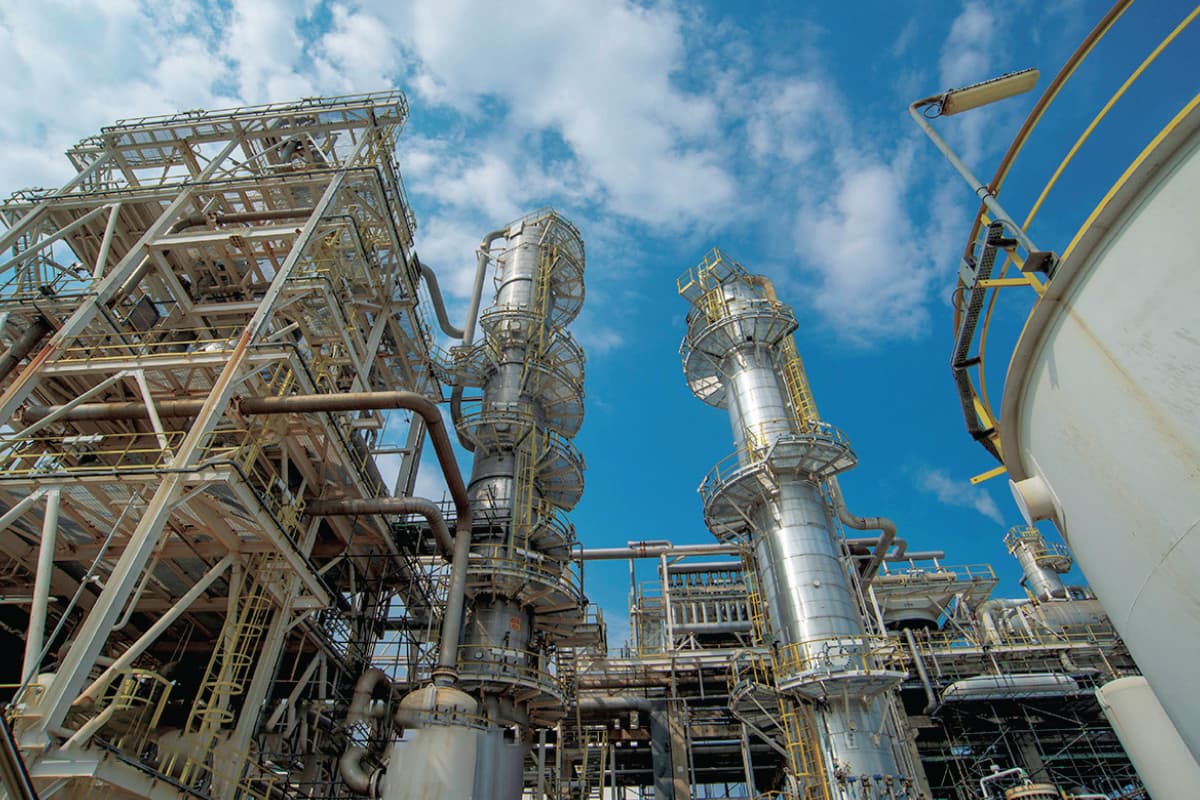
At its biorefinery in Pasir Gudang, Johor, it produces sustainable aviation fuel and renewable naphtha, a substitute for the fossil-derived naphtha used by petrochemical plants. Its best known product is sustainable aviation fuel but the output most directly relevant to chemical manufacturing is renewable naphtha.
Naphtha is conventionally derived from fossil fuels and cracked by petrochemical plants into the building blocks of plastics. EcoCeres makes a substitute from waste feedstocks, which manufacturers can use to produce materials such as polyethylene and polypropylene.
At current blend ratios, the chemical properties of the resulting plastics barely change, meaning manufacturers can adopt renewable naphtha without reformulating their products.

Dannis Poon, EcoCeres’ executive vice-president of operations, explains why petrochemical producers are drawn to it. “Petrochemical plants cannot easily decarbonise in other ways. Renewable naphtha can be fed into existing facilities without major changes to their infrastructure.”
Poon, however, explains that there is no current government mandate that requires petrochemical producers to buy renewable naphtha and demand is entirely voluntary, driven by manufacturers with their own decarbonisation targets and, further downstream, by consumer brands seeking lower-carbon packaging.
Demand is already outstripping EcoCeres’ supply, says Poon, adding that the principal constraint is the availability of feedstock rather than the underlying chemistry.
EcoCeres, which relies primarily on used cooking oil and animal fats, says it will not process virgin edible oils that compete with food production. Waste supply cannot expand as quickly as demand because the amount gnerated is ultimately tied to consumption.
“The easy oil (in this case, the refined vegetable or used cooking oils) is no longer enough. As demand rises, we have to move into more difficult feedstocks,” Poon says.
That could eventually include waste as challenging as sewage, which can contain heavy metals, chlorides and other contaminants that must be removed before it can be processed.
Poon says another source of pressure is the rising cost of used cooking oil.
“When I started in this business six or seven years ago, used cooking oil cost about US$500 to US$600 a tonne. Today, it is around US$1,200.”
Finished sustainable aviation fuel also remains more expensive than conventional jet fuel, Poon explains.
Competition for credible waste raises the question of whether feedstocks sold as waste genuinely come from waste sources. The sector has faced cases in which virgin oil was allegedly passed off as used oil to qualify for incentives.
EcoCeres’ answer is a digital traceability system through which collectors log the source and volume of each pickup using photographs and location data.
“If an airline buys 1,000 tonnes of SAF from us and wants to know where the feedstock came from, we can provide the source data,” Poon says.
FatHopes Energy, which has aggregated used cooking oil in Malaysia since 2007 and is developing its own production facility in Port Klang, has similarly spent almost a decade digitising collection records across its network of waste generators, community aggregators and transporters.
Its group CEO Vinesh Sinha says the standard has shifted. “Traceability is no longer a competitive advantage. It is a prerequisite for market credibility.”
The two companies differ less over whether food-related waste can be used than over how broadly the feedstock pool should extend.
EcoCeres says it will not use virgin edible oils that compete with food production while FatHopes describes itself as feedstock-agnostic and is expanding into palm-derived residues, including palm oil mill effluent oil, spent bleaching earth oil and empty fruit bunch oil.
“Our objective is not to promote one feedstock over another. It is to maximise greenhouse gas emissions reductions at scale,” Sinha says.
Feedstocks should be judged by their measured lifecycle emissions rather than their origin, he argues.
“There is an important distinction between expanding primary agricultural production and recovering waste streams that already exist within established industrial processes,” he says.
The difference determines which materials each producer is prepared to certify and sell, and which of Malaysia’s waste streams can contribute to supply.

Still a challenge to secure supply at scale
Where no drop-in alternative exists at a workable premium, substitution stalls. Ancom Nylex is a major distributor of methanol, almost all of it fossil-based, and has looked for greener supplies.
“Green methanol is technically possible but it costs substantially more because of the electricity and processing required. We are speaking to potential suppliers but few can yet produce it competitively at scale,” Lee says.
Independent engineers identify the same constraint as Dr Chai Wai Siong — assistant professor of chemical engineering at the University of Nottingham Ningbo, China — distinguishes between “what is chemically viable” and “what is volumetrically viable”.
The hydroprocessing technology used, like the one used at EcoCeres’ Johor facility, is already proven internationally but the problem is securing enough certifiable, non-food feedstock.
Chai says Malaysia generates more than 90 million tonnes of palm biomass annually but not all of it can be economically collected or converted.
Only biomass meeting recognised sustainability requirements, such as residues from Malaysian Sustainable Palm Oil-certified plantations, qualifies for some international markets, he explains. “Biomass alone is unlikely to meet long-term aviation fuel demand.”
Although his observation concerns jet fuel, the same pool of used cooking oil, animal fats and agricultural residues also feeds renewable chemical production. As more sectors compete for it, prices rise and producers are pushed towards more difficult waste streams.
Professor Dr Dominic Foo, who heads chemical and environmental engineering at the University of Nottingham Malaysia, adds the lack of certification and infrastructure to the list of constraints.
Producing a substitute is only part of the system as storage segregation, quality assurance, specialised testing and the logistics of moving feedstocks and finished products determine whether a material can be used and recognised as sustainable, he says.
Similarly, Malaysia’s domestic laboratory capacity for internationally required certification and sustainability testing remains limited, says Foo.
Policy support is similarly uneven as Malaysia has proposed a 1% sustainable aviation fuel blending mandate from January 2027, with the National Energy Transition Roadmap and the Malaysia Aviation Decarbonisation Blueprint setting longer-term ambitions.
“There is no equivalent policy for the chemical industry. Companies are trying to find a way but it is still a journey,” Lee says.
For Sinha, whose Port Klang project is intended to produce sustainable aviation fuel, the argument for a mandate is straightforward. “A domestic blending mandate would certainly help establish long-term market certainty and encourage investment across the supply chain.”
Further out sit synthetic e-fuels, made by combining green hydrogen with captured carbon dioxide. Foo says the chemistry is understood but the process is “highly punishing” because much of the input energy is lost across its various stages. Green hydrogen production relies heavily on renewable energy.
Producing e-fuels at scale would thus require the generation of renewable electricity that Malaysia has yet to build and Foo points out that the usage will be in competition with industrial electrification, electric vehicles and data centres, which are all vying for greener sources of energy.
Save by subscribing to us for your print and/or digital copy.
P/S: The Edge is also available on Apple's App Store and Android's Google Play.