

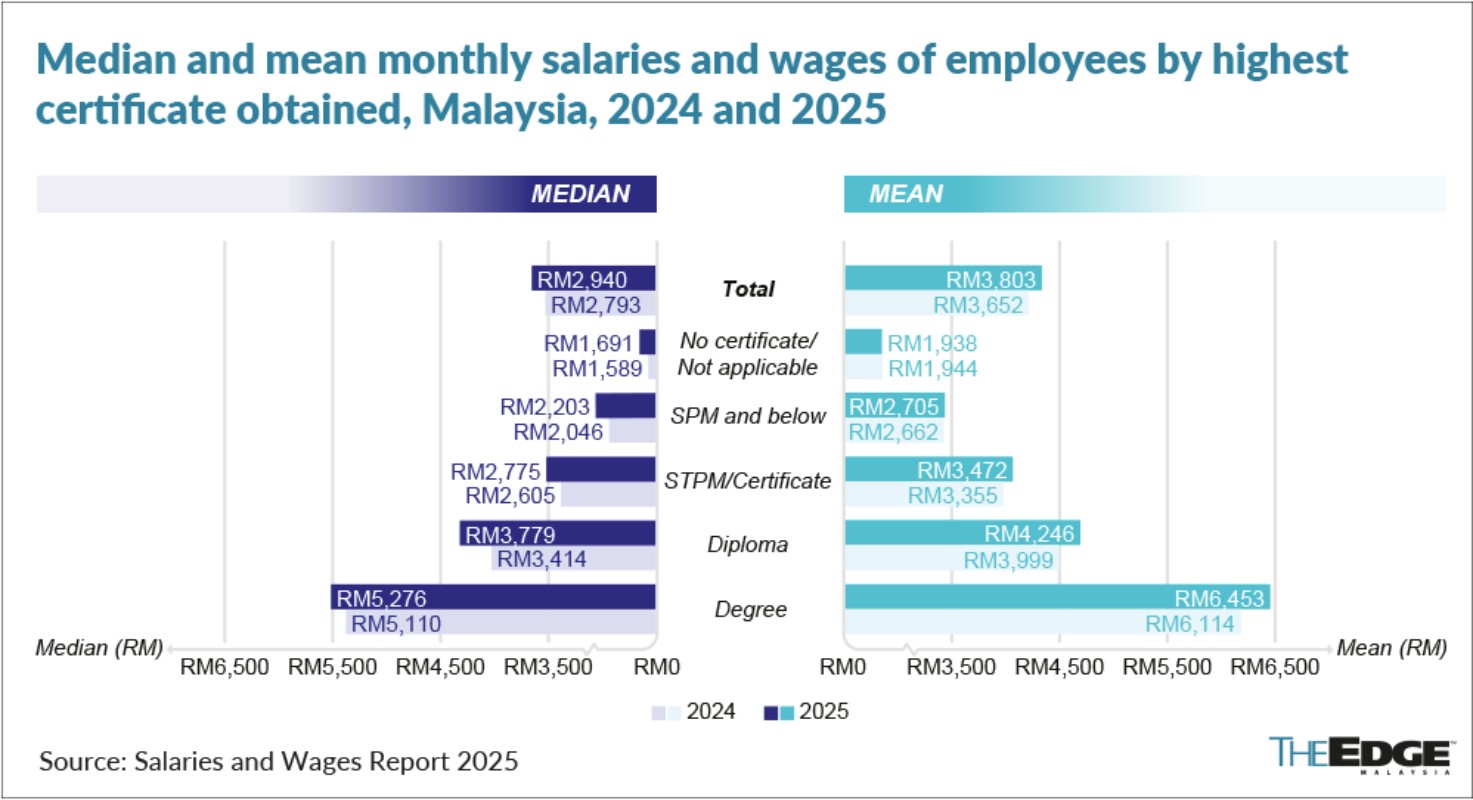
PUTRAJAYA (Sept 21): The average monthly salary and wage of Malaysians increased by 4.1% to RM3,803 in 2025, compared with RM3,652 the previous year, according to the Salaries and Wages Survey Report 2025 published by the Department of Statistics Malaysia (DOSM) on Monday.
At the same time, the median monthly salary and wage increased by 5.3 % to RM2,940 from RM2,793 in 2024.
It said the total number of monthly salary and wage earners rose to 12.01 million, up from 11.96 million in 2024, adding that, of the total, Malaysians accounted for 10.38 million, or 86.4 % of all full-time paid employees.
"The services sector, which represents 71.5%, was the main contributor to the increase in the number of wage earners, rising by 1.8% to 7.42 million people. Meanwhile, mining and quarrying remained the highest average monthly salary and wage at RM6,175, followed by services (RM3,993), manufacturing (RM3,357), construction (RM3,188) and agriculture (RM2,575),” DOSM said in a statement Monday.
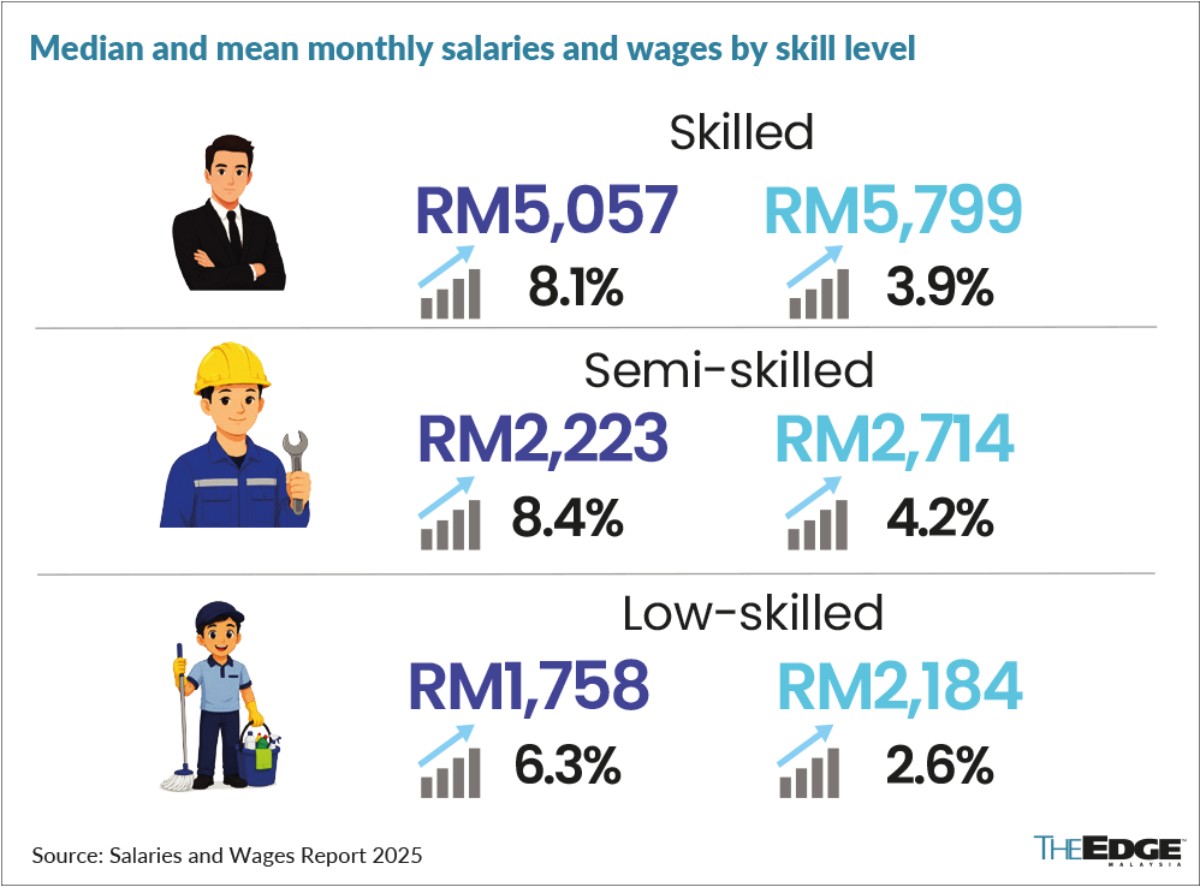
In terms of skills, DOSM said skilled workers, who accounted for 36.6% of all salary earners, recorded the highest average monthly salary and wage at RM5,799, compared with RM5,582 in 2024.
Meanwhile, the semi-skilled category, which accounted for 55.6% of salary earners, recorded a 4.2% increase in average salary to RM2,714 from RM2,604, while the low-skilled category rose by 2.6% to RM2,184 from RM2,128.
"Selangor recorded the highest share of salary earners, at 25.6% of the total number of paid Malaysian workers, followed by Johor (13.6%) and Sarawak (7.6%),” it added.
The DOSM said five states recorded average monthly salaries and wages above the national level, namely Putrajaya at RM5,417, Kuala Lumpur (RM4,955), Selangor (RM4,258), Penang (RM3,912) and Labuan (RM3,887).
It said the positive growth in average and median monthly salaries and wages in 2025 reflects improved labour market conditions and workers’ incomes.
"Looking ahead, continued efforts to increase productivity, strengthen skills and create high-value jobs are important to support sustainable real wage growth and workers’ well-being.
"In line with the aspirations of the 13th Malaysia Plan (13MP), developing a competitive and productive workforce and strengthening labour market reforms are important to support sustainable and inclusive wage growth,” it added.
Uploaded by Magessan Varatharaja