

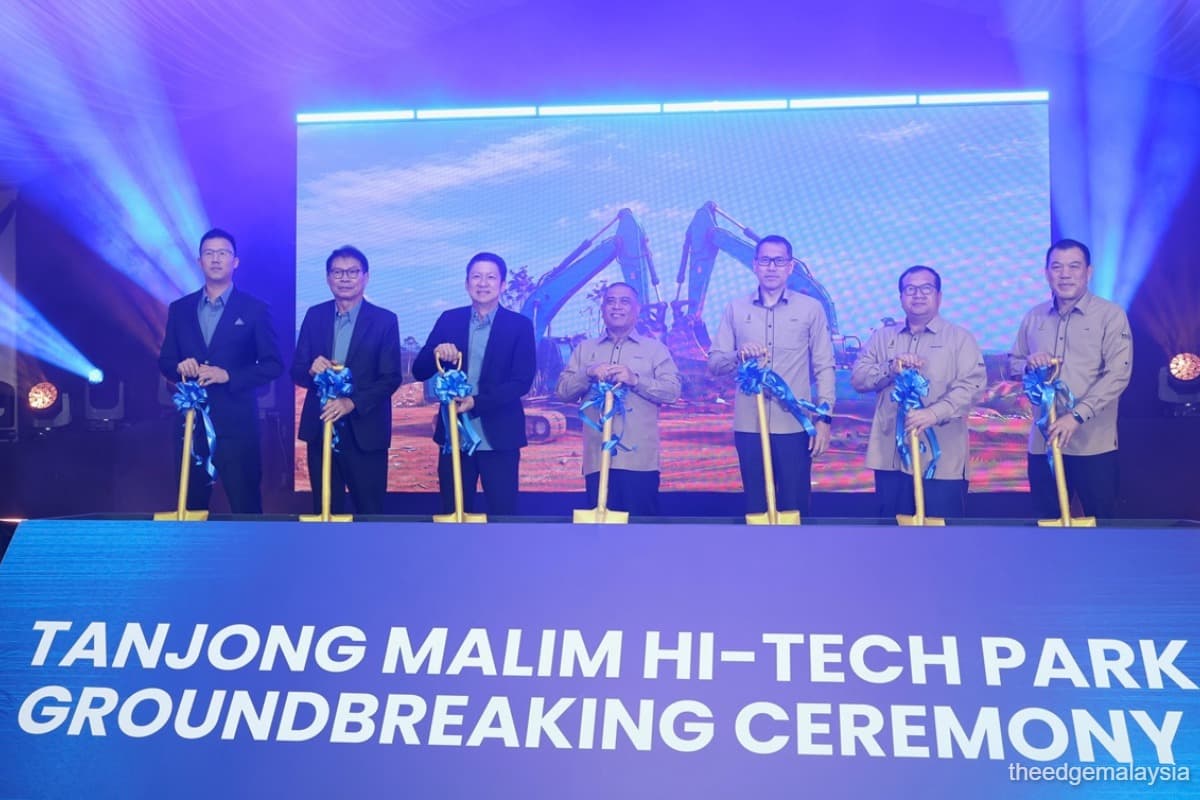
TANJONG MALIM (Sept 21): Setia Awan Land Sdn Bhd (Setia Awan) has launched its first industrial development, the 447-acre Tanjong Malim Hi-Tech Park, as the company seeks to establish an industrial ecosystem alongside the growing automotive activity in the area.
The development, which has an estimated gross development value of RM1.4 billion, was launched on Monday by Perak Menteri Besar Datuk Seri Saarani Mohamad, with the event also marking the groundbreaking of the project.
Located near Proton City at Tanjong Malim, Perak and within the wider Automotive High-Tech Valley (AHTV) growth corridor, Tanjong Malim Hi-Tech Park comprises industrial land, commercial components and supporting facilities.
Setia Awan director Datuk Marcus Doh said the development marked a new chapter for the company after more than three decades of experience in residential and mixed-use development.
“Our vision for Tanjong Malim Hi-Tech Park is to build an industrial ecosystem that supports businesses over the long term, with the infrastructure, commercial amenities and supporting services they need to establish, operate and grow,” he said.
Phase 1 covers 104 acres and offers infrastructure-ready industrial land parcels starting from five acres, with both sale and lease options. The land is priced at RM55 psf.
Doh said Phase 1 had achieved a 50% take-up rate to date, with confirmed investors including Ningbo Fresh Technology Co Ltd and Sheentech Automotive Systems Sdn Bhd.
The launch also introduced Ionera, a 27-acre commercial component comprising 168 commercial units, also serving as Phase 2 of the entire development. The units are priced above RM900,000.
Since registration opened last month, Ionera has recorded more than 100 registrations and bookings, according to Setia Awan.
The launch event also saw the signing of memorandums of understanding with several Ionera tenants, including Billion Group, which will serve as the anchor tenant.
Doh said Setia Awan was also exploring potential expansion of the development in response to the needs of businesses, including possible future industrial components such as semi-detached factories.
“We are not looking at industrial development in isolation. We are looking at the businesses, the workforce and the community as part of one ecosystem,” he said.
The development is also expected to incorporate electric vehicle (EV) charging infrastructure through a collaboration with an EV charging provider, with a combined capacity of five megawatts.
Meanwhile, Saarani said the launch came at a significant point in Tanjong Malim’s development, which is increasingly taking on a new identity as an automotive and industrial centre.
He pointed to the presence of Proton, the development of the AHTV and growing private-sector participation as factors contributing to the area’s transformation. However, he stressed that building a complete automotive hub would require more than industrial land and factories.
“To build a whole industry hub, we can’t build on one or two things. We need to build components; we need to give them logistics and support services,” he said.
Saarani also stressed that industrial development should ultimately benefit the surrounding community, particularly through employment and opportunities for local talent.
“Finally, the development must give benefit to people,” he said, adding that the success of the development should not be measured only by its investment value or physical scale, but also by the number of jobs and companies it creates.
He added that Tanjong Malim Hi-Tech Park, alongside Proton and AHTV, could help create opportunities for Perak-born talent to return and work closer to home.