

This article first appeared in The Edge Malaysia Weekly on September 21, 2026 - September 27, 2026
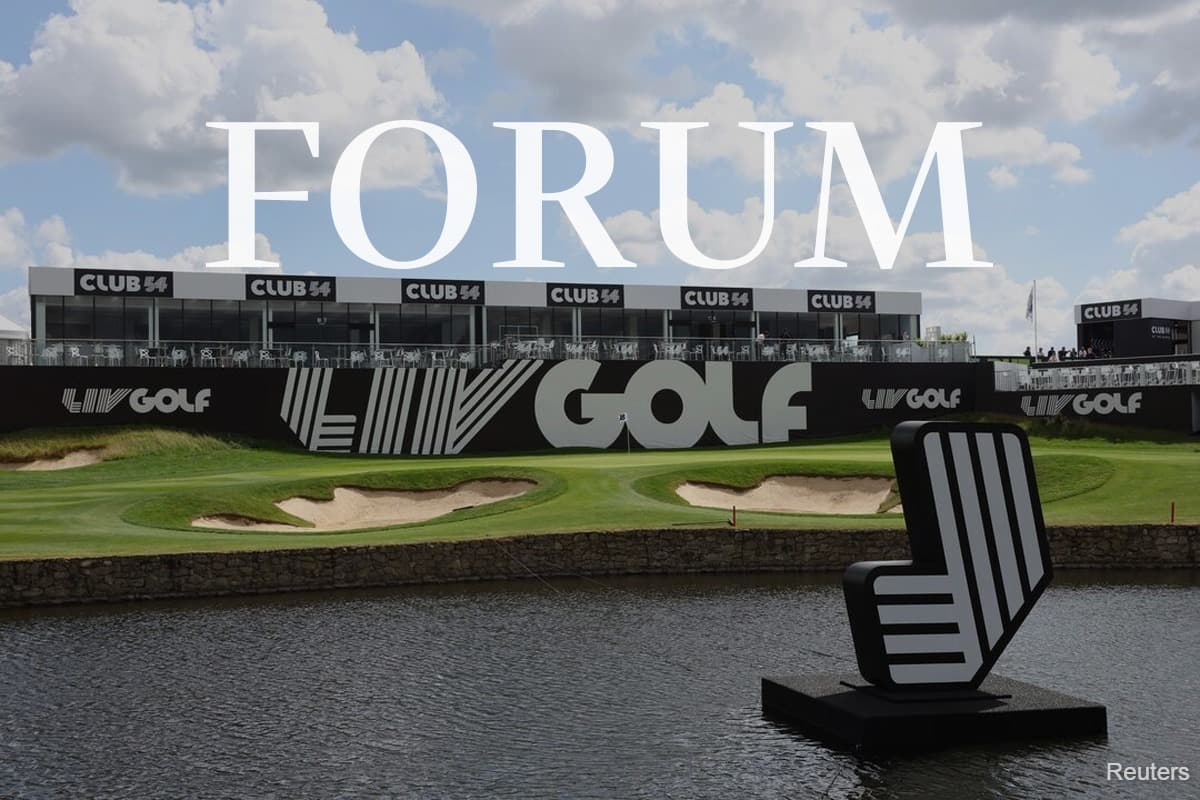
We all make mistakes” was Greg Norman’s response to a question about the 2018 murder and dismemberment of journalist Jamal Kashoggi. Norman was promoting LIV Golf, funded by Saudi Arabia, which was blamed for the killing. He went on “… and you just want to learn by (sic) those mistakes and how you can correct them going forward.” Now that LIV Golf has filed for bankruptcy after wasting US$5 billion (RM20.4 billion) on golf’s civil war, the sport can only wish that Norman had learned from his.
It’s not the first time the Great White Shark has tried to take a bite out of the PGA Tour. In 1994, at his playing peak, the former world No 1 came up with the World Golf Tour (WGT), a similar global elite series whereby the rich get richer. He had the backing of the Murdoch media empire then and thought he had the locker room.
But Arnold Palmer, who made a rousing speech, and Jack Nicklaus stood up for the rank and file. Against those two immortals, the Australian was seen as a mutinous upstart and his scheme was dead in the water.
He didn’t take it well, admitting “it dented me up pretty bad. It cut deep; there’s scar tissue”. He harboured a well-documented grudge ever since. So when, more than two decades later, Saudi Arabia began pumping its oil wealth into sport, he not only craved a share, he saw a chance for revenge.
LIV Golf became his thinly veiled personal vendetta against the Tour, which, he claimed, had taken many of his ideas for its World Golf Championship (WGC) events. And this time, he really did have some clout — generational money — behind him.
Embarking on his second challenge to the hegemony of the PGA Tour with gusto, there was no evidence of any correction. Paid US$50 million a year as CEO, he began a recruitment drive, making offers he thought no one in their right mind could refuse. For players disenchanted with how the PGA Tour was being run, like Phil Mickelson, it was an easy decision to jump ship.
“Lefty”, as loose with his tongue as he was precise with his lob wedge, did not go quietly, lambasting the Tour for its “obnoxious greed”. It seemed a bit rich for someone signing a contract for US$200 million. But he was not complimentary about his new paymasters either, calling them “scary [mothers] to get involved with”.
Unlike in 1994, Norman now had momentum. Former world No 1 Dustin Johnson was a prize catch at US$150 million, followed by Bryson DeChambeau for US$125 million. Big hitters in more ways than one, they bolstered the Tour’s credibility and had the establishment reeling. Loyalists hardly dared look, dreading another A-list defection.
In June 2023, a shock meeting took place between the Tour’s Commissioner Jay Monahan and LIV’s head honcho Yasir Al Rummayan, and an even more surprising “Framework Agreement” was announced. There were no details, but an alliance between the two rivals was in the works. Golf waited. And waited. And nothing happened.
In October, erstwhile loyalist Jon Rahm couldn’t wait any longer and joined LIV for a whopping US$500 million. It might have been a tipping point. Tiger Woods had been offered close to US$1 billion, but like Palmer and Nicklaus before him, he was not for turning. Still, the initial intake was impressive — several box office stars joined and shook the PGA Tour to its foundations.
But then the American sports industry, alarmed at the influence Saudi Arabia might have on a treasured institution, came to the rescue. Called the Strategic Sports Group (SSG), several billionaires and franchise owners injected US$1.5 billion (rising to US$3 billion) to enable the PGA Tour to offer bigger purses and keep its stars.
There was an impasse. LIV became frustrated at being unable to get a worthwhile broadcast deal, while the PGA Tour carried on, albeit in a diminished state. Fans and TV viewers were denied the chance to see the game’s best players duking it out except at the four major championships. And LIV, with its 54 holes, shotgun starts and blaring music, was played on inferior courses and seemed, for all its wealth, tacky and gimmicky. “Golf, but louder”, as its tagline claimed, was not golf at all for most fans.
What made it even more Mickey Mouse was the team element. Expecting fans around the globe to support teams of disparate nationalities, thrown together with names like Cleeks, RangeGoats and OKGC was optimistic at best. The Ryder Cup it was not. Johnson couldn’t remember his 4Aces teammates’ names after winning the team title.
But it was not all negative and perhaps the biggest winner was the Asian Tour. LIV made a US$300 million investment in the tour, which was used to raise the profile and create a new International Series. And even with LIV’s demise, the Asian Tour pivoted swiftly to partner the DP (European) Tour. The southern hemisphere also gave LIV the thumbs up after suffering with the PGA Tour’s all-year-round schedule. LIV’s big names were the first stars that Australia and South Africa had seen in years.
Had LIV been more egalitarian, it may have had more sympathy, but it was overwhelmingly about the top end and Norman’s combative tone throughout showed that the PGA Tour was Public Enemy No 1 as far as he was concerned. He could not hide his contempt in discussions and at one point Nicklaus was moved to say: “Greg needs to go … there needs to be an adult in the room.”
Experience could have told him that toppling an established sports entity is no easy task, even with more money than Croesus. And LIV was not a successful business: its income was negligible and it was being propped up by the Public Investment Fund (PIF).
Galleries were patchy and no big broadcaster would go near it. If market forces had not been held in abeyance, it wouldn’t have lasted a season. It just didn’t cut the mustard with golf fans. Indeed, there was more interest in who was joining them than who was winning — in football, it would have been like following the transfer window but not the matches.
Norman was replaced as CEO in January 2025, but remained behind the scenes until a year ago. Saudi Arabia began to cut back on its investment in other sports and LIV’s days became numbered. Even at the tee-off, post-pandemic, it was a tragedy for the sport to have this internecine dispute simmering.
Golf took off its mask after Covid-19, with millions of new and returning players drawn to the game by getting out into the fresh air. But the wrangle gave off an acrid smell and teed up an inferior, divided product. A generation of fans watched the sport they followed spend half a decade waging a war with itself.
What they got was a labour dispute between multimillionaires and a sovereign wealth fund. Now its players are owed millions and there may be no road back to the PGA Tour without huge penalties. Still, sympathy is hard to find: as Golfweek put it this month, “after four years and US$5.5 billion, LIV Golf isn’t only morally bankrupt...”
Still, Norman, 71, is unrepentant. Asked, even after the latest collapse, if he’d do it again, he said: “In a heartbeat.”
Bob Holmes is a long-time sportswriter specialising in football
Save by subscribing to us for your print and/or digital copy.
P/S: The Edge is also available on Apple's App Store and Android's Google Play.